

447
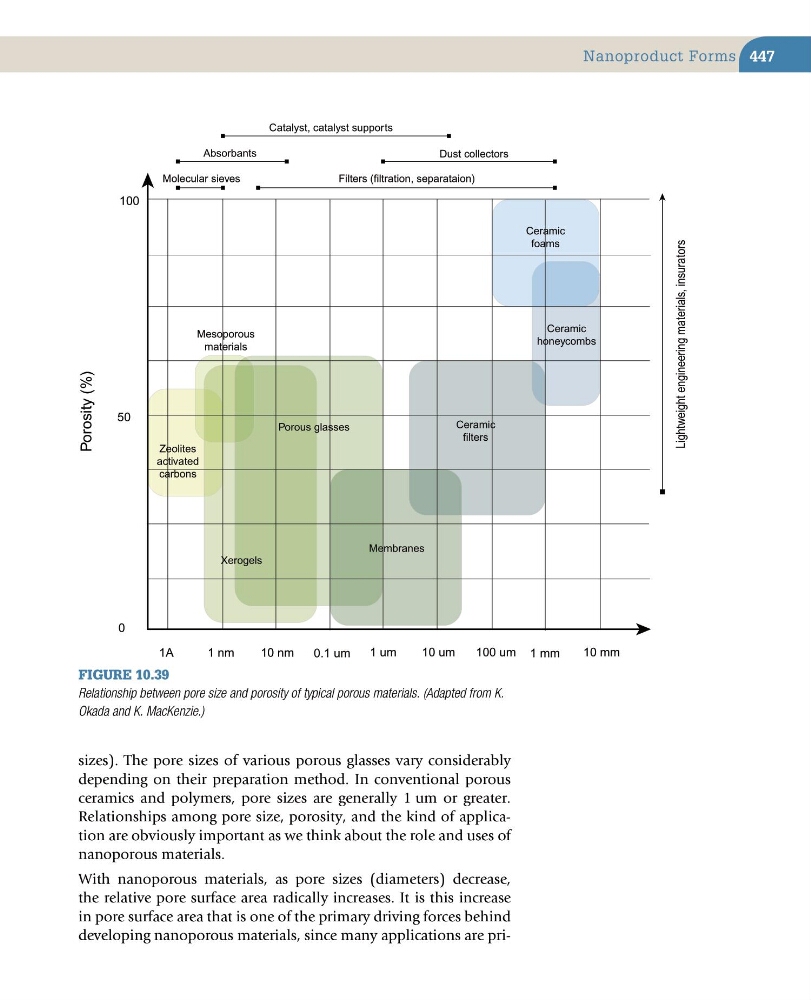
sizes). The pore sizes of various porous glasses vary considerably
depending on their preparation method. In conventional porous
ceramics and polymers, pore sizes are generally 1 um or greater.
Relationships among pore size, porosity, and the kind of application are obviously important as we think about the role and uses of
nanoporous materials.
With nanoporous materials, as pore sizes (diameters) decrease,
the relative pore surface area radically increases. It is this increase
in pore surface area that is one of the primary driving forces behind
developing nanoporous materials, since many applications are priFigure 10.39
Relationship between pore size and porosity of typical porous materials. (Adapted from K.
Okada and K. MacKenzie.)
0
1A
1 nm
10 nm
0.1 um
1 um
10 um
100 um 1 mm
10 mm
50
100
Porosity (%)
Zeolites
activated
carbons
Mesoporous
materials
Xerogels
Porous glasses
Membranes
Ceramic
filters
Ceramic
honeycombs
Ceramic
foams
Molecular sieves
Filters (filtration, separataion)
Dust collectors
Absorbants
Catalyst, catalyst supports
Lightweight engineering materials, insurators
Nanoproduct Forms
sizes). The pore sizes of various porous glasses vary considerably
depending on their preparation method. In conventional porous
ceramics and polymers, pore sizes are generally 1 um or greater.
Relationships among pore size, porosity, and the kind of application are obviously important as we think about the role and uses of
nanoporous materials.
With nanoporous materials, as pore sizes (diameters) decrease,
the relative pore surface area radically increases. It is this increase
in pore surface area that is one of the primary driving forces behind
developing nanoporous materials, since many applications are priFigure 10.39
Relationship between pore size and porosity of typical porous materials. (Adapted from K.
Okada and K. MacKenzie.)
0
1A
1 nm
10 nm
0.1 um
1 um
10 um
100 um 1 mm
10 mm
50
100
Porosity (%)
Zeolites
activated
carbons
Mesoporous
materials
Xerogels
Porous glasses
Membranes
Ceramic
filters
Ceramic
honeycombs
Ceramic
foams
Molecular sieves
Filters (filtration, separataion)
Dust collectors
Absorbants
Catalyst, catalyst supports
Lightweight engineering materials, insurators
Nanoproduct Forms