

441
attract it to the car body. Its role is to absorb impacts from small
stones and the like. A paint layer comes next, with the appropriate
color pigment. It is also electrostatically applied. The final layer is
formed by the nanoparticle clear coat and is about 40 micrometers
thick. It provides the final wearing surface of the paint and, consequently, is exposed to many destructive effects, ranging from abrasion to chemical elements in rain.
nanosealants
Few products are as humble as sealants. Few products serve simpler
but absolutely necessary functions. Few products can rival the
number of applications in other products. Sealants are normally
applied to the surfaces of other materials to prevent or minimize
the excessive absorption, penetration, or passage of liquids or
gases. Common sealants are initially fluid or viscous materials that
are applied to a surface, bond to it, and then change into a solid
via chemical reaction or the use of solvents. Normally they are
applied to materials that have numerous small pores. They may be
intended to keep liquids or gases either out of something or within
something. In some cases sealants might be applied between adjacent materials (in the sense of being a gap filler or serving a joining
function) or between surfaces of face-to-face materials. Sealants are
normally designed to serve specific needs and are often used on a
specified set of host materials.
Common sealants are used to prevent water penetration or absorption in everything from wood floors to fabrics. Many are designed
for “breathability” so that water vapor but not water droplets can
be let through. In these instances, the surface tension present in
surfaces with small pores prevents liquid droplets from passing
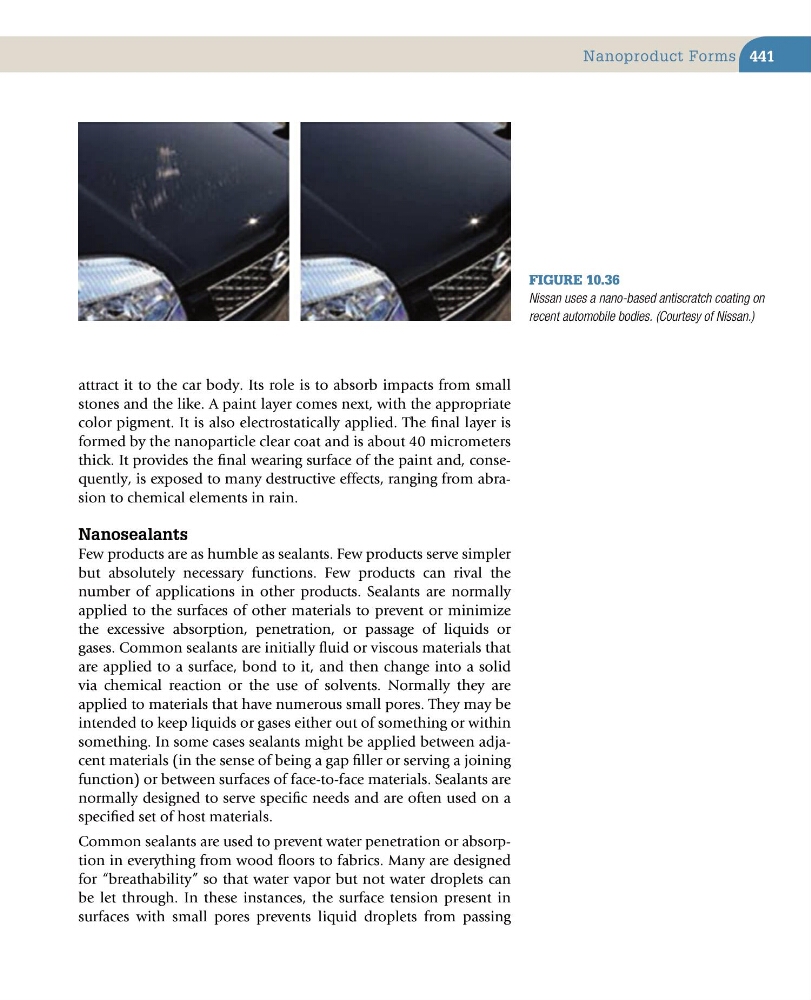
Figure 10.36
Nissan uses a nano-based antiscratch coating on
recent automobile bodies. (Courtesy of Nissan.)
Nanoproduct Forms
attract it to the car body. Its role is to absorb impacts from small
stones and the like. A paint layer comes next, with the appropriate
color pigment. It is also electrostatically applied. The final layer is
formed by the nanoparticle clear coat and is about 40 micrometers
thick. It provides the final wearing surface of the paint and, consequently, is exposed to many destructive effects, ranging from abrasion to chemical elements in rain.
nanosealants
Few products are as humble as sealants. Few products serve simpler
but absolutely necessary functions. Few products can rival the
number of applications in other products. Sealants are normally
applied to the surfaces of other materials to prevent or minimize
the excessive absorption, penetration, or passage of liquids or
gases. Common sealants are initially fluid or viscous materials that
are applied to a surface, bond to it, and then change into a solid
via chemical reaction or the use of solvents. Normally they are
applied to materials that have numerous small pores. They may be
intended to keep liquids or gases either out of something or within
something. In some cases sealants might be applied between adjacent materials (in the sense of being a gap filler or serving a joining
function) or between surfaces of face-to-face materials. Sealants are
normally designed to serve specific needs and are often used on a
specified set of host materials.
Common sealants are used to prevent water penetration or absorption in everything from wood floors to fabrics. Many are designed
for “breathability” so that water vapor but not water droplets can
be let through. In these instances, the surface tension present in
surfaces with small pores prevents liquid droplets from passing
Figure 10.36
Nissan uses a nano-based antiscratch coating on
recent automobile bodies. (Courtesy of Nissan.)
Nanoproduct Forms