

439
organic compositions as well as crystalline fillers. Silica materials
can help prevent corrosion when applied to metals. The addition
of nanoclays can improve the rheological properties of paints (e.g.,
sagging on vertical surfaces during application or pigment settling).
To a limited extent, the addition of nanoclays can help make paints
more flame-spread retardant. (The surface spread of flame is a
crucial issue in an architectural context.)
In some applications, attention is particularly paid to the interactions among a paint, the way it is applied, and the material to
which it is applied. Many paints are electrostatically applied. The
paints are electrostatically charged, which in turn can attract them
to the body being painted. Hence, by using metallic nanoparticles
or carbon nanotube additives in either the paints or the body material, the electrostatic painting process can be greatly enhanced. This
approach is being investigated via the thermoplastic bumpers now
used in many automobiles. The thermoplastics are not intrinsically
conductive, so the addition of nanosized metallic particles helps
the painting process.
Many paints are now designed to have self-cleaning actions, wherein
dirt and other foreign substances are easily washed away naturally
or made loose enough to be easily removed (see Figure 10.35).
Many self-cleaning actions are ultimately based on the hydrophobic Lotus Effect® that was described in detail earlier in this chapter.
Self-cleaning paints are described there as well. For some applications, a particularly interesting approach for paints uses nanoscale materials that have particular photocatalytic and hydrophilic
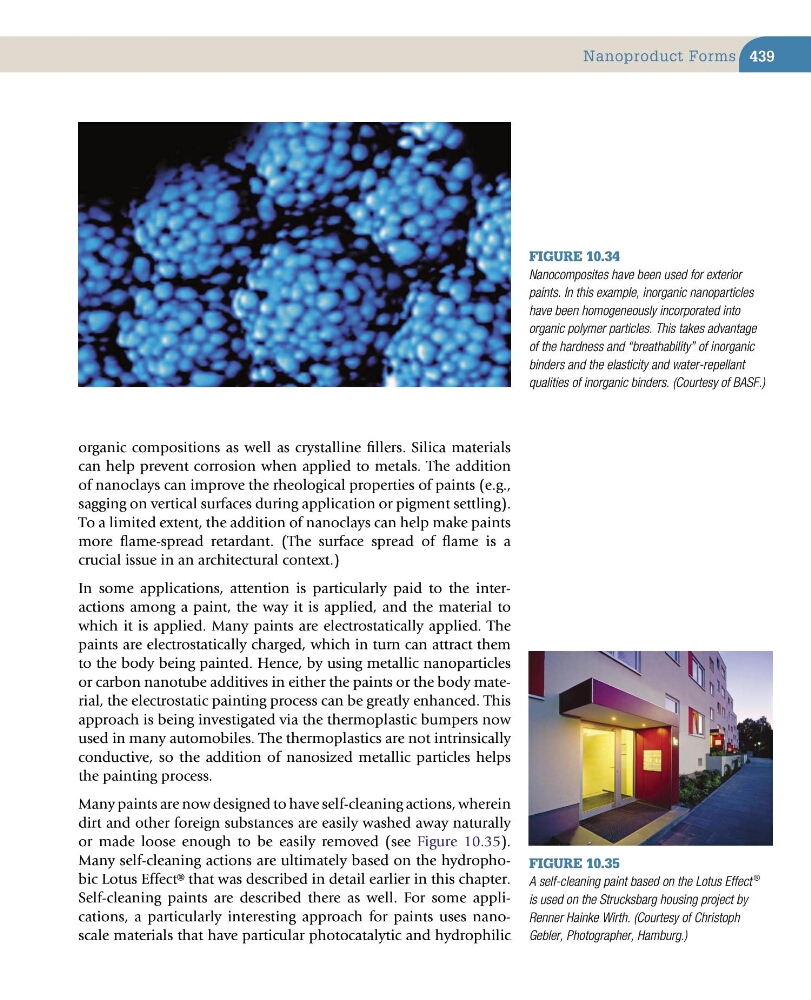
Figure 10.34
Nanocomposites have been used for exterior
paints. In this example, inorganic nanoparticles
have been homogeneously incorporated into
organic polymer particles. This takes advantage
of the hardness and “breathability” of inorganic
binders and the elasticity and water-repellant
qualities of inorganic binders. (Courtesy of BASF.)
Nanoproduct Forms
Figure 10.35
A self-cleaning paint based on the Lotus Effect
®
is used on the Strucksbarg housing project by
Renner Hainke Wirth. (Courtesy of Christoph
Gebler, Photographer, Hamburg.)
organic compositions as well as crystalline fillers. Silica materials
can help prevent corrosion when applied to metals. The addition
of nanoclays can improve the rheological properties of paints (e.g.,
sagging on vertical surfaces during application or pigment settling).
To a limited extent, the addition of nanoclays can help make paints
more flame-spread retardant. (The surface spread of flame is a
crucial issue in an architectural context.)
In some applications, attention is particularly paid to the interactions among a paint, the way it is applied, and the material to
which it is applied. Many paints are electrostatically applied. The
paints are electrostatically charged, which in turn can attract them
to the body being painted. Hence, by using metallic nanoparticles
or carbon nanotube additives in either the paints or the body material, the electrostatic painting process can be greatly enhanced. This
approach is being investigated via the thermoplastic bumpers now
used in many automobiles. The thermoplastics are not intrinsically
conductive, so the addition of nanosized metallic particles helps
the painting process.
Many paints are now designed to have self-cleaning actions, wherein
dirt and other foreign substances are easily washed away naturally
or made loose enough to be easily removed (see Figure 10.35).
Many self-cleaning actions are ultimately based on the hydrophobic Lotus Effect® that was described in detail earlier in this chapter.
Self-cleaning paints are described there as well. For some applications, a particularly interesting approach for paints uses nanoscale materials that have particular photocatalytic and hydrophilic
Figure 10.34
Nanocomposites have been used for exterior
paints. In this example, inorganic nanoparticles
have been homogeneously incorporated into
organic polymer particles. This takes advantage
of the hardness and “breathability” of inorganic
binders and the elasticity and water-repellant
qualities of inorganic binders. (Courtesy of BASF.)
Nanoproduct Forms
Figure 10.35
A self-cleaning paint based on the Lotus Effect
®
is used on the Strucksbarg housing project by
Renner Hainke Wirth. (Courtesy of Christoph
Gebler, Photographer, Hamburg.)