

437
disk drives, and antireflection glasses. They also serve roles as diverse
as catalysts and in decorative applications. There are even thin-film
“optical switches” that literally serve a switching function.
Most of the attributes and characteristics of basic films are generally
similar to those nanocoatings we have already discussed. In general,
many kinds of these structures have been developed to improve the
mechanical, thermal, or electrical characteristics of surfaces. Thin
carbon nanotube composites, for example, have been layered onto
many different base materials to alter one or more of these properties. Here carbon nanotubes are embedded in a thin-film material
(e.g., a polymer or ceramic) in one or more layers. This is a common
way of improving the electrical conductivity of a normally dialectric (insulating) material. Carbon nanotube composites have also
been built up in multiple laminate layers to improve the mechanical properties of surfaces. When this is done, there are normally
enhanced properties parallel to the surface covered but sometimes
less so with out-of-plane properties. Out-of-plane strength properties of multiple layers of carbon nanotube composite films, for
example, are considerably lower than their in-plane properties.
In the optical area, we have already seen many colors and sheen
effects. Of particular importance are multilayered structures
designed to decrease overall surface reflections or improve surface
brightness (see Section 9.5). Layered structures can also be adjusted
to control the relative transmissions of light in the infrared, visible,
and ultraviolet spectrums. Various kinds of interference filters have
also been developed. These ends are accomplished via the use of
multiple layers with varying optical properties.
Some of the more exciting applications of these optical approaches
in architecture and product design come in the form of either mul tilayered thin-film coatings on a rigid substrate, such as common
glass, or standalone thin sheets that can in turn be used independently or applied to the surface of a substrate. Among the most widely
used are dichroic films and filters. Dichroic filters selectively pass
certain wavelengths of light while reflecting others; alternatively,
they selectively reflect certain colors and not others. In particular,
the wavelengths passed or reflected vary with the angle of incidence
of the light. Consequently, a variety of colors appear when the
material is viewed from different angles, and an iridescent effect
can occur.
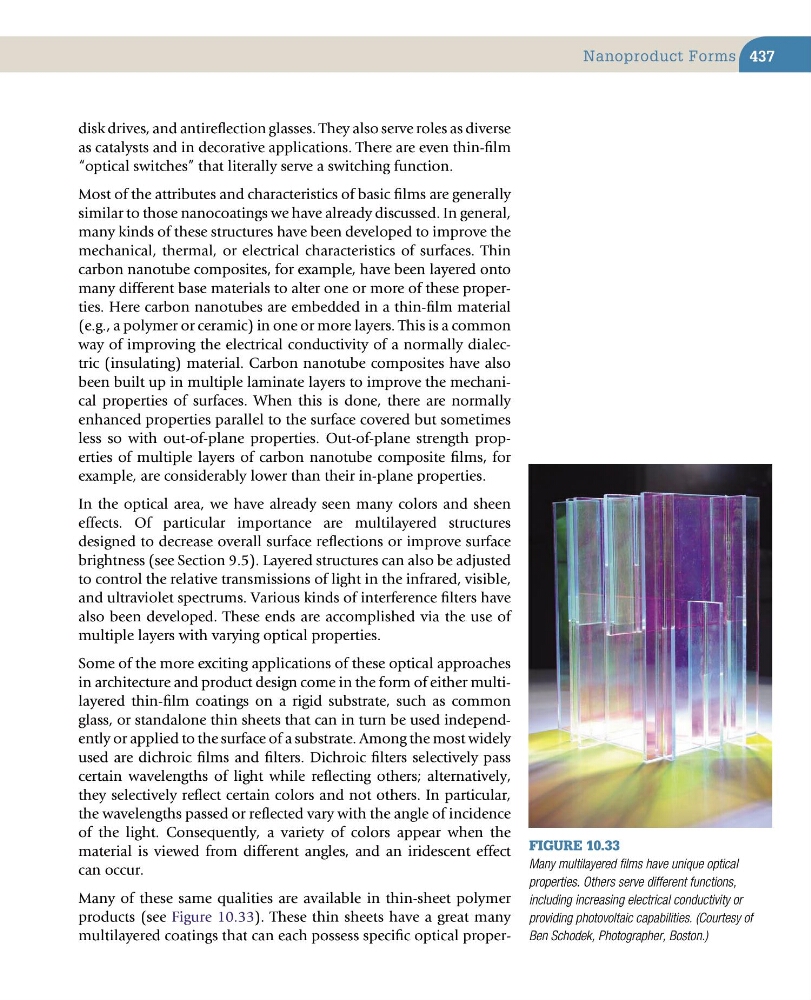
Many of these same qualities are available in thin-sheet polymer
products (see Figure 10.33). These thin sheets have a great many
multilayered coatings that can each possess specific optical properNanoproduct Forms
Figure 10.33
Many multilayered films have unique optical
properties. Others serve different functions,
including increasing electrical conductivity or
providing photovoltaic capabilities. (Courtesy of
Ben Schodek, Photographer, Boston.)
disk drives, and antireflection glasses. They also serve roles as diverse
as catalysts and in decorative applications. There are even thin-film
“optical switches” that literally serve a switching function.
Most of the attributes and characteristics of basic films are generally
similar to those nanocoatings we have already discussed. In general,
many kinds of these structures have been developed to improve the
mechanical, thermal, or electrical characteristics of surfaces. Thin
carbon nanotube composites, for example, have been layered onto
many different base materials to alter one or more of these properties. Here carbon nanotubes are embedded in a thin-film material
(e.g., a polymer or ceramic) in one or more layers. This is a common
way of improving the electrical conductivity of a normally dialectric (insulating) material. Carbon nanotube composites have also
been built up in multiple laminate layers to improve the mechanical properties of surfaces. When this is done, there are normally
enhanced properties parallel to the surface covered but sometimes
less so with out-of-plane properties. Out-of-plane strength properties of multiple layers of carbon nanotube composite films, for
example, are considerably lower than their in-plane properties.
In the optical area, we have already seen many colors and sheen
effects. Of particular importance are multilayered structures
designed to decrease overall surface reflections or improve surface
brightness (see Section 9.5). Layered structures can also be adjusted
to control the relative transmissions of light in the infrared, visible,
and ultraviolet spectrums. Various kinds of interference filters have
also been developed. These ends are accomplished via the use of
multiple layers with varying optical properties.
Some of the more exciting applications of these optical approaches
in architecture and product design come in the form of either mul tilayered thin-film coatings on a rigid substrate, such as common
glass, or standalone thin sheets that can in turn be used independently or applied to the surface of a substrate. Among the most widely
used are dichroic films and filters. Dichroic filters selectively pass
certain wavelengths of light while reflecting others; alternatively,
they selectively reflect certain colors and not others. In particular,
the wavelengths passed or reflected vary with the angle of incidence
of the light. Consequently, a variety of colors appear when the
material is viewed from different angles, and an iridescent effect
can occur.
Many of these same qualities are available in thin-sheet polymer
products (see Figure 10.33). These thin sheets have a great many
multilayered coatings that can each possess specific optical properNanoproduct Forms
Figure 10.33
Many multilayered films have unique optical
properties. Others serve different functions,
including increasing electrical conductivity or
providing photovoltaic capabilities. (Courtesy of
Ben Schodek, Photographer, Boston.)