

415
these cases, research needs concerning long-term efficacies noted
previously are relevant. See Section 10.4 on nanopaints for a further
discussion.
Many textiles have been developed that have self-cleaning properties. As previously noted, whether a hydrophobic or hydrophilic
state exists between a liquid and a solid surface depends on the
relative surface tensions. In everyday textiles such as cotton cloths,
the surface tensions of the solid materials are quite high compared
to those of water; hence wetting typically occurs. When these same
textiles are treated with one or another type of fluorocarbon, the
critical surface tensions of the treated textile is less than that of
water; hence a water-repellant action occurs. Fluorocarbons achieve
this effect by essentially coating individual cloth fibers. This coating
can be more successfully achieved with some solid fibers than
others. Synthetic fibers are easier to coat than cotton, for example.
Nanomaterial innovations can be helpful here. Coatings with nanosized whiskerlike elements can create patterns on fiber surfaces with
spaces smaller than water drops, thus causing the water droplets to
sit on top of the actual fabric. Other methods are based on catalytic
self-cleaning approaches similar to those already described. Silver,
titanium dioxide, or zinc oxide nanoparticles are typically used. A
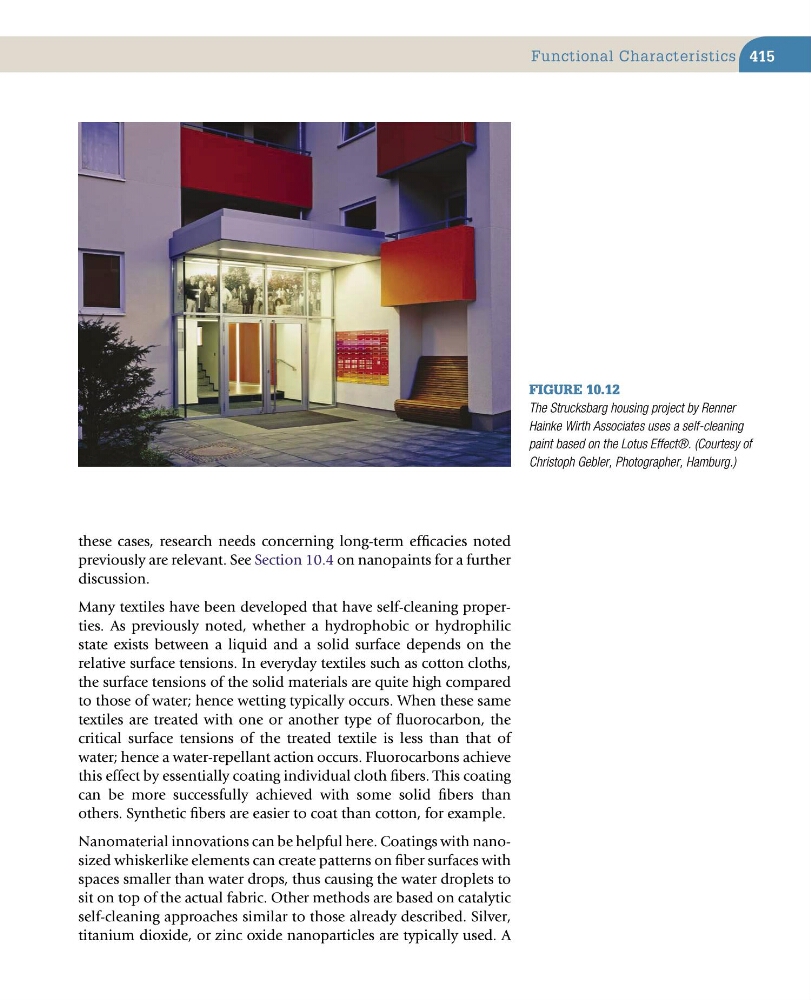
Figure 10.12
The Strucksbarg housing project by Renner
Hainke Wirth Associates uses a self-cleaning
paint based on the Lotus Effect®. (Courtesy of
Christoph Gebler, Photographer, Hamburg.)
Functional Characteristics
these cases, research needs concerning long-term efficacies noted
previously are relevant. See Section 10.4 on nanopaints for a further
discussion.
Many textiles have been developed that have self-cleaning properties. As previously noted, whether a hydrophobic or hydrophilic
state exists between a liquid and a solid surface depends on the
relative surface tensions. In everyday textiles such as cotton cloths,
the surface tensions of the solid materials are quite high compared
to those of water; hence wetting typically occurs. When these same
textiles are treated with one or another type of fluorocarbon, the
critical surface tensions of the treated textile is less than that of
water; hence a water-repellant action occurs. Fluorocarbons achieve
this effect by essentially coating individual cloth fibers. This coating
can be more successfully achieved with some solid fibers than
others. Synthetic fibers are easier to coat than cotton, for example.
Nanomaterial innovations can be helpful here. Coatings with nanosized whiskerlike elements can create patterns on fiber surfaces with
spaces smaller than water drops, thus causing the water droplets to
sit on top of the actual fabric. Other methods are based on catalytic
self-cleaning approaches similar to those already described. Silver,
titanium dioxide, or zinc oxide nanoparticles are typically used. A
Figure 10.12
The Strucksbarg housing project by Renner
Hainke Wirth Associates uses a self-cleaning
paint based on the Lotus Effect®. (Courtesy of
Christoph Gebler, Photographer, Hamburg.)
Functional Characteristics