

397
In the current context, many groups that commercially produce
nanomaterials (such as various kinds of nanoparticles or nanotubes) are just now transitioning from their roles as suppliers to the
research sector to that of becoming producers of commodity products. This transition, in turn, is being driven by the development of
more and more real applications that demand larger quantities, or
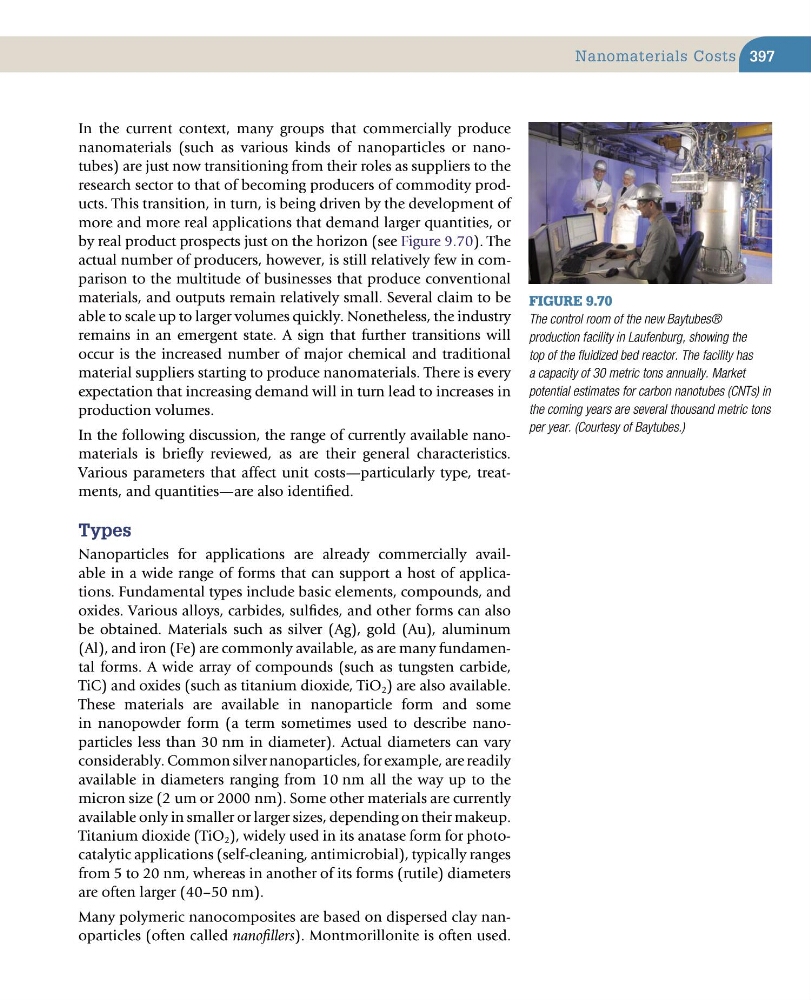
by real product prospects just on the horizon (see Figure 9.70). The
actual number of producers, however, is still relatively few in comparison to the multitude of businesses that produce conventional
materials, and outputs remain relatively small. Several claim to be
able to scale up to larger volumes quickly. Nonetheless, the industry
remains in an emergent state. A sign that further transitions will
occur is the increased number of major chemical and traditional
material suppliers starting to produce nanomaterials. There is every
expectation that increasing demand will in turn lead to increases in
production volumes.
In the following discussion, the range of currently available nanomaterials is briefly reviewed, as are their general characteristics.
Various parameters that affect unit costs—particularly type, treatments, and quantities—are also identified.
types
Nanoparticles for applications are already commercially available in a wide range of forms that can support a host of applications. Fundamental types include basic elements, compounds, and
oxides. Various alloys, carbides, sulfides, and other forms can also
be obtained. Materials such as silver (Ag), gold (Au), aluminum
(Al), and iron (Fe) are commonly available, as are many fundamental forms. A wide array of compounds (such as tungsten carbide,
TiC) and oxides (such as titanium dioxide, TiO 2 ) are also available.
These materials are available in nanoparticle form and some
in nanopowder form (a term sometimes used to describe nanoparticles less than 30 nm in diameter). Actual diameters can vary
considerably. Common silver nanoparticles, for example, are readily
available in diameters ranging from 10 nm all the way up to the
micron size (2 um or 2000 nm). Some other materials are currently
available only in smaller or larger sizes, depending on their makeup.
Titanium dioxide (TiO 2 ), widely used in its anatase form for photocatalytic applications (self-cleaning, antimicrobial), typically ranges
from 5 to 20 nm, whereas in another of its forms (rutile) diameters
are often larger (40–50 nm).
Many polymeric nanocomposites are based on dispersed clay nanoparticles (often called nanofillers). Montmorillonite is often used.
Figure 9.70
The control room of the new Baytubes®
production facility in Laufenburg, showing the
top of the fluidized bed reactor. The facility has
a capacity of 30 metric tons annually. Market
potential estimates for carbon nanotubes (CNTs) in
the coming years are several thousand metric tons
per year. (Courtesy of Baytubes.)
Nanomaterials Costs
In the current context, many groups that commercially produce
nanomaterials (such as various kinds of nanoparticles or nanotubes) are just now transitioning from their roles as suppliers to the
research sector to that of becoming producers of commodity products. This transition, in turn, is being driven by the development of
more and more real applications that demand larger quantities, or
by real product prospects just on the horizon (see Figure 9.70). The
actual number of producers, however, is still relatively few in comparison to the multitude of businesses that produce conventional
materials, and outputs remain relatively small. Several claim to be
able to scale up to larger volumes quickly. Nonetheless, the industry
remains in an emergent state. A sign that further transitions will
occur is the increased number of major chemical and traditional
material suppliers starting to produce nanomaterials. There is every
expectation that increasing demand will in turn lead to increases in
production volumes.
In the following discussion, the range of currently available nanomaterials is briefly reviewed, as are their general characteristics.
Various parameters that affect unit costs—particularly type, treatments, and quantities—are also identified.
types
Nanoparticles for applications are already commercially available in a wide range of forms that can support a host of applications. Fundamental types include basic elements, compounds, and
oxides. Various alloys, carbides, sulfides, and other forms can also
be obtained. Materials such as silver (Ag), gold (Au), aluminum
(Al), and iron (Fe) are commonly available, as are many fundamental forms. A wide array of compounds (such as tungsten carbide,
TiC) and oxides (such as titanium dioxide, TiO 2 ) are also available.
These materials are available in nanoparticle form and some
in nanopowder form (a term sometimes used to describe nanoparticles less than 30 nm in diameter). Actual diameters can vary
considerably. Common silver nanoparticles, for example, are readily
available in diameters ranging from 10 nm all the way up to the
micron size (2 um or 2000 nm). Some other materials are currently
available only in smaller or larger sizes, depending on their makeup.
Titanium dioxide (TiO 2 ), widely used in its anatase form for photocatalytic applications (self-cleaning, antimicrobial), typically ranges
from 5 to 20 nm, whereas in another of its forms (rutile) diameters
are often larger (40–50 nm).
Many polymeric nanocomposites are based on dispersed clay nanoparticles (often called nanofillers). Montmorillonite is often used.
Figure 9.70
The control room of the new Baytubes®
production facility in Laufenburg, showing the
top of the fluidized bed reactor. The facility has
a capacity of 30 metric tons annually. Market
potential estimates for carbon nanotubes (CNTs) in
the coming years are several thousand metric tons
per year. (Courtesy of Baytubes.)
Nanomaterials Costs