

393
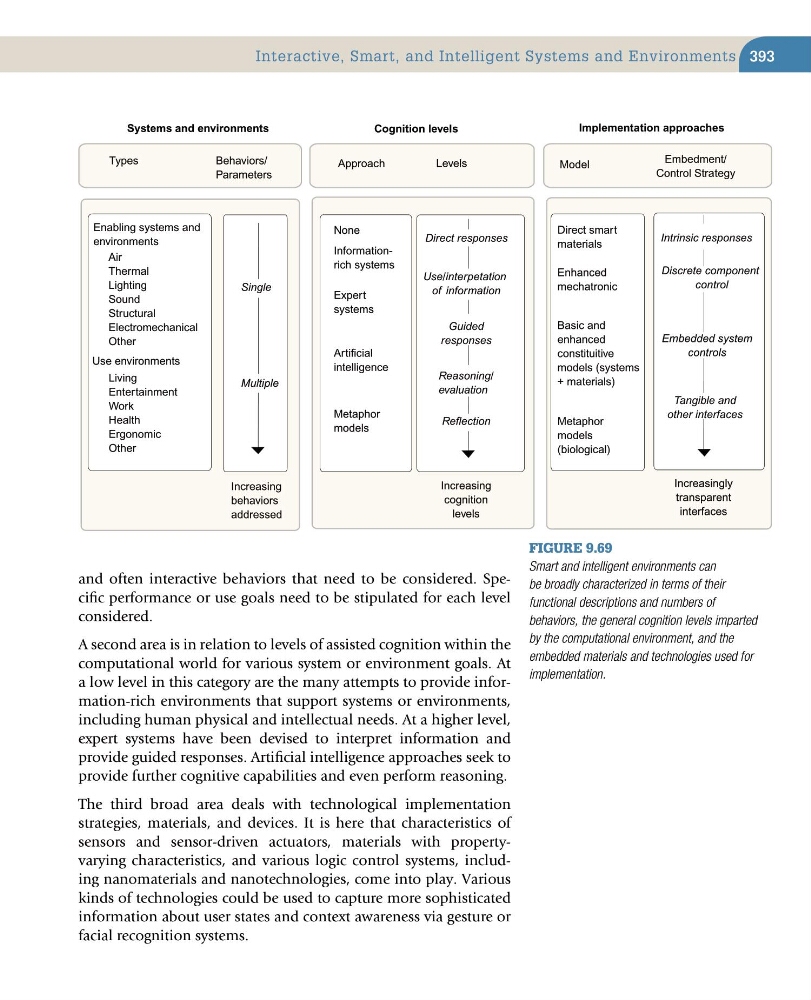
and often interactive behaviors that need to be considered. Specific performance or use goals need to be stipulated for each level
considered.
A second area is in relation to levels of assisted cognition within the
computational world for various system or environment goals. At
a low level in this category are the many attempts to provide information-rich environments that support systems or environments,
including human physical and intellectual needs. At a higher level,
expert systems have been devised to interpret information and
provide guided responses. Artificial intelligence approaches seek to
provide further cognitive capabilities and even perform reasoning.
The third broad area deals with technological implementation
strategies, materials, and devices. It is here that characteristics of
sensors and sensor-driven actuators, materials with propertyvarying characteristics, and various logic control systems, including nanomaterials and nanotechnologies, come into play. Various
kinds of technologies could be used to capture more sophisticated
information about user states and context awareness via gesture or
facial recognition systems.
Figure 9.69
Smart and intelligent environments can
be broadly characterized in terms of their
functional descriptions and numbers of
behaviors, the general cognition levels imparted
by the computational environment, and the
embedded materials and technologies used for
implementation.
Air
Thermal
Lighting
Sound
Structural
Electromechanical
Other
Enabling systems and
environments
Behaviors/
Parameters
Use environments
Living
Entertainment
Work
Health
Ergonomic
Other
Systems and environments
Cognition levels
None
Expert
systems
Artificial
intelligence
Metaphor
models
Informationrich systems
Increasing
behaviors
addressed
Types
Approach
Levels
Implementation approaches
Direct smart
materials
Enhanced
mechatronic
Basic and
enhanced
constituitive
models (systems
+ materials)
Metaphor
models
(biological)
Embedment/
Control Strategy
Model
Increasingly
transparent
interfaces
Tangible and
other interfaces
Discrete component
control
Embedded system
controls
Increasing
cognition
levels
Direct responses
Use/interpetation
of information
Reflection
Guided
responses
Reasoning/
evaluation
Single
Multiple
Intrinsic responses
Interactive, Smart, and Intelligent Systems and Environments
and often interactive behaviors that need to be considered. Specific performance or use goals need to be stipulated for each level
considered.
A second area is in relation to levels of assisted cognition within the
computational world for various system or environment goals. At
a low level in this category are the many attempts to provide information-rich environments that support systems or environments,
including human physical and intellectual needs. At a higher level,
expert systems have been devised to interpret information and
provide guided responses. Artificial intelligence approaches seek to
provide further cognitive capabilities and even perform reasoning.
The third broad area deals with technological implementation
strategies, materials, and devices. It is here that characteristics of
sensors and sensor-driven actuators, materials with propertyvarying characteristics, and various logic control systems, including nanomaterials and nanotechnologies, come into play. Various
kinds of technologies could be used to capture more sophisticated
information about user states and context awareness via gesture or
facial recognition systems.
Figure 9.69
Smart and intelligent environments can
be broadly characterized in terms of their
functional descriptions and numbers of
behaviors, the general cognition levels imparted
by the computational environment, and the
embedded materials and technologies used for
implementation.
Air
Thermal
Lighting
Sound
Structural
Electromechanical
Other
Enabling systems and
environments
Behaviors/
Parameters
Use environments
Living
Entertainment
Work
Health
Ergonomic
Other
Systems and environments
Cognition levels
None
Expert
systems
Artificial
intelligence
Metaphor
models
Informationrich systems
Increasing
behaviors
addressed
Types
Approach
Levels
Implementation approaches
Direct smart
materials
Enhanced
mechatronic
Basic and
enhanced
constituitive
models (systems
+ materials)
Metaphor
models
(biological)
Embedment/
Control Strategy
Model
Increasingly
transparent
interfaces
Tangible and
other interfaces
Discrete component
control
Embedded system
controls
Increasing
cognition
levels
Direct responses
Use/interpetation
of information
Reflection
Guided
responses
Reasoning/
evaluation
Single
Multiple
Intrinsic responses
Interactive, Smart, and Intelligent Systems and Environments