

379
tions. Sound-related phenomena also relate to other environments
addressed in this book, such as lighting or thermal environments.
Sonoluminescence phenomena, for example, can be expected to
find use. (Sonoluminescence is the emission of light by bubbles in a
liquid excited by sound.) The field of thermoacoustics—the interaction of sound and heat—offers excitement in a different realm.
Nanomaterials can be expected to play roles of one type or another
in these different areas.
9.7 EnaBling EnvironmEnts and
systEms: EnErgy
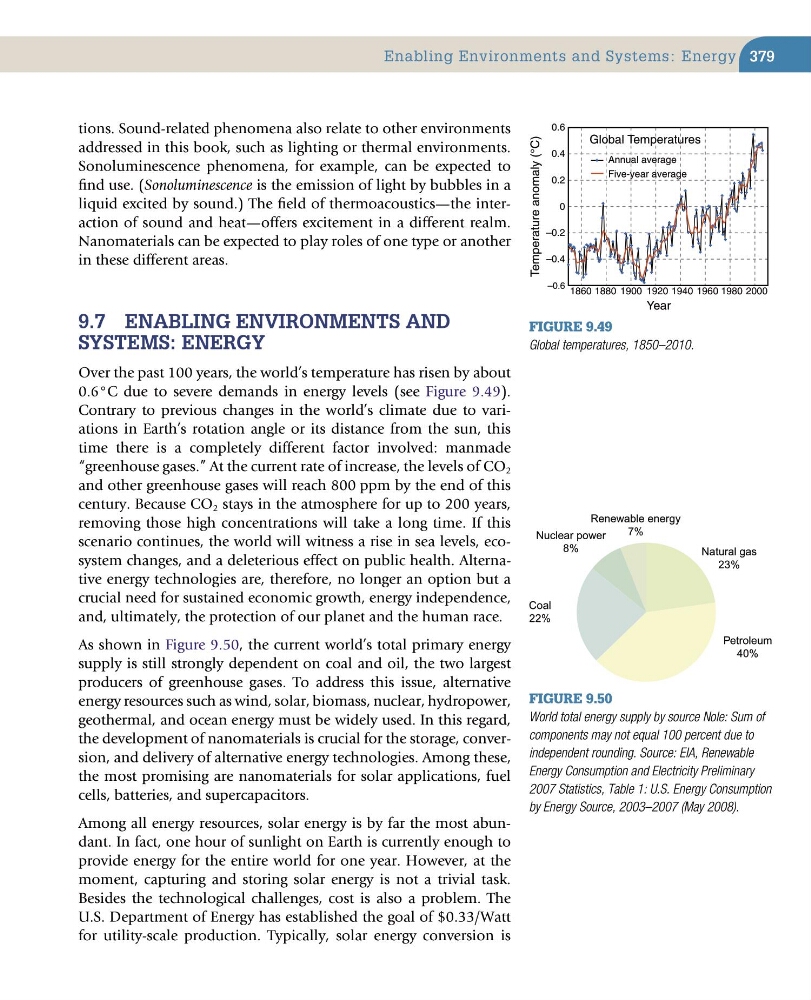
Over the past 100 years, the world’s temperature has risen by about
0.6°C due to severe demands in energy levels (see Figure 9.49).
Contrary to previous changes in the world’s climate due to variations in Earth’s rotation angle or its distance from the sun, this
time there is a completely different factor involved: manmade
“greenhouse gases.” At the current rate of increase, the levels of CO 2
and other greenhouse gases will reach 800 ppm by the end of this
century. Because CO 2 stays in the atmosphere for up to 200 years,
removing those high concentrations will take a long time. If this
scenario continues, the world will witness a rise in sea levels, ecosystem changes, and a deleterious effect on public health. Alternative energy technologies are, therefore, no longer an option but a
crucial need for sustained economic growth, energy independence,
and, ultimately, the protection of our planet and the human race.
As shown in Figure 9.50, the current world’s total primary energy
supply is still strongly dependent on coal and oil, the two largest
producers of greenhouse gases. To address this issue, alternative
energy resources such as wind, solar, biomass, nuclear, hydropower,
geothermal, and ocean energy must be widely used. In this regard,
the development of nanomaterials is crucial for the storage, conversion, and delivery of alternative energy technologies. Among these,
the most promising are nanomaterials for solar applications, fuel
cells, batteries, and supercapacitors.
Among all energy resources, solar energy is by far the most abundant. In fact, one hour of sunlight on Earth is currently enough to
provide energy for the entire world for one year. However, at the
moment, capturing and storing solar energy is not a trivial task.
Besides the technological challenges, cost is also a problem. The
U.S. Department of Energy has established the goal of $0.33/Watt
for utility-scale production. Typically, solar energy conversion is
Figure 9.49
Global temperatures, 1850–2010.
1860
–0.6
–0.4
–0.2
0
Temperature anomaly (°C)
0.2
0.4
0.6
1900
Year
Global Temperatures
1920 1940 1960 1980 2000
1880
Annual average
Five-year average
Figure 9.50
World total energy supply by source Nole: Sum of
components may not equal 100 percent due to
independent rounding. Source: EIA, Renewable
Energy Consumption and Electricity Preliminary
2007 Statistics, Table 1: U.S. Energy Consumption
by Energy Source, 2003–2007 (May 2008).
Renewable energy
7%
Nuclear power
8%
Coal
22%
Petroleum
40%
Natural gas
23%
Enabling Environments and Systems: Energy
tions. Sound-related phenomena also relate to other environments
addressed in this book, such as lighting or thermal environments.
Sonoluminescence phenomena, for example, can be expected to
find use. (Sonoluminescence is the emission of light by bubbles in a
liquid excited by sound.) The field of thermoacoustics—the interaction of sound and heat—offers excitement in a different realm.
Nanomaterials can be expected to play roles of one type or another
in these different areas.
9.7 EnaBling EnvironmEnts and
systEms: EnErgy
Over the past 100 years, the world’s temperature has risen by about
0.6°C due to severe demands in energy levels (see Figure 9.49).
Contrary to previous changes in the world’s climate due to variations in Earth’s rotation angle or its distance from the sun, this
time there is a completely different factor involved: manmade
“greenhouse gases.” At the current rate of increase, the levels of CO 2
and other greenhouse gases will reach 800 ppm by the end of this
century. Because CO 2 stays in the atmosphere for up to 200 years,
removing those high concentrations will take a long time. If this
scenario continues, the world will witness a rise in sea levels, ecosystem changes, and a deleterious effect on public health. Alternative energy technologies are, therefore, no longer an option but a
crucial need for sustained economic growth, energy independence,
and, ultimately, the protection of our planet and the human race.
As shown in Figure 9.50, the current world’s total primary energy
supply is still strongly dependent on coal and oil, the two largest
producers of greenhouse gases. To address this issue, alternative
energy resources such as wind, solar, biomass, nuclear, hydropower,
geothermal, and ocean energy must be widely used. In this regard,
the development of nanomaterials is crucial for the storage, conversion, and delivery of alternative energy technologies. Among these,
the most promising are nanomaterials for solar applications, fuel
cells, batteries, and supercapacitors.
Among all energy resources, solar energy is by far the most abundant. In fact, one hour of sunlight on Earth is currently enough to
provide energy for the entire world for one year. However, at the
moment, capturing and storing solar energy is not a trivial task.
Besides the technological challenges, cost is also a problem. The
U.S. Department of Energy has established the goal of $0.33/Watt
for utility-scale production. Typically, solar energy conversion is
Figure 9.49
Global temperatures, 1850–2010.
1860
–0.6
–0.4
–0.2
0
Temperature anomaly (°C)
0.2
0.4
0.6
1900
Year
Global Temperatures
1920 1940 1960 1980 2000
1880
Annual average
Five-year average
Figure 9.50
World total energy supply by source Nole: Sum of
components may not equal 100 percent due to
independent rounding. Source: EIA, Renewable
Energy Consumption and Electricity Preliminary
2007 Statistics, Table 1: U.S. Energy Consumption
by Energy Source, 2003–2007 (May 2008).
Renewable energy
7%
Nuclear power
8%
Coal
22%
Petroleum
40%
Natural gas
23%
Enabling Environments and Systems: Energy