

377
success has been limited. The important development here is the
use of highly porous carbon materials for momentarily absorbing
increased air pressures. Used in the Panasonic Nano-Bass Exciter,
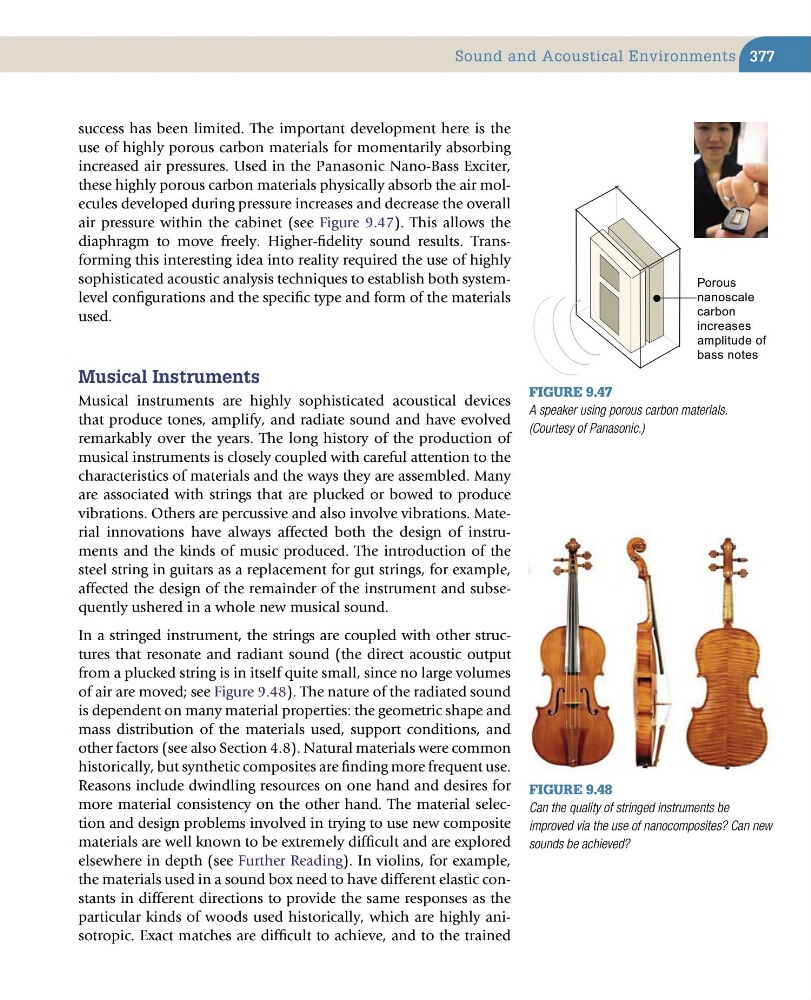
these highly porous carbon materials physically absorb the air molecules developed during pressure increases and decrease the overall
air pressure within the cabinet (see Figure 9.47). This allows the
diaphragm to move freely. Higher-fidelity sound results. Transforming this interesting idea into reality required the use of highly
sophisticated acoustic analysis techniques to establish both systemlevel configurations and the specific type and form of the materials
used.
musical instruments
Musical instruments are highly sophisticated acoustical devices
that produce tones, amplify, and radiate sound and have evolved
remarkably over the years. The long history of the production of
musical instruments is closely coupled with careful attention to the
characteristics of materials and the ways they are assembled. Many
are associated with strings that are plucked or bowed to produce
vibrations. Others are percussive and also involve vibrations. Material innovations have always affected both the design of instruments and the kinds of music produced. The introduction of the
steel string in guitars as a replacement for gut strings, for example,
affected the design of the remainder of the instrument and subsequently ushered in a whole new musical sound.
In a stringed instrument, the strings are coupled with other structures that resonate and radiant sound (the direct acoustic output
from a plucked string is in itself quite small, since no large volumes
of air are moved; see Figure 9.48). The nature of the radiated sound
is dependent on many material properties: the geometric shape and
mass distribution of the materials used, support conditions, and
other factors (see also Section 4.8). Natural materials were common
historically, but synthetic composites are finding more frequent use.
Reasons include dwindling resources on one hand and desires for
more material consistency on the other hand. The material selection and design problems involved in trying to use new composite
materials are well known to be extremely difficult and are explored
elsewhere in depth (see Further Reading). In violins, for example,
the materials used in a sound box need to have different elastic constants in different directions to provide the same responses as the
particular kinds of woods used historically, which are highly anisotropic. Exact matches are difficult to achieve, and to the trained
Figure 9.47
A speaker using porous carbon materials.
(Courtesy of Panasonic.)
Porous
nanoscale
carbon
increases
amplitude of
bass notes
Figure 9.48
Can the quality of stringed instruments be
improved via the use of nanocomposites? Can new
sounds be achieved?
Sound and Acoustical Environments
success has been limited. The important development here is the
use of highly porous carbon materials for momentarily absorbing
increased air pressures. Used in the Panasonic Nano-Bass Exciter,
these highly porous carbon materials physically absorb the air molecules developed during pressure increases and decrease the overall
air pressure within the cabinet (see Figure 9.47). This allows the
diaphragm to move freely. Higher-fidelity sound results. Transforming this interesting idea into reality required the use of highly
sophisticated acoustic analysis techniques to establish both systemlevel configurations and the specific type and form of the materials
used.
musical instruments
Musical instruments are highly sophisticated acoustical devices
that produce tones, amplify, and radiate sound and have evolved
remarkably over the years. The long history of the production of
musical instruments is closely coupled with careful attention to the
characteristics of materials and the ways they are assembled. Many
are associated with strings that are plucked or bowed to produce
vibrations. Others are percussive and also involve vibrations. Material innovations have always affected both the design of instruments and the kinds of music produced. The introduction of the
steel string in guitars as a replacement for gut strings, for example,
affected the design of the remainder of the instrument and subsequently ushered in a whole new musical sound.
In a stringed instrument, the strings are coupled with other structures that resonate and radiant sound (the direct acoustic output
from a plucked string is in itself quite small, since no large volumes
of air are moved; see Figure 9.48). The nature of the radiated sound
is dependent on many material properties: the geometric shape and
mass distribution of the materials used, support conditions, and
other factors (see also Section 4.8). Natural materials were common
historically, but synthetic composites are finding more frequent use.
Reasons include dwindling resources on one hand and desires for
more material consistency on the other hand. The material selection and design problems involved in trying to use new composite
materials are well known to be extremely difficult and are explored
elsewhere in depth (see Further Reading). In violins, for example,
the materials used in a sound box need to have different elastic constants in different directions to provide the same responses as the
particular kinds of woods used historically, which are highly anisotropic. Exact matches are difficult to achieve, and to the trained
Figure 9.47
A speaker using porous carbon materials.
(Courtesy of Panasonic.)
Porous
nanoscale
carbon
increases
amplitude of
bass notes
Figure 9.48
Can the quality of stringed instruments be
improved via the use of nanocomposites? Can new
sounds be achieved?
Sound and Acoustical Environments