

335
our perception and understanding of the visual world and is used
in countless products that society uses on a daily basis. Light can
carry information and be used in a host of ways we are just now
beginning to understand. Nanotechnology opportunities in the
broad field of photonics, which deals with generating and controlling light at a basic level, are seemingly everywhere. Applications in
devices are widespread, including in the thousands of optical and
laser-based devices that are among the fundamental workhorses
of our modern technological infrastructure. Quantum dots, lightcontrol films, and other nano-based technologies offer many direct
applications. Interestingly, we also know that photo-based systems
are important in manufacturing and production, including the very
top-down production of nano-based materials and technologies
that are the subject of this book.
In this section we explore nanotechnologies in relation to light. We
start by briefly reviewing the basic characteristics of light itself as
well as the essential properties of materials that are relevant to the
control and manipulation of light. We do this because it remains
surprising how many experienced designers still stumble over very
basic ideas concerning color and related light phenomena, which in
turn prevent them from creatively using light as a design tool. The
exact way in which nanomaterials can be used to control traditional
phenomena of light absorption, reflection, transmittance, or refraction is fundamental to an understanding of how to effectively use
them in practice. There are needs for materials with either enhanced
reflective properties (such as the color, multireflective, or mirror
films used in many products) or those with so-called antireflective
properties (see Figure 9.26). Though many current surfaces or films
can be engineered to have these or other useful properties, many
work only at single wavelengths (or highly restricted wavelength
bands), thus limiting their usefulness. Utilization of nanomaterials can potentially enable the same performances over much wider
bandwidths. More generally, various combinations of approaches
at nano, micro, and macro scales can be effectively used together to
provide even more versatile design approaches.
We also look at light-emitting devices (LEDs) that form the workhorses of countless products that are used throughout society, from
simple consumer products such as flashlights all the way through
complex scientific instruments. LEDs have literally revolutionalized
architectural lighting as well as display in the past few years (see
Figure 9.27). We will see that nanotechnologies—particularly nanophosphors and quantum dots—can lead to great improvements
in these devices. Quantum dot LEDs (QLEDs) promise even further
improvements.
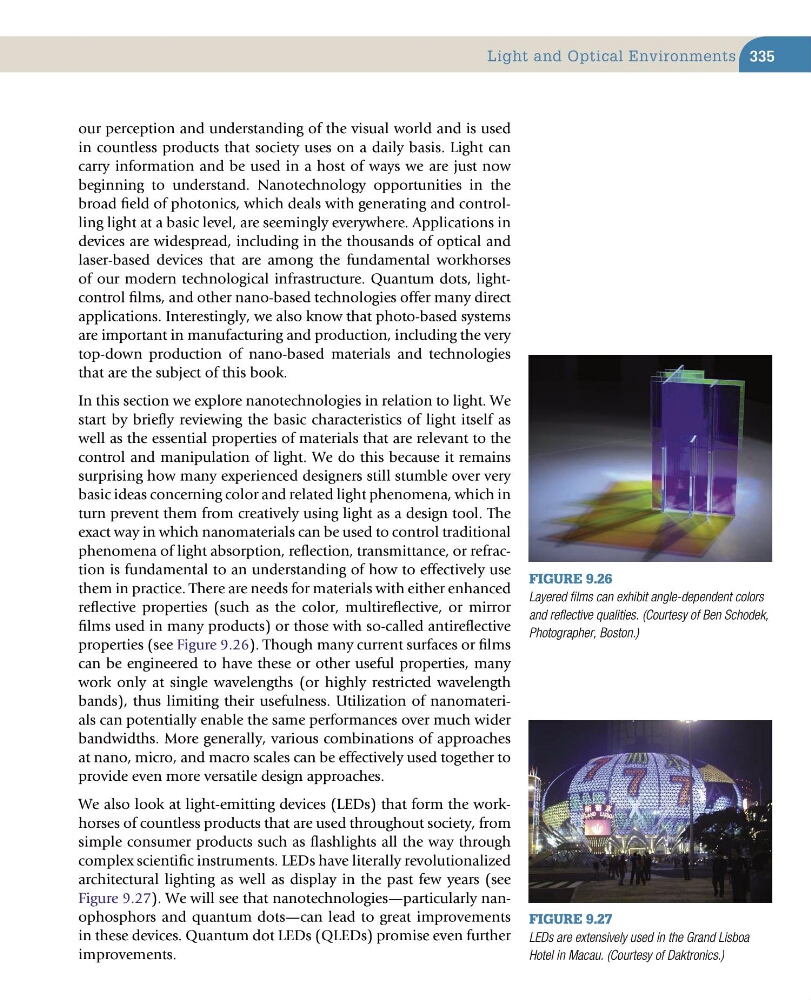
Figure 9.26
Layered films can exhibit angle-dependent colors
and reflective qualities. (Courtesy of Ben Schodek,
Photographer, Boston.)
Figure 9.27
LEDs are extensively used in the Grand Lisboa
Hotel in Macau. (Courtesy of Daktronics.)
Light and Optical Environments
our perception and understanding of the visual world and is used
in countless products that society uses on a daily basis. Light can
carry information and be used in a host of ways we are just now
beginning to understand. Nanotechnology opportunities in the
broad field of photonics, which deals with generating and controlling light at a basic level, are seemingly everywhere. Applications in
devices are widespread, including in the thousands of optical and
laser-based devices that are among the fundamental workhorses
of our modern technological infrastructure. Quantum dots, lightcontrol films, and other nano-based technologies offer many direct
applications. Interestingly, we also know that photo-based systems
are important in manufacturing and production, including the very
top-down production of nano-based materials and technologies
that are the subject of this book.
In this section we explore nanotechnologies in relation to light. We
start by briefly reviewing the basic characteristics of light itself as
well as the essential properties of materials that are relevant to the
control and manipulation of light. We do this because it remains
surprising how many experienced designers still stumble over very
basic ideas concerning color and related light phenomena, which in
turn prevent them from creatively using light as a design tool. The
exact way in which nanomaterials can be used to control traditional
phenomena of light absorption, reflection, transmittance, or refraction is fundamental to an understanding of how to effectively use
them in practice. There are needs for materials with either enhanced
reflective properties (such as the color, multireflective, or mirror
films used in many products) or those with so-called antireflective
properties (see Figure 9.26). Though many current surfaces or films
can be engineered to have these or other useful properties, many
work only at single wavelengths (or highly restricted wavelength
bands), thus limiting their usefulness. Utilization of nanomaterials can potentially enable the same performances over much wider
bandwidths. More generally, various combinations of approaches
at nano, micro, and macro scales can be effectively used together to
provide even more versatile design approaches.
We also look at light-emitting devices (LEDs) that form the workhorses of countless products that are used throughout society, from
simple consumer products such as flashlights all the way through
complex scientific instruments. LEDs have literally revolutionalized
architectural lighting as well as display in the past few years (see
Figure 9.27). We will see that nanotechnologies—particularly nanophosphors and quantum dots—can lead to great improvements
in these devices. Quantum dot LEDs (QLEDs) promise even further
improvements.
Figure 9.26
Layered films can exhibit angle-dependent colors
and reflective qualities. (Courtesy of Ben Schodek,
Photographer, Boston.)
Figure 9.27
LEDs are extensively used in the Grand Lisboa
Hotel in Macau. (Courtesy of Daktronics.)
Light and Optical Environments