

C haptEr 9 design Environments and systems
318
shielding or insulating function is needed. Nano-related mechanisms for accomplishing these ends vary.
We noted in Section 4.4 that heat is transported through solid materials in several primary ways. The role of the “mean-free path” was
noted as well. Thermal conductivity can be decreased (and the material made to act more like an insulator) by altering the mean-free
path via the introduction of impurity atoms or very fine dispersed
particles. This effect has long been known. Thus common approaches
intended to increase the strength of a metal can also lead to changes
in thermal conductivity. To decrease thermal conductivity, finely dispersed nanoparticles or nanocrystals can be used to create a matrix
of scattering centers that can reduce conductivities and create materials with better insulating capabilities. Here, the various shapes of
the nanoparticles can potentially be an important variable.
Thermal conductivity in certain materials can also be increased,
instead of decreased, by introducing nanoparticles. The thermal
conductivity of many polymers or fluids that are normally nonconductive, for example, can be enhanced via the inclusion of carbon
nanoparticles (for example, graphite). Shape considerations are
important here. Generally, spherical nanoparticles are less effective
than carbon nanotubes or nanofibrils. The latter have particularly
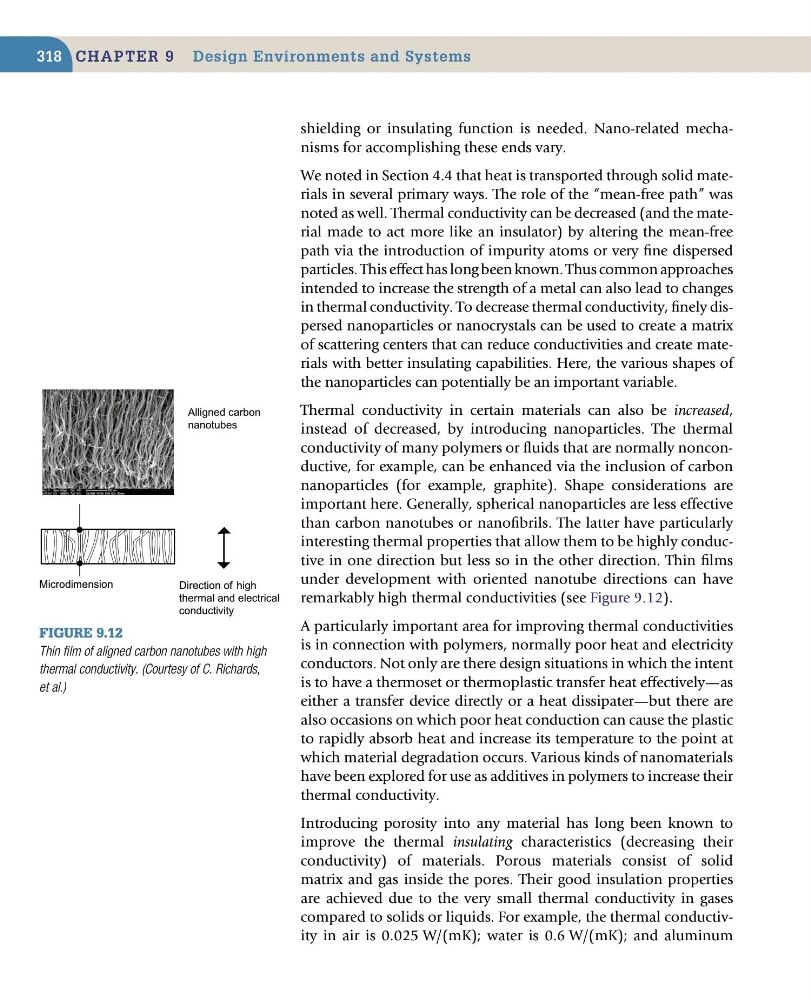
interesting thermal properties that allow them to be highly conductive in one direction but less so in the other direction. Thin films
under development with oriented nanotube directions can have
remarkably high thermal conductivities (see Figure 9.12).
A particularly important area for improving thermal conductivities
is in connection with polymers, normally poor heat and electricity
conductors. Not only are there design situations in which the intent
is to have a thermoset or thermoplastic transfer heat effectively—as
either a transfer device directly or a heat dissipater—but there are
also occasions on which poor heat conduction can cause the plastic
to rapidly absorb heat and increase its temperature to the point at
which material degradation occurs. Various kinds of nanomaterials
have been explored for use as additives in polymers to increase their
thermal conductivity.
Introducing porosity into any material has long been known to
improve the thermal insulating characteristics (decreasing their
conductivity) of materials. Porous materials consist of solid
matrix and gas inside the pores. Their good insulation properties
are achieved due to the very small thermal conductivity in gases
compared to solids or liquids. For example, the thermal conductivity in air is 0.025 W/(mK); water is 0.6 W/(mK); and aluminum
Figure 9.12
Thin film of aligned carbon nanotubes with high
thermal conductivity. (Courtesy of C. Richards,
et al.)
Alligned carbon
nanotubes
Microdimension
Direction of high
thermal and electrical
conductivity
318
shielding or insulating function is needed. Nano-related mechanisms for accomplishing these ends vary.
We noted in Section 4.4 that heat is transported through solid materials in several primary ways. The role of the “mean-free path” was
noted as well. Thermal conductivity can be decreased (and the material made to act more like an insulator) by altering the mean-free
path via the introduction of impurity atoms or very fine dispersed
particles. This effect has long been known. Thus common approaches
intended to increase the strength of a metal can also lead to changes
in thermal conductivity. To decrease thermal conductivity, finely dispersed nanoparticles or nanocrystals can be used to create a matrix
of scattering centers that can reduce conductivities and create materials with better insulating capabilities. Here, the various shapes of
the nanoparticles can potentially be an important variable.
Thermal conductivity in certain materials can also be increased,
instead of decreased, by introducing nanoparticles. The thermal
conductivity of many polymers or fluids that are normally nonconductive, for example, can be enhanced via the inclusion of carbon
nanoparticles (for example, graphite). Shape considerations are
important here. Generally, spherical nanoparticles are less effective
than carbon nanotubes or nanofibrils. The latter have particularly
interesting thermal properties that allow them to be highly conductive in one direction but less so in the other direction. Thin films
under development with oriented nanotube directions can have
remarkably high thermal conductivities (see Figure 9.12).
A particularly important area for improving thermal conductivities
is in connection with polymers, normally poor heat and electricity
conductors. Not only are there design situations in which the intent
is to have a thermoset or thermoplastic transfer heat effectively—as
either a transfer device directly or a heat dissipater—but there are
also occasions on which poor heat conduction can cause the plastic
to rapidly absorb heat and increase its temperature to the point at
which material degradation occurs. Various kinds of nanomaterials
have been explored for use as additives in polymers to increase their
thermal conductivity.
Introducing porosity into any material has long been known to
improve the thermal insulating characteristics (decreasing their
conductivity) of materials. Porous materials consist of solid
matrix and gas inside the pores. Their good insulation properties
are achieved due to the very small thermal conductivity in gases
compared to solids or liquids. For example, the thermal conductivity in air is 0.025 W/(mK); water is 0.6 W/(mK); and aluminum
Figure 9.12
Thin film of aligned carbon nanotubes with high
thermal conductivity. (Courtesy of C. Richards,
et al.)
Alligned carbon
nanotubes
Microdimension
Direction of high
thermal and electrical
conductivity