

313
heat gain (lighting elements, people, equipment, direct heating
sources) may be distributed in different ways throughout the space
and can interact with one another via fundamental methods of heat
transfer (conduction, convection, and radiation). Turbulent and
laminar air movements consequently invariably exist, as do related
temperature variations. The way a human responds to or perceives
the thermal environment that is present further complicates the
issue of how to design thermal environments of this type because
of their own highly complex thermoregulation characteristics.
Evaporation considerations enter in that in turn require control
of relative humidity levels in relation to temperatures. Ventilation
levels are also important—not only for human comfort but also to
aid in assuring that a clean-air environment is provided. All these
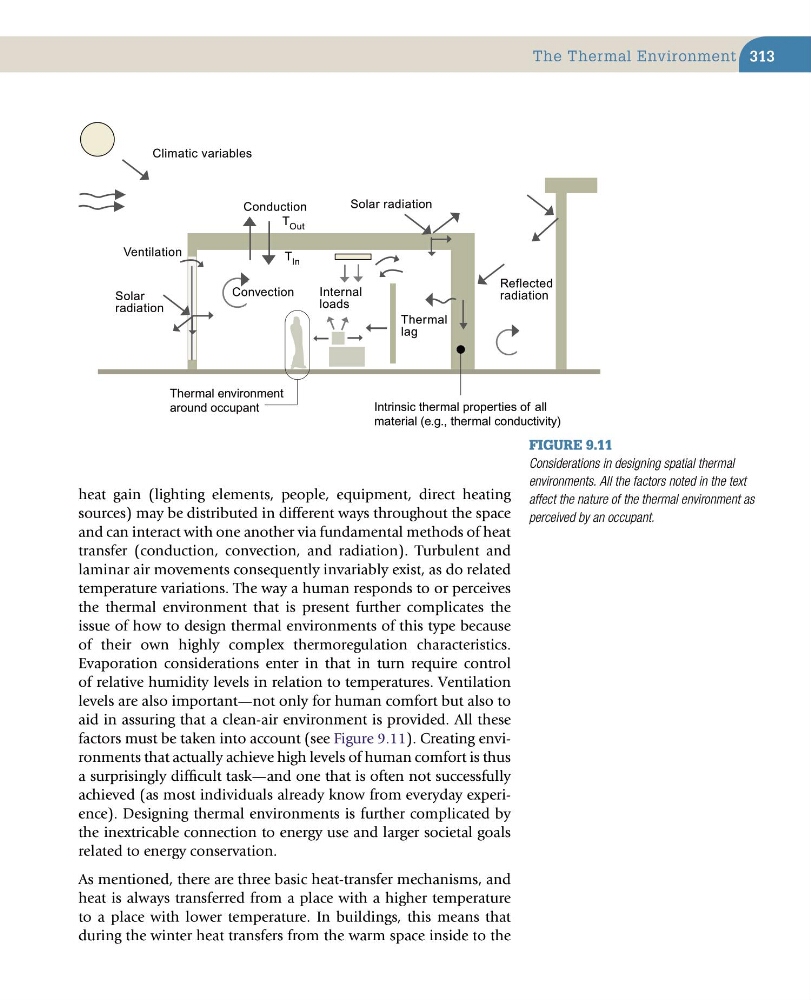
factors must be taken into account (see Figure 9.11). Creating environments that actually achieve high levels of human comfort is thus
a surprisingly difficult task—and one that is often not successfully
achieved (as most individuals already know from everyday experience). Designing thermal environments is further complicated by
the inextricable connection to energy use and larger societal goals
related to energy conservation.
As mentioned, there are three basic heat-transfer mechanisms, and
heat is always transferred from a place with a higher temperature
to a place with lower temperature. In buildings, this means that
during the winter heat transfers from the warm space inside to the
Figure 9.11
Considerations in designing spatial thermal
environments. All the factors noted in the text
affect the nature of the thermal environment as
perceived by an occupant.
Climatic variables
Ventilation
Internal
loads
T Out
T In
Reflected
radiation
Thermal
lag
Conduction
Solar radiation
Solar
radiation
Convection
Thermal environment
around occupant
Intrinsic thermal properties of all
material (e.g., thermal conductivity)
The Thermal Environment
heat gain (lighting elements, people, equipment, direct heating
sources) may be distributed in different ways throughout the space
and can interact with one another via fundamental methods of heat
transfer (conduction, convection, and radiation). Turbulent and
laminar air movements consequently invariably exist, as do related
temperature variations. The way a human responds to or perceives
the thermal environment that is present further complicates the
issue of how to design thermal environments of this type because
of their own highly complex thermoregulation characteristics.
Evaporation considerations enter in that in turn require control
of relative humidity levels in relation to temperatures. Ventilation
levels are also important—not only for human comfort but also to
aid in assuring that a clean-air environment is provided. All these
factors must be taken into account (see Figure 9.11). Creating environments that actually achieve high levels of human comfort is thus
a surprisingly difficult task—and one that is often not successfully
achieved (as most individuals already know from everyday experience). Designing thermal environments is further complicated by
the inextricable connection to energy use and larger societal goals
related to energy conservation.
As mentioned, there are three basic heat-transfer mechanisms, and
heat is always transferred from a place with a higher temperature
to a place with lower temperature. In buildings, this means that
during the winter heat transfers from the warm space inside to the
Figure 9.11
Considerations in designing spatial thermal
environments. All the factors noted in the text
affect the nature of the thermal environment as
perceived by an occupant.
Climatic variables
Ventilation
Internal
loads
T Out
T In
Reflected
radiation
Thermal
lag
Conduction
Solar radiation
Solar
radiation
Convection
Thermal environment
around occupant
Intrinsic thermal properties of all
material (e.g., thermal conductivity)
The Thermal Environment