

C haptEr 9 design Environments and systems
304
relative surface areas of the cement particles. Relative surface areas
of other materials in the mix are also important, thus presenting
an opportunity for the use of nanomaterials, with their inherently
high surface-to-volume ratios.
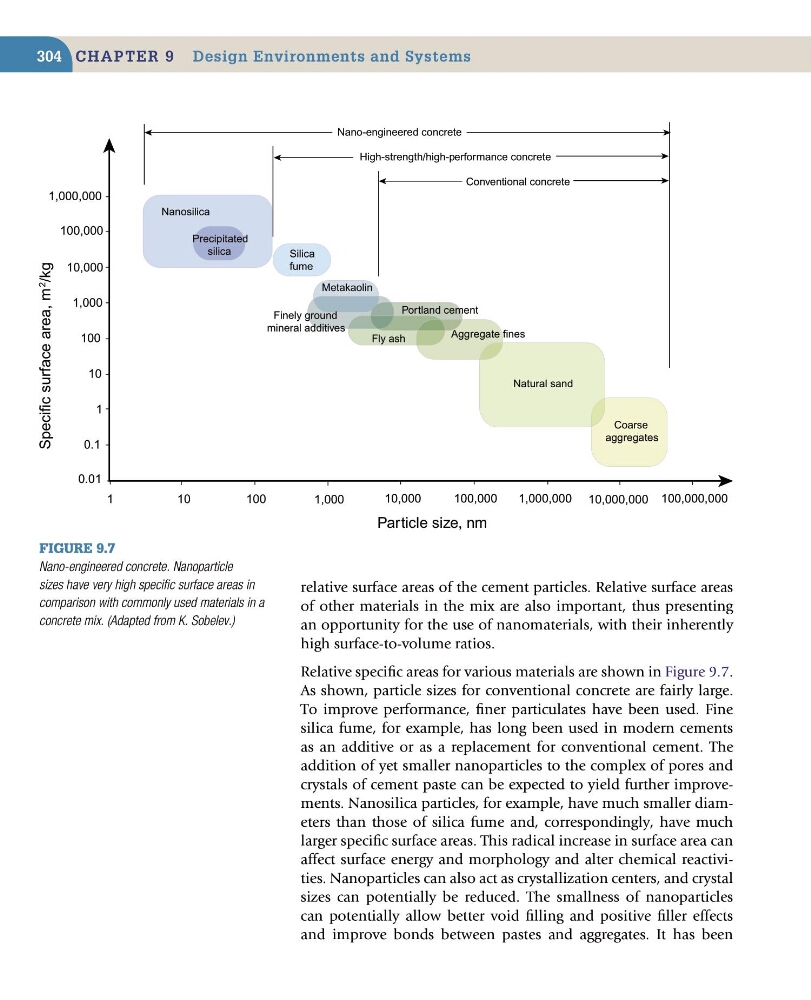
Relative specific areas for various materials are shown in Figure 9.7.
As shown, particle sizes for conventional concrete are fairly large.
To improve performance, finer particulates have been used. Fine
silica fume, for example, has long been used in modern cements
as an additive or as a replacement for conventional cement. The
addition of yet smaller nanoparticles to the complex of pores and
crystals of cement paste can be expected to yield further improvements. Nanosilica particles, for example, have much smaller diameters than those of silica fume and, correspondingly, have much
larger specific surface areas. This radical increase in surface area can
affect surface energy and morphology and alter chemical reactivities. Nanoparticles can also act as crystallization centers, and crystal
sizes can potentially be reduced. The smallness of nanoparticles
can potentially allow better void filling and positive filler effects
and improve bonds between pastes and aggregates. It has been
Figure 9.7
Nano-engineered concrete. Nanoparticle
sizes have very high specific surface areas in
comparison with commonly used materials in a
concrete mix. (Adapted from K. Sobelev.)
Nano-engineered concrete
High-strength/high-performance concrete
Conventional concrete
Coarse
aggregates
Natural sand
Aggregate fines
Fly ash
Portland cement
Finely ground
mineral additives
Metakaolin
Silica
fume
Precipitated
silica
Nanosilica
1
10
100
1,000
10,000
100,000
1,000,000 10,000,000 100,000,000
0.01
0.1
1
10
100
1,000
10,000
100,000
1,000,000
Particle size, nm
Specific surface area, m
2
/kg
304
relative surface areas of the cement particles. Relative surface areas
of other materials in the mix are also important, thus presenting
an opportunity for the use of nanomaterials, with their inherently
high surface-to-volume ratios.
Relative specific areas for various materials are shown in Figure 9.7.
As shown, particle sizes for conventional concrete are fairly large.
To improve performance, finer particulates have been used. Fine
silica fume, for example, has long been used in modern cements
as an additive or as a replacement for conventional cement. The
addition of yet smaller nanoparticles to the complex of pores and
crystals of cement paste can be expected to yield further improvements. Nanosilica particles, for example, have much smaller diameters than those of silica fume and, correspondingly, have much
larger specific surface areas. This radical increase in surface area can
affect surface energy and morphology and alter chemical reactivities. Nanoparticles can also act as crystallization centers, and crystal
sizes can potentially be reduced. The smallness of nanoparticles
can potentially allow better void filling and positive filler effects
and improve bonds between pastes and aggregates. It has been
Figure 9.7
Nano-engineered concrete. Nanoparticle
sizes have very high specific surface areas in
comparison with commonly used materials in a
concrete mix. (Adapted from K. Sobelev.)
Nano-engineered concrete
High-strength/high-performance concrete
Conventional concrete
Coarse
aggregates
Natural sand
Aggregate fines
Fly ash
Portland cement
Finely ground
mineral additives
Metakaolin
Silica
fume
Precipitated
silica
Nanosilica
1
10
100
1,000
10,000
100,000
1,000,000 10,000,000 100,000,000
0.01
0.1
1
10
100
1,000
10,000
100,000
1,000,000
Particle size, nm
Specific surface area, m
2
/kg