

CHApter 2 An evolutionary perspective
22
nanoscience is new, some of the technology is not. For example,
nanoparticles of carbon have been used for the reinforcement of
tires for over 100 years, nanoscale proteins have been part of vaccines since the early 20th century, and nature’s own nanotechnology, such as photosynthesis, has been around for millions of years.
The ruby-red color of stained glass, known and used in the Middle
Ages, is due to the presence of gold nanoparticles trapped in the
glass matrix (see the next section). The decorative glaze known as
luster, also found on medieval pottery, is the result of special optical
properties provided by the gold nanoparticles. However, modern
nanotechnology gained prominence with the discovery of various
forms of carbon, such as the C 60 molecule and carbon nanotubes.
Simultaneously, with the advance of analytical tools capable of
resolving and manipulating matter at the atomic level, scientists
started asking: What if we could build things the way nature does,
atom by atom and molecule by molecule? This approach involves
molecular manipulation and molecular engineering in the context
of building molecular machines and molecular devices with atomic
precision.
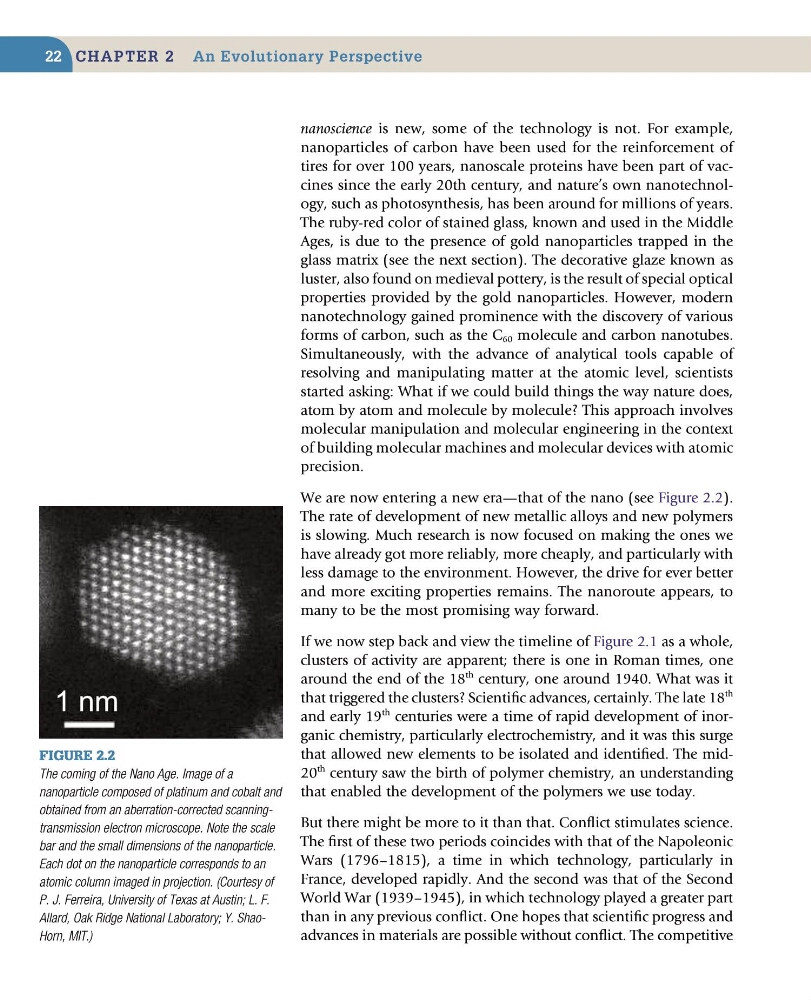
We are now entering a new era—that of the nano (see Figure 2.2).
The rate of development of new metallic alloys and new polymers
is slowing. Much research is now focused on making the ones we
have already got more reliably, more cheaply, and particularly with
less damage to the environment. However, the drive for ever better
and more exciting properties remains. The nanoroute appears, to
many to be the most promising way forward.
If we now step back and view the timeline of Figure 2.1 as a whole,
clusters of activity are apparent; there is one in Roman times, one
around the end of the 18
th century, one around 1940. What was it
that triggered the clusters? Scientific advances, certainly. The late 18
th
and early 19
th centuries were a time of rapid development of inorganic chemistry, particularly electrochemistry, and it was this surge
that allowed new elements to be isolated and identified. The mid20
th century saw the birth of polymer chemistry, an understanding
that enabled the development of the polymers we use today.
But there might be more to it than that. Conflict stimulates science.
The first of these two periods coincides with that of the Napoleonic
Wars (1796–1815), a time in which technology, particularly in
France, developed rapidly. And the second was that of the Second
World War (1939–1945), in which technology played a greater part
than in any previous conflict. One hopes that scientific progress and
advances in materials are possible without conflict. The competitive
Figure 2.2
The coming of the Nano Age. Image of a
nanoparticle composed of platinum and cobalt and
obtained from an aberration-corrected scanningtransmission electron microscope. Note the scale
bar and the small dimensions of the nanoparticle.
Each dot on the nanoparticle corresponds to an
atomic column imaged in projection. (Courtesy of
P. J. Ferreira, University of Texas at Austin; L. F.
Allard, Oak Ridge National Laboratory; Y. ShaoHorn, MIT.)
22
nanoscience is new, some of the technology is not. For example,
nanoparticles of carbon have been used for the reinforcement of
tires for over 100 years, nanoscale proteins have been part of vaccines since the early 20th century, and nature’s own nanotechnology, such as photosynthesis, has been around for millions of years.
The ruby-red color of stained glass, known and used in the Middle
Ages, is due to the presence of gold nanoparticles trapped in the
glass matrix (see the next section). The decorative glaze known as
luster, also found on medieval pottery, is the result of special optical
properties provided by the gold nanoparticles. However, modern
nanotechnology gained prominence with the discovery of various
forms of carbon, such as the C 60 molecule and carbon nanotubes.
Simultaneously, with the advance of analytical tools capable of
resolving and manipulating matter at the atomic level, scientists
started asking: What if we could build things the way nature does,
atom by atom and molecule by molecule? This approach involves
molecular manipulation and molecular engineering in the context
of building molecular machines and molecular devices with atomic
precision.
We are now entering a new era—that of the nano (see Figure 2.2).
The rate of development of new metallic alloys and new polymers
is slowing. Much research is now focused on making the ones we
have already got more reliably, more cheaply, and particularly with
less damage to the environment. However, the drive for ever better
and more exciting properties remains. The nanoroute appears, to
many to be the most promising way forward.
If we now step back and view the timeline of Figure 2.1 as a whole,
clusters of activity are apparent; there is one in Roman times, one
around the end of the 18
th century, one around 1940. What was it
that triggered the clusters? Scientific advances, certainly. The late 18
th
and early 19
th centuries were a time of rapid development of inorganic chemistry, particularly electrochemistry, and it was this surge
that allowed new elements to be isolated and identified. The mid20
th century saw the birth of polymer chemistry, an understanding
that enabled the development of the polymers we use today.
But there might be more to it than that. Conflict stimulates science.
The first of these two periods coincides with that of the Napoleonic
Wars (1796–1815), a time in which technology, particularly in
France, developed rapidly. And the second was that of the Second
World War (1939–1945), in which technology played a greater part
than in any previous conflict. One hopes that scientific progress and
advances in materials are possible without conflict. The competitive
Figure 2.2
The coming of the Nano Age. Image of a
nanoparticle composed of platinum and cobalt and
obtained from an aberration-corrected scanningtransmission electron microscope. Note the scale
bar and the small dimensions of the nanoparticle.
Each dot on the nanoparticle corresponds to an
atomic column imaged in projection. (Courtesy of
P. J. Ferreira, University of Texas at Austin; L. F.
Allard, Oak Ridge National Laboratory; Y. ShaoHorn, MIT.)