

C haptEr 9 design Environments and systems
298
applications that currently use one or another type of carbonfiber composite material. Carbon-fiber composites are known to
be extremely light and strong, and have found wide application
in everything from bicycle frames to tennis racquets to racing car
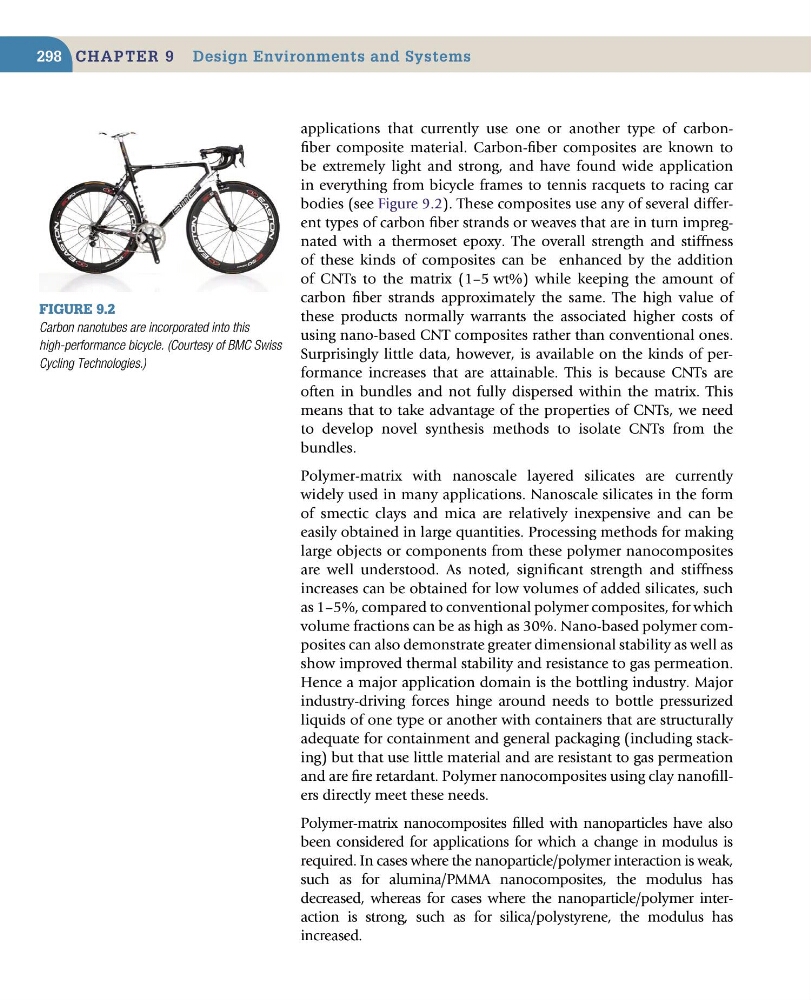
bodies (see Figure 9.2). These composites use any of several different types of carbon fiber strands or weaves that are in turn impregnated with a thermoset epoxy. The overall strength and stiffness
of these kinds of composites can be enhanced by the addition
of CNTs to the matrix (1–5 wt%) while keeping the amount of
carbon fiber strands approximately the same. The high value of
these products normally warrants the associated higher costs of
using nano-based CNT composites rather than conventional ones.
Surprisingly little data, however, is available on the kinds of performance increases that are attainable. This is because CNTs are
often in bundles and not fully dispersed within the matrix. This
means that to take advantage of the properties of CNTs, we need
to develop novel synthesis methods to isolate CNTs from the
bundles.
Polymer-matrix with nanoscale layered silicates are currently
widely used in many applications. Nanoscale silicates in the form
of smectic clays and mica are relatively inexpensive and can be
easily obtained in large quantities. Processing methods for making
large objects or components from these polymer nanocomposites
are well understood. As noted, significant strength and stiffness
increases can be obtained for low volumes of added silicates, such
as 1–5%, compared to conventional polymer composites, for which
volume fractions can be as high as 30%. Nano-based polymer composites can also demonstrate greater dimensional stability as well as
show improved thermal stability and resistance to gas permeation.
Hence a major application domain is the bottling industry. Major
industry-driving forces hinge around needs to bottle pressurized
liquids of one type or another with containers that are structurally
adequate for containment and general packaging (including stacking) but that use little material and are resistant to gas permeation
and are fire retardant. Polymer nanocomposites using clay nanofillers directly meet these needs.
Polymer-matrix nanocomposites filled with nanoparticles have also
been considered for applications for which a change in modulus is
required. In cases where the nanoparticle/polymer interaction is weak,
such as for alumina/PMMA nanocomposites, the modulus has
decreased, whereas for cases where the nanoparticle/polymer interaction is strong, such as for silica/polystyrene, the modulus has
increased.
Figure 9.2
Carbon nanotubes are incorporated into this
high-performance bicycle. (Courtesy of BMC Swiss
Cycling Technologies.)
298
applications that currently use one or another type of carbonfiber composite material. Carbon-fiber composites are known to
be extremely light and strong, and have found wide application
in everything from bicycle frames to tennis racquets to racing car
bodies (see Figure 9.2). These composites use any of several different types of carbon fiber strands or weaves that are in turn impregnated with a thermoset epoxy. The overall strength and stiffness
of these kinds of composites can be enhanced by the addition
of CNTs to the matrix (1–5 wt%) while keeping the amount of
carbon fiber strands approximately the same. The high value of
these products normally warrants the associated higher costs of
using nano-based CNT composites rather than conventional ones.
Surprisingly little data, however, is available on the kinds of performance increases that are attainable. This is because CNTs are
often in bundles and not fully dispersed within the matrix. This
means that to take advantage of the properties of CNTs, we need
to develop novel synthesis methods to isolate CNTs from the
bundles.
Polymer-matrix with nanoscale layered silicates are currently
widely used in many applications. Nanoscale silicates in the form
of smectic clays and mica are relatively inexpensive and can be
easily obtained in large quantities. Processing methods for making
large objects or components from these polymer nanocomposites
are well understood. As noted, significant strength and stiffness
increases can be obtained for low volumes of added silicates, such
as 1–5%, compared to conventional polymer composites, for which
volume fractions can be as high as 30%. Nano-based polymer composites can also demonstrate greater dimensional stability as well as
show improved thermal stability and resistance to gas permeation.
Hence a major application domain is the bottling industry. Major
industry-driving forces hinge around needs to bottle pressurized
liquids of one type or another with containers that are structurally
adequate for containment and general packaging (including stacking) but that use little material and are resistant to gas permeation
and are fire retardant. Polymer nanocomposites using clay nanofillers directly meet these needs.
Polymer-matrix nanocomposites filled with nanoparticles have also
been considered for applications for which a change in modulus is
required. In cases where the nanoparticle/polymer interaction is weak,
such as for alumina/PMMA nanocomposites, the modulus has
decreased, whereas for cases where the nanoparticle/polymer interaction is strong, such as for silica/polystyrene, the modulus has
increased.
Figure 9.2
Carbon nanotubes are incorporated into this
high-performance bicycle. (Courtesy of BMC Swiss
Cycling Technologies.)