

295
■ The shear modulus (G), which relates shear stresses to shear
strains.
■ The bulk modulus (K), which has to do with volume change.
■ Poisson’s ratio (v), which relates transverse to longitudinal
strains.
Other measures relate to the hardness of a material, its fatigue
characteristics, and other factors. Measures such as the “moment
of inertia (I)” of a member are also used to quantitatively describe
the amount and distribution of material in the cross-section of a
typical member.
Normally, making detailed structural analyses is the domain of the
structural or mechanical engineer, and many tools, such as finite
element analyses, are used during this process. Analysis and design
procedures, however, go hand in hand. Typically a preliminary
design is established and then analyzed. Comparison of calculated
stress and deformation values to allowable criteria for the materials
used and in relation to the use context yields an understanding of
the viability of the structure. Critical parts that fail to meet design
criteria are then reshaped and resized or a new material is selected
for use. Design is typically an iterative process. These many analytical and design procedures are well documented in other sources
and will not be covered here. Rather, we concentrate on the influence of material properties on design outcomes.
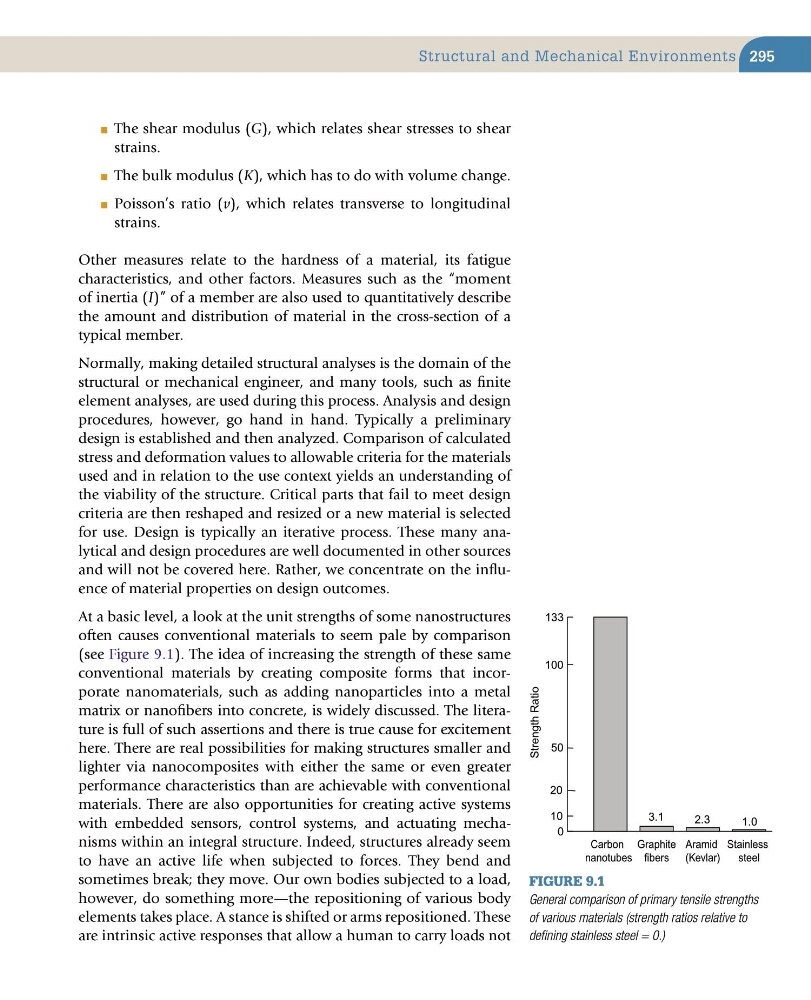
At a basic level, a look at the unit strengths of some nanostructures
often causes conventional materials to seem pale by comparison
(see Figure 9.1). The idea of increasing the strength of these same
conventional materials by creating composite forms that incorporate nanomaterials, such as adding nanoparticles into a metal
matrix or nanofibers into concrete, is widely discussed. The literature is full of such assertions and there is true cause for excitement
here. There are real possibilities for making structures smaller and
lighter via nanocomposites with either the same or even greater
performance characteristics than are achievable with conventional
materials. There are also opportunities for creating active systems
with embedded sensors, control systems, and actuating mechanisms within an integral structure. Indeed, structures already seem
to have an active life when subjected to forces. They bend and
sometimes break; they move. Our own bodies subjected to a load,
however, do something more—the repositioning of various body
elements takes place. A stance is shifted or arms repositioned. These
are intrinsic active responses that allow a human to carry loads not
Figure 9.1
General comparison of primary tensile strengths
of various materials (strength ratios relative to
defining stainless steel = 0.)
0
133
Stainless
steel
Aramid
(Kevlar)
Graphite
fibers
Carbon
nanotubes
3.1
2.3
1.0
100
10
20
50
Strength Ratio
Structural and Mechanical Environments
■ The shear modulus (G), which relates shear stresses to shear
strains.
■ The bulk modulus (K), which has to do with volume change.
■ Poisson’s ratio (v), which relates transverse to longitudinal
strains.
Other measures relate to the hardness of a material, its fatigue
characteristics, and other factors. Measures such as the “moment
of inertia (I)” of a member are also used to quantitatively describe
the amount and distribution of material in the cross-section of a
typical member.
Normally, making detailed structural analyses is the domain of the
structural or mechanical engineer, and many tools, such as finite
element analyses, are used during this process. Analysis and design
procedures, however, go hand in hand. Typically a preliminary
design is established and then analyzed. Comparison of calculated
stress and deformation values to allowable criteria for the materials
used and in relation to the use context yields an understanding of
the viability of the structure. Critical parts that fail to meet design
criteria are then reshaped and resized or a new material is selected
for use. Design is typically an iterative process. These many analytical and design procedures are well documented in other sources
and will not be covered here. Rather, we concentrate on the influence of material properties on design outcomes.
At a basic level, a look at the unit strengths of some nanostructures
often causes conventional materials to seem pale by comparison
(see Figure 9.1). The idea of increasing the strength of these same
conventional materials by creating composite forms that incorporate nanomaterials, such as adding nanoparticles into a metal
matrix or nanofibers into concrete, is widely discussed. The literature is full of such assertions and there is true cause for excitement
here. There are real possibilities for making structures smaller and
lighter via nanocomposites with either the same or even greater
performance characteristics than are achievable with conventional
materials. There are also opportunities for creating active systems
with embedded sensors, control systems, and actuating mechanisms within an integral structure. Indeed, structures already seem
to have an active life when subjected to forces. They bend and
sometimes break; they move. Our own bodies subjected to a load,
however, do something more—the repositioning of various body
elements takes place. A stance is shifted or arms repositioned. These
are intrinsic active responses that allow a human to carry loads not
Figure 9.1
General comparison of primary tensile strengths
of various materials (strength ratios relative to
defining stainless steel = 0.)
0
133
Stainless
steel
Aramid
(Kevlar)
Graphite
fibers
Carbon
nanotubes
3.1
2.3
1.0
100
10
20
50
Strength Ratio
Structural and Mechanical Environments