

chaPter 7 nanomaterials: Properties
246
of CNTs in nanocomposites has also improved the thermal stability
of polymer-matrix nanocomposites by increasing the onset decomposition temperature. The mechanisms behind the enhancement
in thermal stability involve the retardation of the decomposition
rate of the polymer at the CNT/polymer interface and improved
heat dissipation due to the enhancement of the thermal conductivity. Overall, this effect is very important for applications in which
the nanocomposite will be subjected to high temperatures. As for
the addition of nanoparticles, CNTs also influence the Tg of the
polymer matrix. This is important because the Tg limits the temperatures at which the nanocomposite can be used. So far, the addition of CNTs to polymer-matrix composites have both increased
and decreased the Tg, depending on the conformation of the CNTs.
Straight SWCNTs and MWCNTs have increased the Tg of an epoxy
matrix, whereas coiled CNTs/epoxy nanocomposites have exhibited a reduction in Tg.
We are now left to discuss the use of 2-D second-phase nanomaterials in polymer nanocomposites. These are platelike layered
materials with a thickness on the order of 1 nm but with an aspect
ratio of 25 or above. The most common are layered silicates. When
these are added to polymer-matrix nanocomposites, a wide array of
property enhancements can be achieved, such as increased stiffness
and strength, improved UV resistance and gas permeability, greater
dimensional stability, and superior flame resistance. Remarkably,
these enhancements in properties are obtainable at extremely
low-filler concentrations (2–5% vol), a fraction of what is typically needed in conventional composite materials (30–40% vol).
In addition, contrary to most conventional composite systems, the
matrix properties are often not sacrificed. Among the layered silicates, mica and smectic clays are the most used. Mica consists of
large sheets of silicate with strong bonds between the layers. On the
contrary, the smectic clays exhibit weak bonds between the layers.
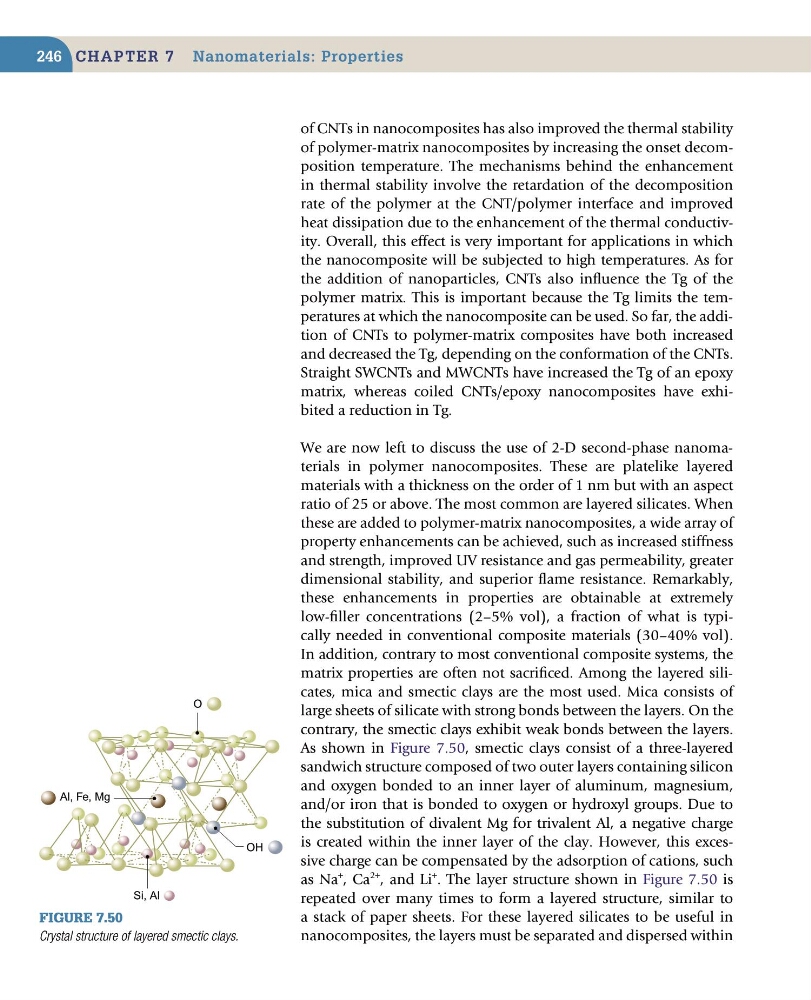
As shown in Figure 7.50, smectic clays consist of a three-layered
sandwich structure composed of two outer layers containing silicon
and oxygen bonded to an inner layer of aluminum, magnesium,
and/or iron that is bonded to oxygen or hydroxyl groups. Due to
the substitution of divalent Mg for trivalent Al, a negative charge
is created within the inner layer of the clay. However, this excessive charge can be compensated by the adsorption of cations, such
as Na
+ , Ca
2+ , and Li
+ . The layer structure shown in Figure 7.50 is
repeated over many times to form a layered structure, similar to
a stack of paper sheets. For these layered silicates to be useful in
nanocomposites, the layers must be separated and dispersed within
Figure 7.50
Crystal structure of layered smectic clays.
O
Al, Fe, Mg
Si, Al
OH
246
of CNTs in nanocomposites has also improved the thermal stability
of polymer-matrix nanocomposites by increasing the onset decomposition temperature. The mechanisms behind the enhancement
in thermal stability involve the retardation of the decomposition
rate of the polymer at the CNT/polymer interface and improved
heat dissipation due to the enhancement of the thermal conductivity. Overall, this effect is very important for applications in which
the nanocomposite will be subjected to high temperatures. As for
the addition of nanoparticles, CNTs also influence the Tg of the
polymer matrix. This is important because the Tg limits the temperatures at which the nanocomposite can be used. So far, the addition of CNTs to polymer-matrix composites have both increased
and decreased the Tg, depending on the conformation of the CNTs.
Straight SWCNTs and MWCNTs have increased the Tg of an epoxy
matrix, whereas coiled CNTs/epoxy nanocomposites have exhibited a reduction in Tg.
We are now left to discuss the use of 2-D second-phase nanomaterials in polymer nanocomposites. These are platelike layered
materials with a thickness on the order of 1 nm but with an aspect
ratio of 25 or above. The most common are layered silicates. When
these are added to polymer-matrix nanocomposites, a wide array of
property enhancements can be achieved, such as increased stiffness
and strength, improved UV resistance and gas permeability, greater
dimensional stability, and superior flame resistance. Remarkably,
these enhancements in properties are obtainable at extremely
low-filler concentrations (2–5% vol), a fraction of what is typically needed in conventional composite materials (30–40% vol).
In addition, contrary to most conventional composite systems, the
matrix properties are often not sacrificed. Among the layered silicates, mica and smectic clays are the most used. Mica consists of
large sheets of silicate with strong bonds between the layers. On the
contrary, the smectic clays exhibit weak bonds between the layers.
As shown in Figure 7.50, smectic clays consist of a three-layered
sandwich structure composed of two outer layers containing silicon
and oxygen bonded to an inner layer of aluminum, magnesium,
and/or iron that is bonded to oxygen or hydroxyl groups. Due to
the substitution of divalent Mg for trivalent Al, a negative charge
is created within the inner layer of the clay. However, this excessive charge can be compensated by the adsorption of cations, such
as Na
+ , Ca
2+ , and Li
+ . The layer structure shown in Figure 7.50 is
repeated over many times to form a layered structure, similar to
a stack of paper sheets. For these layered silicates to be useful in
nanocomposites, the layers must be separated and dispersed within
Figure 7.50
Crystal structure of layered smectic clays.
O
Al, Fe, Mg
Si, Al
OH