

chaPter 7 nanomaterials: Properties
206
nanolaminates
Nanolaminates are multilayers, alternating layers, usually of two
different materials. To be interesting, the layers have to be thin—in
practice, a thickness between a few atomic layers and a few tens
of nanometers. To build a nanolaminate of any thickness, then,
takes hundreds or thousands of layers. They are, however, relatively
easy to make by sequential evaporation from two separate sources
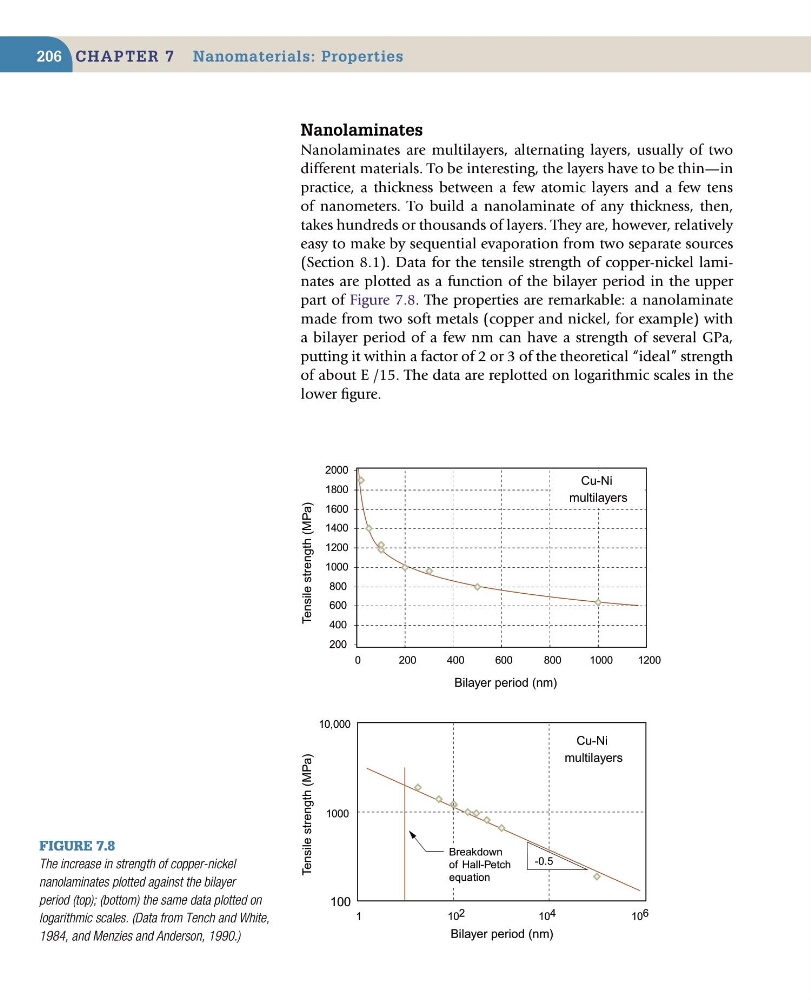
(Section 8.1). Data for the tensile strength of copper-nickel laminates are plotted as a function of the bilayer period in the upper
part of Figure 7.8. The properties are remarkable: a nanolaminate
made from two soft metals (copper and nickel, for example) with
a bilayer period of a few nm can have a strength of several GPa,
putting it within a factor of 2 or 3 of the theoretical “ideal” strength
of about E /15. The data are replotted on logarithmic scales in the
lower figure.
Figure 7.8
The increase in strength of copper-nickel
nanolaminates plotted against the bilayer
period (top); (bottom) the same data plotted on
logarithmic scales. (Data from Tench and White,
1984, and Menzies and Anderson, 1990.)
Bilayer period (nm)
Bilayer period (nm)
Tensile strength (MPa)
Tensile strength (MPa)
200
400
600
800
1000
1200
1400
1600
1800
2000
0
200
400
600
800
1000
1200
100
1000
10,000
1
10 2
10 4
10 6
-0.5
Cu-Ni
multilayers
Cu-Ni
multilayers
Breakdown
of Hall-Petch
equation
206
nanolaminates
Nanolaminates are multilayers, alternating layers, usually of two
different materials. To be interesting, the layers have to be thin—in
practice, a thickness between a few atomic layers and a few tens
of nanometers. To build a nanolaminate of any thickness, then,
takes hundreds or thousands of layers. They are, however, relatively
easy to make by sequential evaporation from two separate sources
(Section 8.1). Data for the tensile strength of copper-nickel laminates are plotted as a function of the bilayer period in the upper
part of Figure 7.8. The properties are remarkable: a nanolaminate
made from two soft metals (copper and nickel, for example) with
a bilayer period of a few nm can have a strength of several GPa,
putting it within a factor of 2 or 3 of the theoretical “ideal” strength
of about E /15. The data are replotted on logarithmic scales in the
lower figure.
Figure 7.8
The increase in strength of copper-nickel
nanolaminates plotted against the bilayer
period (top); (bottom) the same data plotted on
logarithmic scales. (Data from Tench and White,
1984, and Menzies and Anderson, 1990.)
Bilayer period (nm)
Bilayer period (nm)
Tensile strength (MPa)
Tensile strength (MPa)
200
400
600
800
1000
1200
1400
1600
1800
2000
0
200
400
600
800
1000
1200
100
1000
10,000
1
10 2
10 4
10 6
-0.5
Cu-Ni
multilayers
Cu-Ni
multilayers
Breakdown
of Hall-Petch
equation