

C hapter 6 nanomaterials: Classes and fundamentals
182
Since we now have several working models for the categorization of
2-D nanomaterials, let’s move on to 3-D nanomaterials. Following
our previous definition, bulk nanomaterials are materials that do
not have any dimension at the nanoscale. However, bulk nanomaterials still exhibit features at the nanoscale. As previously
dis cussed, bulk nanomaterials with dimensions larger than the
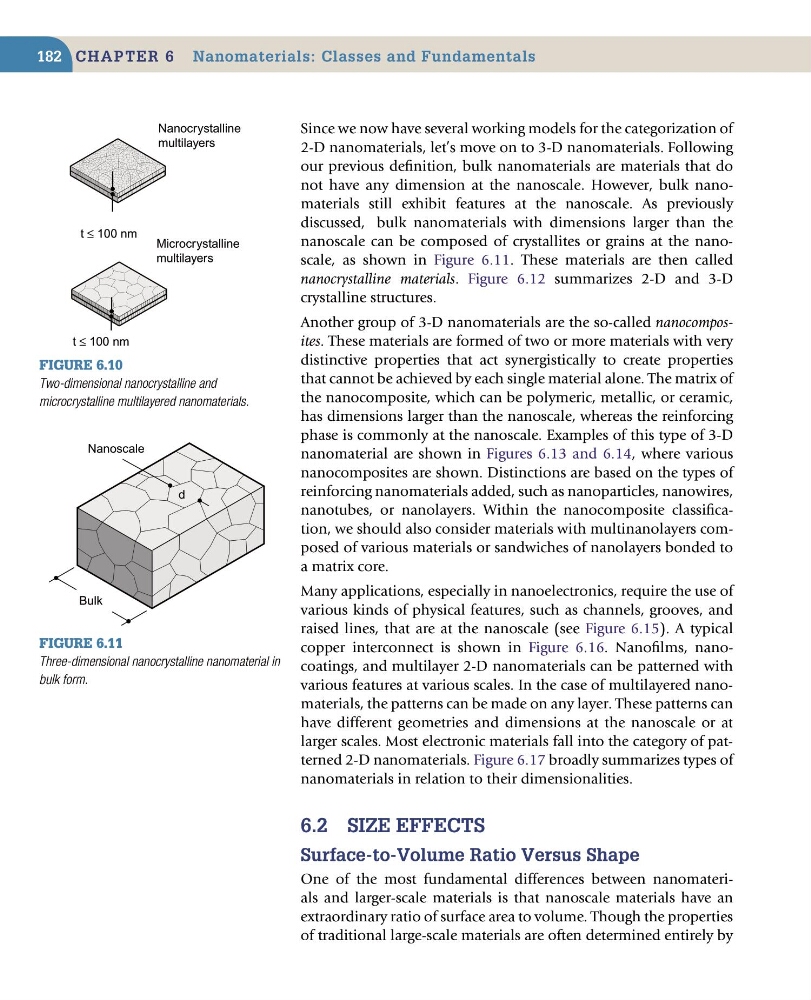
nano scale can be composed of crystallites or grains at the nanoscale, as shown in Figure 6.11. These materials are then called
nanocrystalline materials. Figure 6.12 summarizes 2-D and 3-D
crystalline structures.
Another group of 3-D nanomaterials are the so-called nanocomposites. These materials are formed of two or more materials with very
distinctive properties that act synergistically to create properties
that cannot be achieved by each single material alone. The matrix of
the nanocomposite, which can be polymeric, metallic, or ceramic,
has dimensions larger than the nanoscale, whereas the reinforcing
phase is commonly at the nanoscale. Examples of this type of 3-D
nanomaterial are shown in Figures 6.13 and 6.14, where various
nanocomposites are shown. Distinctions are based on the types of
reinforcing nanomaterials added, such as nanoparticles, nanowires,
nanotubes, or nanolayers. Within the nanocomposite classification, we should also consider materials with multinanolayers composed of various materials or sandwiches of nanolayers bonded to
a matrix core.
Many applications, especially in nanoelectronics, require the use of
various kinds of physical features, such as channels, grooves, and
raised lines, that are at the nanoscale (see Figure 6.15). A typical
copper interconnect is shown in Figure 6.16. Nanofilms, nanocoatings, and multilayer 2-D nanomaterials can be patterned with
various features at various scales. In the case of multilayered nanomaterials, the patterns can be made on any layer. These patterns can
have different geometries and dimensions at the nanoscale or at
larger scales. Most electronic materials fall into the category of patterned 2-D nanomaterials. Figure 6.17 broadly summarizes types of
nanomaterials in relation to their dimensionalities.
6.2 size effeCts
surface-to-Volume ratio Versus shape
One of the most fundamental differences between nanomaterials and larger-scale materials is that nanoscale materials have an
extraordinary ratio of surface area to volume. Though the properties
of traditional large-scale materials are often determined entirely by
Figure 6.10
Two-dimensional nanocrystalline and
microcrystalline multilayered nanomaterials.
Nanocrystalline
multilayers
t ≤ 100 nm
Microcrystalline
multilayers
t ≤ 100 nm
Figure 6.11
Three-dimensional nanocrystalline nanomaterial in
bulk form.
d
Bulk
Nanoscale
182
Since we now have several working models for the categorization of
2-D nanomaterials, let’s move on to 3-D nanomaterials. Following
our previous definition, bulk nanomaterials are materials that do
not have any dimension at the nanoscale. However, bulk nanomaterials still exhibit features at the nanoscale. As previously
dis cussed, bulk nanomaterials with dimensions larger than the
nano scale can be composed of crystallites or grains at the nanoscale, as shown in Figure 6.11. These materials are then called
nanocrystalline materials. Figure 6.12 summarizes 2-D and 3-D
crystalline structures.
Another group of 3-D nanomaterials are the so-called nanocomposites. These materials are formed of two or more materials with very
distinctive properties that act synergistically to create properties
that cannot be achieved by each single material alone. The matrix of
the nanocomposite, which can be polymeric, metallic, or ceramic,
has dimensions larger than the nanoscale, whereas the reinforcing
phase is commonly at the nanoscale. Examples of this type of 3-D
nanomaterial are shown in Figures 6.13 and 6.14, where various
nanocomposites are shown. Distinctions are based on the types of
reinforcing nanomaterials added, such as nanoparticles, nanowires,
nanotubes, or nanolayers. Within the nanocomposite classification, we should also consider materials with multinanolayers composed of various materials or sandwiches of nanolayers bonded to
a matrix core.
Many applications, especially in nanoelectronics, require the use of
various kinds of physical features, such as channels, grooves, and
raised lines, that are at the nanoscale (see Figure 6.15). A typical
copper interconnect is shown in Figure 6.16. Nanofilms, nanocoatings, and multilayer 2-D nanomaterials can be patterned with
various features at various scales. In the case of multilayered nanomaterials, the patterns can be made on any layer. These patterns can
have different geometries and dimensions at the nanoscale or at
larger scales. Most electronic materials fall into the category of patterned 2-D nanomaterials. Figure 6.17 broadly summarizes types of
nanomaterials in relation to their dimensionalities.
6.2 size effeCts
surface-to-Volume ratio Versus shape
One of the most fundamental differences between nanomaterials and larger-scale materials is that nanoscale materials have an
extraordinary ratio of surface area to volume. Though the properties
of traditional large-scale materials are often determined entirely by
Figure 6.10
Two-dimensional nanocrystalline and
microcrystalline multilayered nanomaterials.
Nanocrystalline
multilayers
t ≤ 100 nm
Microcrystalline
multilayers
t ≤ 100 nm
Figure 6.11
Three-dimensional nanocrystalline nanomaterial in
bulk form.
d
Bulk
Nanoscale