

171
Appendix: Material Indices
The performance, P, of a component is characterized by a performance equation. The performance equation contains groups of material properties. These groups are the material indices. Sometimes
the “group” is a single property; thus if the performance of a beam
is measured by its stiffness, the performance equation contains
only one property, the elastic modulus E. It is the material index
for this problem. More commonly the performance equation contains a group of two or more properties. Familiar examples are the
specific stiffness, E/ρ, and the specific strength, σ y /ρ (where σ y . is the
yield strength or elastic limit, and ρ is the density), but there are
many others. They are a key to the optimal selection of materials.
Details of the method, with numerous examples, are given in the
texts cited under Further Reading. This appendix compiles indices
for a range of common applications. The symbols used in the tables
are defined in the first of them. A simple example is shown here to
illustrate the general process used in determining an index for a
particular situation.
eXaMPle: DeterMination oF a
Material inDeX For a light,
strong tie roD
Minimizing Weight
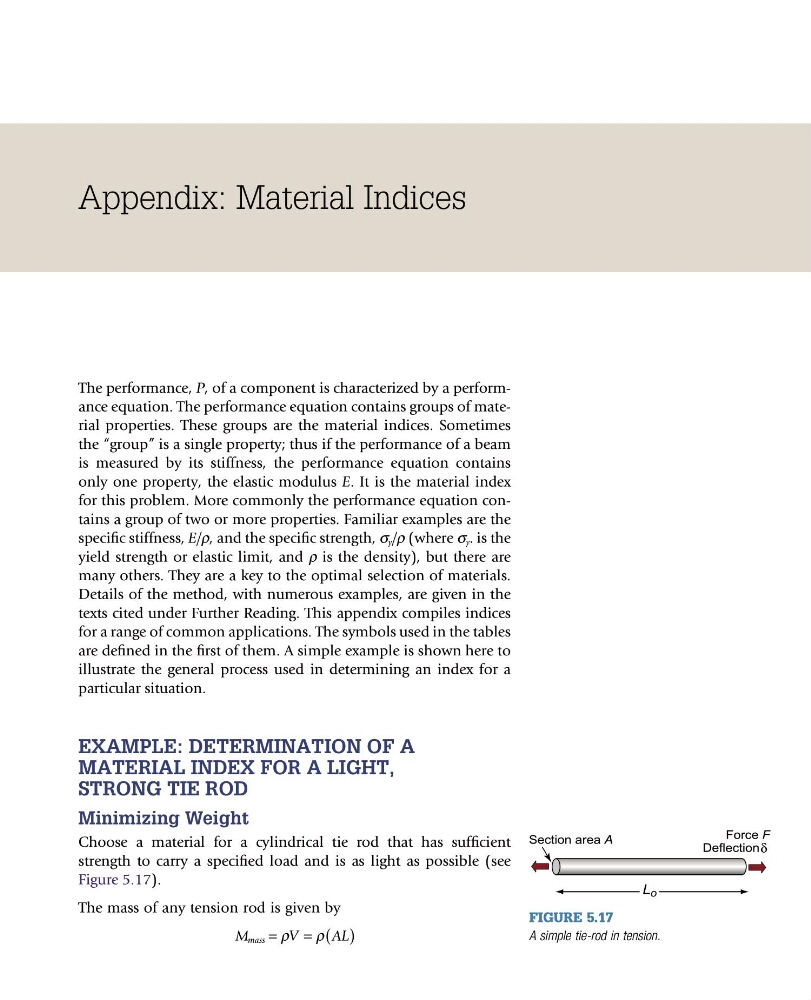
Choose a material for a cylindrical tie rod that has sufficient
strength to carry a specified load and is as light as possible (see
Figure 5.17).
The mass of any tension rod is given by
M
V
AL
mass =
= ( )
ρ
ρ
Figure 5.17
A simple tie-rod in tension.
Section area A
Force F
L o
δ
Deflection
Appendix: Material Indices
The performance, P, of a component is characterized by a performance equation. The performance equation contains groups of material properties. These groups are the material indices. Sometimes
the “group” is a single property; thus if the performance of a beam
is measured by its stiffness, the performance equation contains
only one property, the elastic modulus E. It is the material index
for this problem. More commonly the performance equation contains a group of two or more properties. Familiar examples are the
specific stiffness, E/ρ, and the specific strength, σ y /ρ (where σ y . is the
yield strength or elastic limit, and ρ is the density), but there are
many others. They are a key to the optimal selection of materials.
Details of the method, with numerous examples, are given in the
texts cited under Further Reading. This appendix compiles indices
for a range of common applications. The symbols used in the tables
are defined in the first of them. A simple example is shown here to
illustrate the general process used in determining an index for a
particular situation.
eXaMPle: DeterMination oF a
Material inDeX For a light,
strong tie roD
Minimizing Weight
Choose a material for a cylindrical tie rod that has sufficient
strength to carry a specified load and is as light as possible (see
Figure 5.17).
The mass of any tension rod is given by
M
V
AL
mass =
= ( )
ρ
ρ
Figure 5.17
A simple tie-rod in tension.
Section area A
Force F
L o
δ
Deflection