

7
and geometries produced. As for disadvantages, due to the inherent presence of polymers, soft lithography processes often exhibit
significant strains that are not ideal for certain applications, such as
nanoelectronics.
From the discussion so far, it is obvious that the top-down approach
is not a friendly, inexpensive, and rapid way of producing nanostructures. Therefore, a bottom-up approach needs to be considered.
The concept of the bottom-up approach is that one starts with
atoms or molecules, which build up to form larger structures. In
this context, there are three important enabling bottom-up technologies, namely (1) supramolecular and molecular chemistry, (2)
scanning probes, and (3) biotechnology. The supramolecular and
molecular chemistry route is based on the concept of selfassembly. This is a strategy for nanofabrication that involves
designing molecules so that they aggregate into desired structures.
The advantages of self-assembly are that (1) it solves the most
difficult steps in nanofabrication, which involve creating small
structures; (2) it can directly incorporate and bond biological
structures with inorganic structures to act as components in a
system, and (3) it produces structures that are relatively defect-free.
One of the best examples of self-assembly is the fabrication of
carbon nanotubes. These nanostructures are composed of C atoms
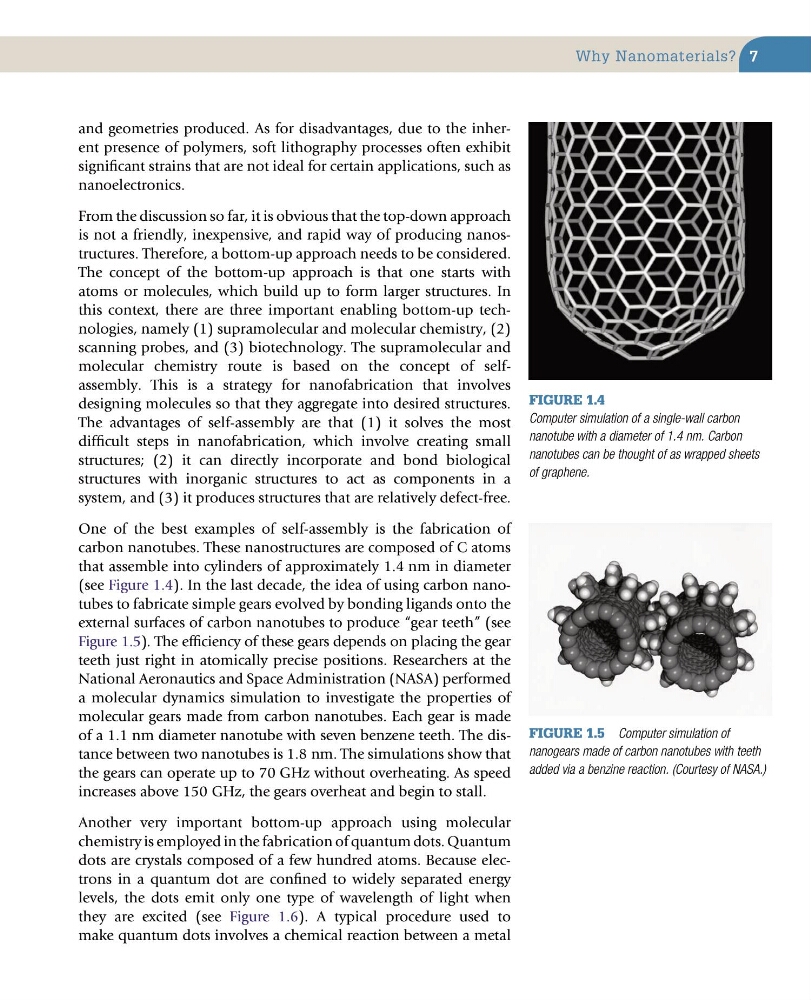
that assemble into cylinders of approximately 1.4 nm in diameter
(see Figure 1.4). In the last decade, the idea of using carbon nanotubes to fabricate simple gears evolved by bonding ligands onto the
external surfaces of carbon nanotubes to produce “gear teeth” (see
Figure 1.5). The efficiency of these gears depends on placing the gear
teeth just right in atomically precise positions. Researchers at the
National Aeronautics and Space Administration (NASA) performed
a molecular dynamics simulation to investigate the properties of
molecular gears made from carbon nanotubes. Each gear is made
of a 1.1 nm diameter nanotube with seven benzene teeth. The distance between two nanotubes is 1.8 nm. The simulations show that
the gears can operate up to 70 GHz without overheating. As speed
increases above 150 GHz, the gears overheat and begin to stall.
Another very important bottom-up approach using molecular
chemistry is employed in the fabrication of quantum dots. Quantum
dots are crystals composed of a few hundred atoms. Because electrons in a quantum dot are confined to widely separated energy
levels, the dots emit only one type of wavelength of light when
they are excited (see Figure 1.6). A typical procedure used to
make quantum dots involves a chemical reaction between a metal
Figure 1.4
Computer simulation of a single-wall carbon
nanotube with a diameter of 1.4 nm. Carbon
nanotubes can be thought of as wrapped sheets
of graphene.
Figure 1.5 Computer simulation of
nanogears made of carbon nanotubes with teeth
added via a benzine reaction. (Courtesy of NASA.)
Why Nanomaterials?
and geometries produced. As for disadvantages, due to the inherent presence of polymers, soft lithography processes often exhibit
significant strains that are not ideal for certain applications, such as
nanoelectronics.
From the discussion so far, it is obvious that the top-down approach
is not a friendly, inexpensive, and rapid way of producing nanostructures. Therefore, a bottom-up approach needs to be considered.
The concept of the bottom-up approach is that one starts with
atoms or molecules, which build up to form larger structures. In
this context, there are three important enabling bottom-up technologies, namely (1) supramolecular and molecular chemistry, (2)
scanning probes, and (3) biotechnology. The supramolecular and
molecular chemistry route is based on the concept of selfassembly. This is a strategy for nanofabrication that involves
designing molecules so that they aggregate into desired structures.
The advantages of self-assembly are that (1) it solves the most
difficult steps in nanofabrication, which involve creating small
structures; (2) it can directly incorporate and bond biological
structures with inorganic structures to act as components in a
system, and (3) it produces structures that are relatively defect-free.
One of the best examples of self-assembly is the fabrication of
carbon nanotubes. These nanostructures are composed of C atoms
that assemble into cylinders of approximately 1.4 nm in diameter
(see Figure 1.4). In the last decade, the idea of using carbon nanotubes to fabricate simple gears evolved by bonding ligands onto the
external surfaces of carbon nanotubes to produce “gear teeth” (see
Figure 1.5). The efficiency of these gears depends on placing the gear
teeth just right in atomically precise positions. Researchers at the
National Aeronautics and Space Administration (NASA) performed
a molecular dynamics simulation to investigate the properties of
molecular gears made from carbon nanotubes. Each gear is made
of a 1.1 nm diameter nanotube with seven benzene teeth. The distance between two nanotubes is 1.8 nm. The simulations show that
the gears can operate up to 70 GHz without overheating. As speed
increases above 150 GHz, the gears overheat and begin to stall.
Another very important bottom-up approach using molecular
chemistry is employed in the fabrication of quantum dots. Quantum
dots are crystals composed of a few hundred atoms. Because electrons in a quantum dot are confined to widely separated energy
levels, the dots emit only one type of wavelength of light when
they are excited (see Figure 1.6). A typical procedure used to
make quantum dots involves a chemical reaction between a metal
Figure 1.4
Computer simulation of a single-wall carbon
nanotube with a diameter of 1.4 nm. Carbon
nanotubes can be thought of as wrapped sheets
of graphene.
Figure 1.5 Computer simulation of
nanogears made of carbon nanotubes with teeth
added via a benzine reaction. (Courtesy of NASA.)
Why Nanomaterials?