

C hapter 4 Material Classes, structure, and properties
144
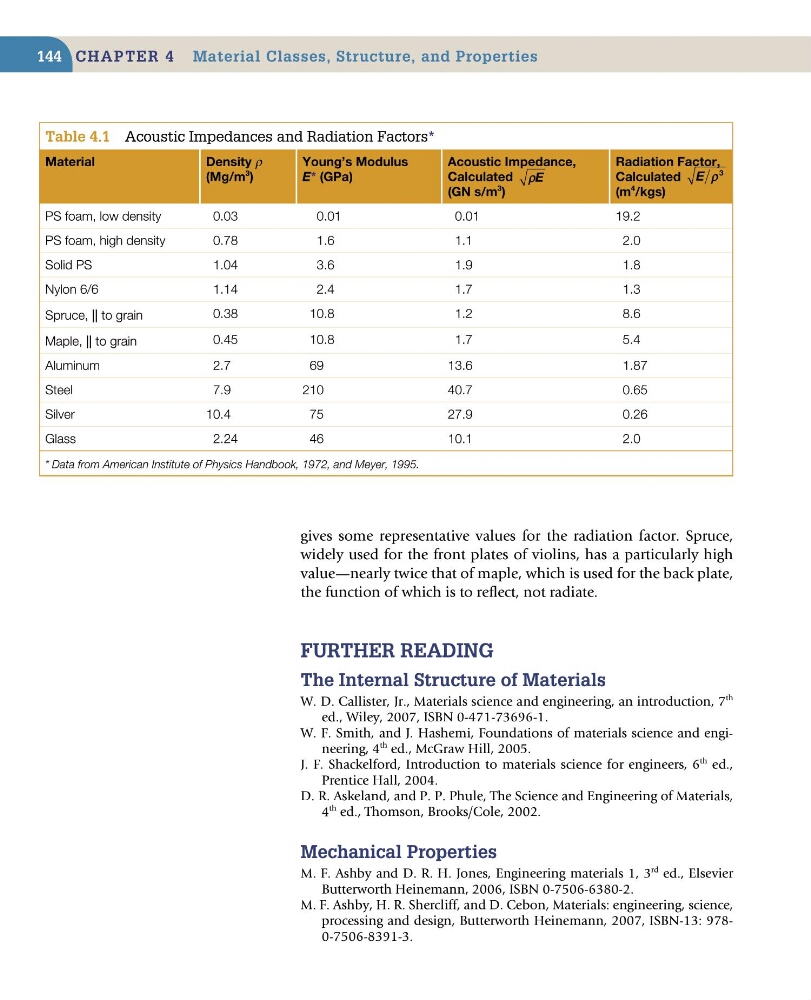
gives some representative values for the radiation factor. Spruce,
widely used for the front plates of violins, has a particularly high
value—nearly twice that of maple, which is used for the back plate,
the function of which is to reflect, not radiate.
further reaDiNg
the internal structure of Materials
W. D. Callister, Jr., Materials science and engineering, an introduction, 7
th
ed., Wiley, 2007, ISBN 0-471-73696-1.
W. F. Smith, and J. Hashemi, Foundations of materials science and engineering, 4
th ed., McGraw Hill, 2005.
J. F. Shackelford, Introduction to materials science for engineers, 6
th ed.,
Prentice Hall, 2004.
D. R. Askeland, and P. P. Phule, The Science and Engineering of Materials,
4
th ed., Thomson, Brooks/Cole, 2002.
Mechanical properties
M. F. Ashby and D. R. H. Jones, Engineering materials 1, 3
rd ed., Elsevier
Butterworth Heinemann, 2006, ISBN 0-7506-6380-2.
M. F. Ashby, H. R. Shercliff, and D. Cebon, Materials: engineering, science,
processing and design, Butterworth Heinemann, 2007, ISBN-13: 9780-7506-8391-3.
table 4.1 Acoustic Impedances and Radiation Factors*
Material
Density ρ
(Mg/m
3 )
Young’s Modulus
E* (GPa)
Acoustic Impedance,
Calculated rE
(GN s/m
3 )
Radiation Factor,
Calculated E r
3
(m
4 /kgs)
PS foam, low density
0.03
0.01
0.01
19.2
PS foam, high density
0.78
1.6
1.1
2.0
Solid PS
1.04
3.6
1.9
1.8
Nylon 6/6
1.14
2.4
1.7
1.3
Spruce, || to grain
0.38
10.8
1.2
8.6
Maple, || to grain
0.45
10.8
1.7
5.4
Aluminum
2.7
69
13.6
1.87
Steel
7.9
210
40.7
0.65
Silver
10.4
75
27.9
0.26
Glass
2.24
46
10.1
2.0
* Data from American Institute of Physics Handbook, 1972, and Meyer, 1995.
144
gives some representative values for the radiation factor. Spruce,
widely used for the front plates of violins, has a particularly high
value—nearly twice that of maple, which is used for the back plate,
the function of which is to reflect, not radiate.
further reaDiNg
the internal structure of Materials
W. D. Callister, Jr., Materials science and engineering, an introduction, 7
th
ed., Wiley, 2007, ISBN 0-471-73696-1.
W. F. Smith, and J. Hashemi, Foundations of materials science and engineering, 4
th ed., McGraw Hill, 2005.
J. F. Shackelford, Introduction to materials science for engineers, 6
th ed.,
Prentice Hall, 2004.
D. R. Askeland, and P. P. Phule, The Science and Engineering of Materials,
4
th ed., Thomson, Brooks/Cole, 2002.
Mechanical properties
M. F. Ashby and D. R. H. Jones, Engineering materials 1, 3
rd ed., Elsevier
Butterworth Heinemann, 2006, ISBN 0-7506-6380-2.
M. F. Ashby, H. R. Shercliff, and D. Cebon, Materials: engineering, science,
processing and design, Butterworth Heinemann, 2007, ISBN-13: 9780-7506-8391-3.
table 4.1 Acoustic Impedances and Radiation Factors*
Material
Density ρ
(Mg/m
3 )
Young’s Modulus
E* (GPa)
Acoustic Impedance,
Calculated rE
(GN s/m
3 )
Radiation Factor,
Calculated E r
3
(m
4 /kgs)
PS foam, low density
0.03
0.01
0.01
19.2
PS foam, high density
0.78
1.6
1.1
2.0
Solid PS
1.04
3.6
1.9
1.8
Nylon 6/6
1.14
2.4
1.7
1.3
Spruce, || to grain
0.38
10.8
1.2
8.6
Maple, || to grain
0.45
10.8
1.7
5.4
Aluminum
2.7
69
13.6
1.87
Steel
7.9
210
40.7
0.65
Silver
10.4
75
27.9
0.26
Glass
2.24
46
10.1
2.0
* Data from American Institute of Physics Handbook, 1972, and Meyer, 1995.