

C hapter 4 Material Classes, structure, and properties
138
well, so if exposed to white light they appear silver. Others—copper,
brass, bronze—reflect some colors better than others and appear
colored because, in penetrating this tiny distance into the surface,
some wavelengths are slightly absorbed.
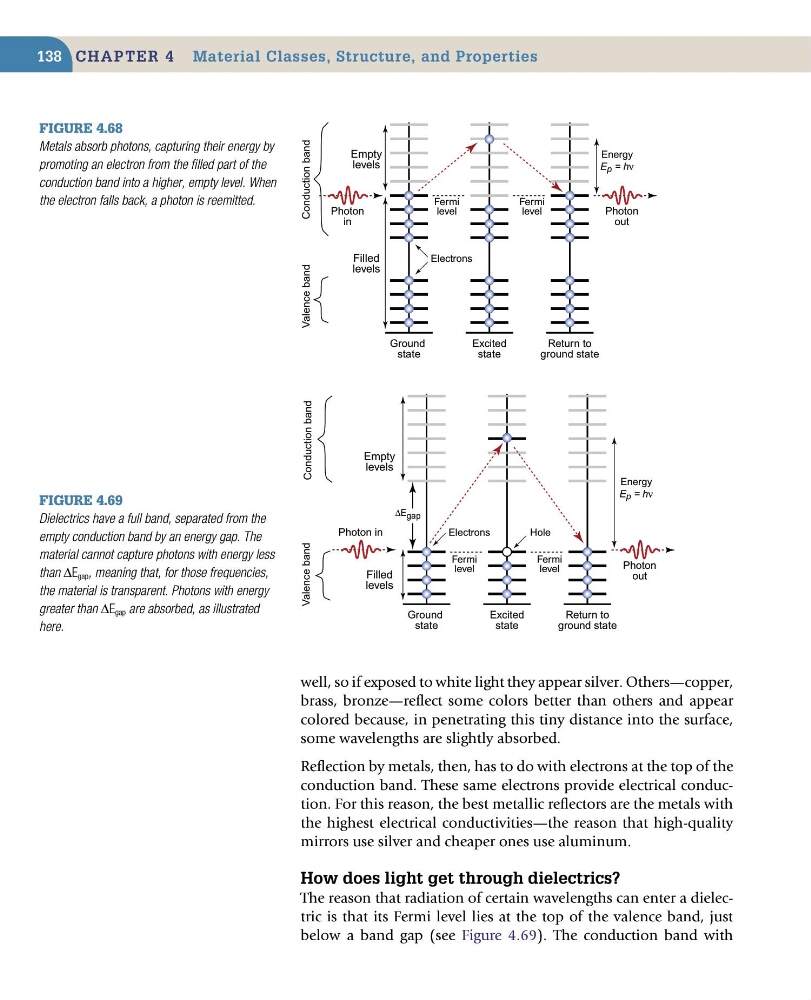
Reflection by metals, then, has to do with electrons at the top of the
conduction band. These same electrons provide electrical conduction. For this reason, the best metallic reflectors are the metals with
the highest electrical conductivities—the reason that high-quality
mirrors use silver and cheaper ones use aluminum.
how does light get through dielectrics?
The reason that radiation of certain wavelengths can enter a dielectric is that its Fermi level lies at the top of the valence band, just
below a band gap (see Figure 4.69). The conduction band with
Ground
state
Fermi
level
Fermi
level
Energy
E p = hν
Hole
Electrons
Filled
levels
Empty
levels
Photon in
Excited
state
Return to
ground state
Photon
out
∆E gap
Valence band
Conduction band
Figure 4.69
Dielectrics have a full band, separated from the
empty conduction band by an energy gap. The
material cannot capture photons with energy less
than ΔE gap , meaning that, for those frequencies,
the material is transparent. Photons with energy
greater than ΔE gap are absorbed, as illustrated
here.
Figure 4.68
Metals absorb photons, capturing their energy by
promoting an electron from the filled part of the
conduction band into a higher, empty level. When
the electron falls back, a photon is reemitted.
Ground
state
Fermi
level
Fermi
level
Energy
E p = hν
Electrons
Filled
levels
Empty
levels
Photon
in
Excited
state
Return to
ground state
Photon
out
Valence band
Conduction band
138
well, so if exposed to white light they appear silver. Others—copper,
brass, bronze—reflect some colors better than others and appear
colored because, in penetrating this tiny distance into the surface,
some wavelengths are slightly absorbed.
Reflection by metals, then, has to do with electrons at the top of the
conduction band. These same electrons provide electrical conduction. For this reason, the best metallic reflectors are the metals with
the highest electrical conductivities—the reason that high-quality
mirrors use silver and cheaper ones use aluminum.
how does light get through dielectrics?
The reason that radiation of certain wavelengths can enter a dielectric is that its Fermi level lies at the top of the valence band, just
below a band gap (see Figure 4.69). The conduction band with
Ground
state
Fermi
level
Fermi
level
Energy
E p = hν
Hole
Electrons
Filled
levels
Empty
levels
Photon in
Excited
state
Return to
ground state
Photon
out
∆E gap
Valence band
Conduction band
Figure 4.69
Dielectrics have a full band, separated from the
empty conduction band by an energy gap. The
material cannot capture photons with energy less
than ΔE gap , meaning that, for those frequencies,
the material is transparent. Photons with energy
greater than ΔE gap are absorbed, as illustrated
here.
Figure 4.68
Metals absorb photons, capturing their energy by
promoting an electron from the filled part of the
conduction band into a higher, empty level. When
the electron falls back, a photon is reemitted.
Ground
state
Fermi
level
Fermi
level
Energy
E p = hν
Electrons
Filled
levels
Empty
levels
Photon
in
Excited
state
Return to
ground state
Photon
out
Valence band
Conduction band