

The Internal Structure of Materials 95
degree of ductility because when the metal is bent, the electrons
can easily rearrange their position, and thus bonds do not need to
broken.
We are now left to discuss another type of chemical bonding, called
Van der Waals bonding or secondary bonding. These are weak bonds
that are typically electrostatic attractions. They arise from atomic or
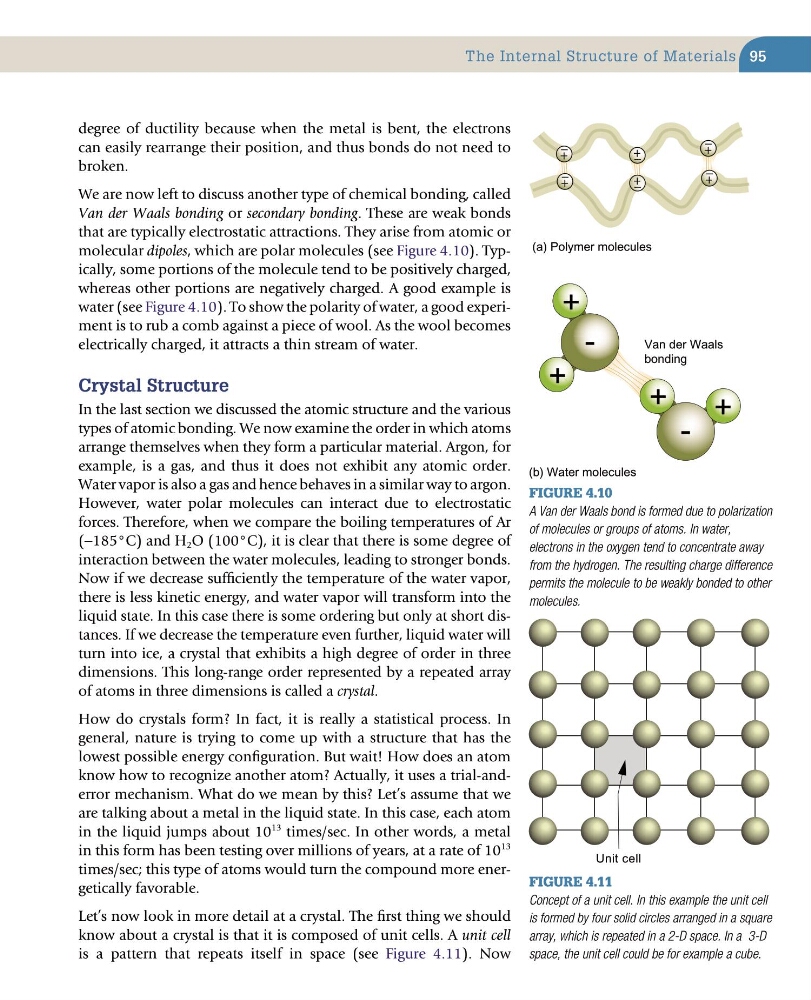
molecular dipoles, which are polar molecules (see Figure 4.10). Typically, some portions of the molecule tend to be positively charged,
whereas other portions are negatively charged. A good example is
water (see Figure 4.10). To show the polarity of water, a good experiment is to rub a comb against a piece of wool. As the wool becomes
electrically charged, it attracts a thin stream of water.
Crystal structure
In the last section we discussed the atomic structure and the various
types of atomic bonding. We now examine the order in which atoms
arrange themselves when they form a particular material. Argon, for
example, is a gas, and thus it does not exhibit any atomic order.
Water vapor is also a gas and hence behaves in a similar way to argon.
However, water polar molecules can interact due to electrostatic
forces. Therefore, when we compare the boiling temperatures of Ar
(−185°C) and H 2 O (100°C), it is clear that there is some degree of
interaction between the water molecules, leading to stronger bonds.
Now if we decrease sufficiently the temperature of the water vapor,
there is less kinetic energy, and water vapor will transform into the
liquid state. In this case there is some ordering but only at short distances. If we decrease the temperature even further, liquid water will
turn into ice, a crystal that exhibits a high degree of order in three
dimensions. This long-range order represented by a repeated array
of atoms in three dimensions is called a crystal.
How do crystals form? In fact, it is really a statistical process. In
general, nature is trying to come up with a structure that has the
lowest possible energy configuration. But wait! How does an atom
know how to recognize another atom? Actually, it uses a trial-anderror mechanism. What do we mean by this? Let’s assume that we
are talking about a metal in the liquid state. In this case, each atom
in the liquid jumps about 10
13 times/sec. In other words, a metal
in this form has been testing over millions of years, at a rate of 10
13
times/sec; this type of atoms would turn the compound more energetically favorable.
Let’s now look in more detail at a crystal. The first thing we should
know about a crystal is that it is composed of unit cells. A unit cell
is a pattern that repeats itself in space (see Figure 4.11). Now
Figure 4.10
A Van der Waals bond is formed due to polarization
of molecules or groups of atoms. In water,
electrons in the oxygen tend to concentrate away
from the hydrogen. The resulting charge difference
permits the molecule to be weakly bonded to other
molecules.
+
-
-
+
+
+
(a) Polymer molecules
(b) Water molecules
Van der Waals
bonding
Figure 4.11
Concept of a unit cell. In this example the unit cell
is formed by four solid circles arranged in a square
array, which is repeated in a 2-D space. In a 3-D
space, the unit cell could be for example a cube.
Unit cell
degree of ductility because when the metal is bent, the electrons
can easily rearrange their position, and thus bonds do not need to
broken.
We are now left to discuss another type of chemical bonding, called
Van der Waals bonding or secondary bonding. These are weak bonds
that are typically electrostatic attractions. They arise from atomic or
molecular dipoles, which are polar molecules (see Figure 4.10). Typically, some portions of the molecule tend to be positively charged,
whereas other portions are negatively charged. A good example is
water (see Figure 4.10). To show the polarity of water, a good experiment is to rub a comb against a piece of wool. As the wool becomes
electrically charged, it attracts a thin stream of water.
Crystal structure
In the last section we discussed the atomic structure and the various
types of atomic bonding. We now examine the order in which atoms
arrange themselves when they form a particular material. Argon, for
example, is a gas, and thus it does not exhibit any atomic order.
Water vapor is also a gas and hence behaves in a similar way to argon.
However, water polar molecules can interact due to electrostatic
forces. Therefore, when we compare the boiling temperatures of Ar
(−185°C) and H 2 O (100°C), it is clear that there is some degree of
interaction between the water molecules, leading to stronger bonds.
Now if we decrease sufficiently the temperature of the water vapor,
there is less kinetic energy, and water vapor will transform into the
liquid state. In this case there is some ordering but only at short distances. If we decrease the temperature even further, liquid water will
turn into ice, a crystal that exhibits a high degree of order in three
dimensions. This long-range order represented by a repeated array
of atoms in three dimensions is called a crystal.
How do crystals form? In fact, it is really a statistical process. In
general, nature is trying to come up with a structure that has the
lowest possible energy configuration. But wait! How does an atom
know how to recognize another atom? Actually, it uses a trial-anderror mechanism. What do we mean by this? Let’s assume that we
are talking about a metal in the liquid state. In this case, each atom
in the liquid jumps about 10
13 times/sec. In other words, a metal
in this form has been testing over millions of years, at a rate of 10
13
times/sec; this type of atoms would turn the compound more energetically favorable.
Let’s now look in more detail at a crystal. The first thing we should
know about a crystal is that it is composed of unit cells. A unit cell
is a pattern that repeats itself in space (see Figure 4.11). Now
Figure 4.10
A Van der Waals bond is formed due to polarization
of molecules or groups of atoms. In water,
electrons in the oxygen tend to concentrate away
from the hydrogen. The resulting charge difference
permits the molecule to be weakly bonded to other
molecules.
+
-
-
+
+
+
(a) Polymer molecules
(b) Water molecules
Van der Waals
bonding
Figure 4.11
Concept of a unit cell. In this example the unit cell
is formed by four solid circles arranged in a square
array, which is repeated in a 2-D space. In a 3-D
space, the unit cell could be for example a cube.
Unit cell