

having a substantial spin density at the central P atom. Thus, the carbonylation of a
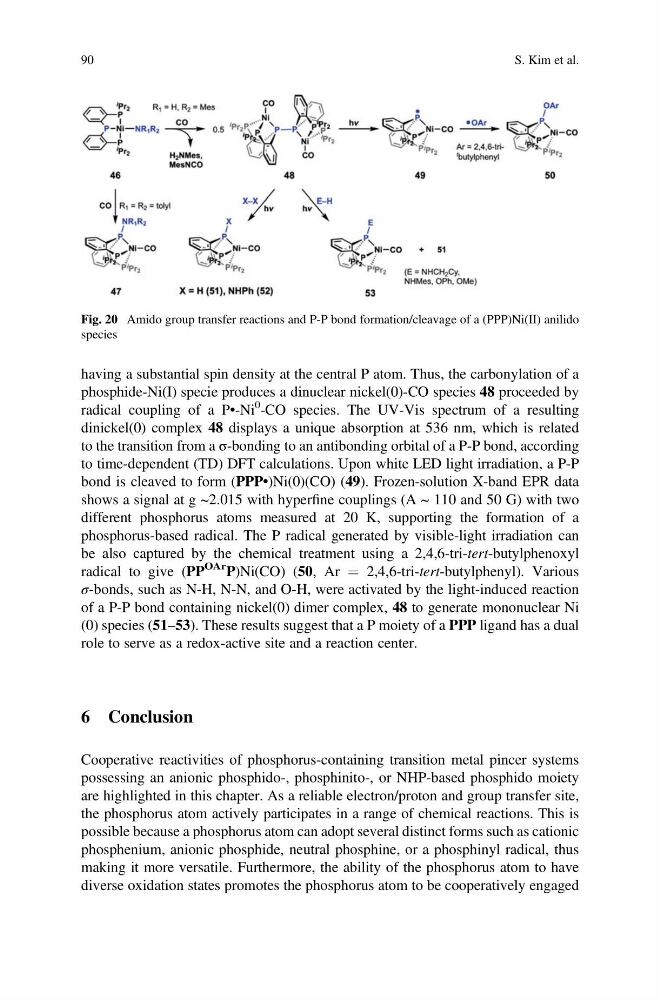
phosphide-Ni(I) specie produces a dinuclear nickel(0)-CO species 48 proceeded by
radical coupling of a P•-Ni
0 -CO species. The UV-Vis spectrum of a resulting
dinickel(0) complex 48 displays a unique absorption at 536 nm, which is related
to the transition from a σ-bonding to an antibonding orbital of a P-P bond, according
to time-dependent (TD) DFT calculations. Upon white LED light irradiation, a P-P
bond is cleaved to form (PPP•)Ni(0)(CO) (49). Frozen-solution X-band EPR data
shows a signal at g ~2.015 with hyperfine couplings (A ~ 110 and 50 G) with two
different phosphorus atoms measured at 20 K, supporting the formation of a
phosphorus-based radical. The P radical generated by visible-light irradiation can
be also captured by the chemical treatment using a 2,4,6-tri-tert-butylphenoxyl
radical to give (PP
OAr P)Ni(CO) (50, Ar ¼ 2,4,6-tri-tert-butylphenyl). Various
σ-bonds, such as N-H, N-N, and O-H, were activated by the light-induced reaction
of a P-P bond containing nickel(0) dimer complex, 48 to generate mononuclear Ni
(0) species (51–53). These results suggest that a P moiety of a PPP ligand has a dual
role to serve as a redox-active site and a reaction center.
6 Conclusion
Cooperative reactivities of phosphorus-containing transition metal pincer systems
possessing an anionic phosphido-, phosphinito-, or NHP-based phosphido moiety
are highlighted in this chapter. As a reliable electron/proton and group transfer site,
the phosphorus atom actively participates in a range of chemical reactions. This is
possible because a phosphorus atom can adopt several distinct forms such as cationic
phosphenium, anionic phosphide, neutral phosphine, or a phosphinyl radical, thus
making it more versatile. Furthermore, the ability of the phosphorus atom to have
diverse oxidation states promotes the phosphorus atom to be cooperatively engaged
Fig. 20 Amido group transfer reactions and P-P bond formation/cleavage of a (PPP)Ni(II) anilido
species
90
S. Kim et al.
phosphide-Ni(I) specie produces a dinuclear nickel(0)-CO species 48 proceeded by
radical coupling of a P•-Ni
0 -CO species. The UV-Vis spectrum of a resulting
dinickel(0) complex 48 displays a unique absorption at 536 nm, which is related
to the transition from a σ-bonding to an antibonding orbital of a P-P bond, according
to time-dependent (TD) DFT calculations. Upon white LED light irradiation, a P-P
bond is cleaved to form (PPP•)Ni(0)(CO) (49). Frozen-solution X-band EPR data
shows a signal at g ~2.015 with hyperfine couplings (A ~ 110 and 50 G) with two
different phosphorus atoms measured at 20 K, supporting the formation of a
phosphorus-based radical. The P radical generated by visible-light irradiation can
be also captured by the chemical treatment using a 2,4,6-tri-tert-butylphenoxyl
radical to give (PP
OAr P)Ni(CO) (50, Ar ¼ 2,4,6-tri-tert-butylphenyl). Various
σ-bonds, such as N-H, N-N, and O-H, were activated by the light-induced reaction
of a P-P bond containing nickel(0) dimer complex, 48 to generate mononuclear Ni
(0) species (51–53). These results suggest that a P moiety of a PPP ligand has a dual
role to serve as a redox-active site and a reaction center.
6 Conclusion
Cooperative reactivities of phosphorus-containing transition metal pincer systems
possessing an anionic phosphido-, phosphinito-, or NHP-based phosphido moiety
are highlighted in this chapter. As a reliable electron/proton and group transfer site,
the phosphorus atom actively participates in a range of chemical reactions. This is
possible because a phosphorus atom can adopt several distinct forms such as cationic
phosphenium, anionic phosphide, neutral phosphine, or a phosphinyl radical, thus
making it more versatile. Furthermore, the ability of the phosphorus atom to have
diverse oxidation states promotes the phosphorus atom to be cooperatively engaged
Fig. 20 Amido group transfer reactions and P-P bond formation/cleavage of a (PPP)Ni(II) anilido
species
90
S. Kim et al.