

phosphinite moiety was transferred to the carbon atom of CO 2 to give a Ni(II)methylcarbonate species (PPP)Ni(OC(O)OMe) (41). This reaction leads to the
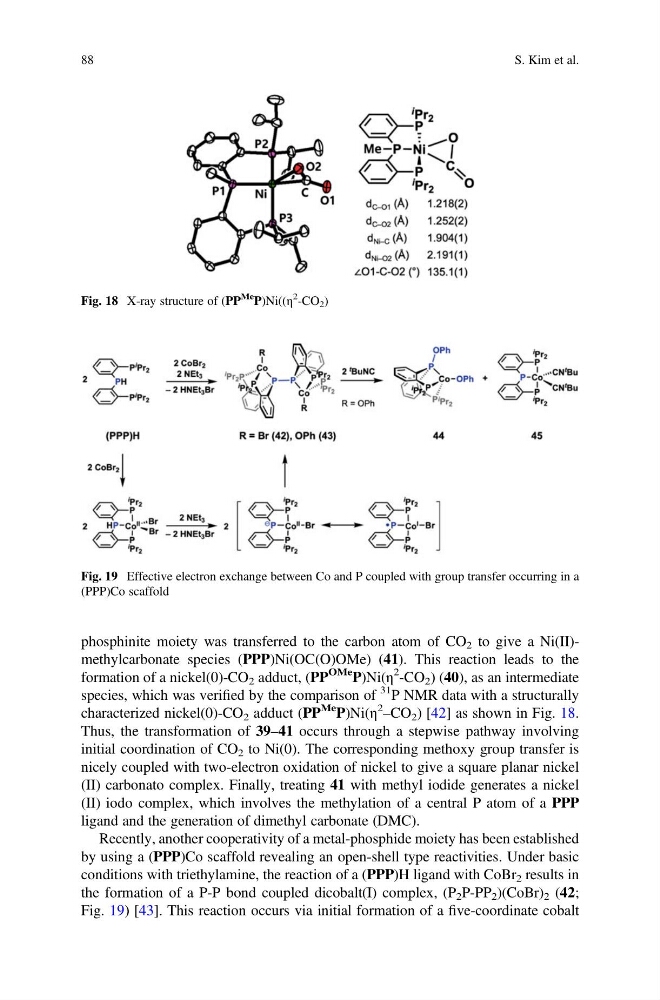
formation of a nickel(0)-CO 2 adduct, (PP
OMe P)Ni(η
2 -CO 2 ) (40), as an intermediate
species, which was verified by the comparison of
31 P NMR data with a structurally
characterized nickel(0)-CO 2 adduct (PP
Me P)Ni(η
2
–CO 2 ) [42] as shown in Fig. 18.
Thus, the transformation of 39–41 occurs through a stepwise pathway involving
initial coordination of CO 2 to Ni(0). The corresponding methoxy group transfer is
nicely coupled with two-electron oxidation of nickel to give a square planar nickel
(II) carbonato complex. Finally, treating 41 with methyl iodide generates a nickel
(II) iodo complex, which involves the methylation of a central P atom of a PPP
ligand and the generation of dimethyl carbonate (DMC).
Recently, another cooperativity of a metal-phosphide moiety has been established
by using a (PPP)Co scaffold revealing an open-shell type reactivities. Under basic
conditions with triethylamine, the reaction of a (PPP)H ligand with CoBr 2 results in
the formation of a P-P bond coupled dicobalt(I) complex, (P 2 P-PP 2 )(CoBr) 2 (42;
Fig. 19) [43]. This reaction occurs via initial formation of a five-coordinate cobalt
Fig. 18 X-ray structure of (PP
Me P)Ni((η
2
-CO 2 )
Fig. 19 Effective electron exchange between Co and P coupled with group transfer occurring in a
(PPP)Co scaffold
88
S. Kim et al.
formation of a nickel(0)-CO 2 adduct, (PP
OMe P)Ni(η
2 -CO 2 ) (40), as an intermediate
species, which was verified by the comparison of
31 P NMR data with a structurally
characterized nickel(0)-CO 2 adduct (PP
Me P)Ni(η
2
–CO 2 ) [42] as shown in Fig. 18.
Thus, the transformation of 39–41 occurs through a stepwise pathway involving
initial coordination of CO 2 to Ni(0). The corresponding methoxy group transfer is
nicely coupled with two-electron oxidation of nickel to give a square planar nickel
(II) carbonato complex. Finally, treating 41 with methyl iodide generates a nickel
(II) iodo complex, which involves the methylation of a central P atom of a PPP
ligand and the generation of dimethyl carbonate (DMC).
Recently, another cooperativity of a metal-phosphide moiety has been established
by using a (PPP)Co scaffold revealing an open-shell type reactivities. Under basic
conditions with triethylamine, the reaction of a (PPP)H ligand with CoBr 2 results in
the formation of a P-P bond coupled dicobalt(I) complex, (P 2 P-PP 2 )(CoBr) 2 (42;
Fig. 19) [43]. This reaction occurs via initial formation of a five-coordinate cobalt
Fig. 18 X-ray structure of (PP
Me P)Ni((η
2
-CO 2 )
Fig. 19 Effective electron exchange between Co and P coupled with group transfer occurring in a
(PPP)Co scaffold
88
S. Kim et al.