

to generate reactive species by cooperative cleavage of element-hydrogen bonds
using the L3Ni
0 (PPh 3 ) or related acceptor pincer systems.
Apart from the presently discussed example, metal-ligand cooperative systems
employing a π-acceptor imine pincer ligand are scarce. This is likely due to the
propensity of imine ligands to form η
1 (N) complexes, requiring subtle ligand design.
As mentioned before, side-on coordinated ketone motifs can be synthesized in the
coordination sphere of a transition metal by formal oxygen atom transfer processes
to a carbene complex. Similar reactivity was observed by Piers and co-workers who
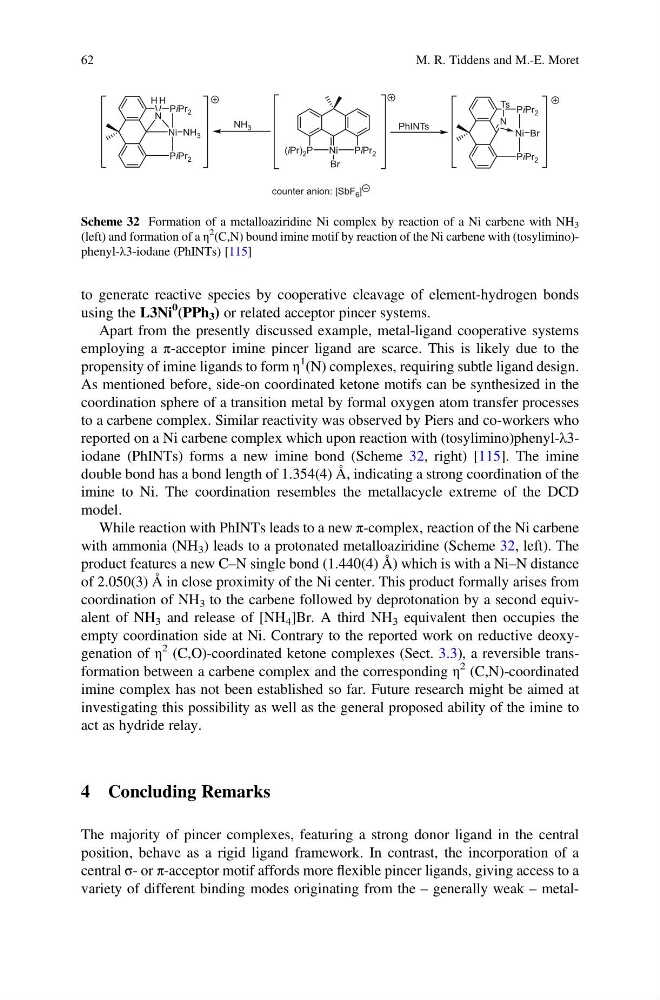
reported on a Ni carbene complex which upon reaction with (tosylimino)phenyl-λ3iodane (PhINTs) forms a new imine bond (Scheme 32, right) [115]. The imine
double bond has a bond length of 1.354(4) Å, indicating a strong coordination of the
imine to Ni. The coordination resembles the metallacycle extreme of the DCD
model.
While reaction with PhINTs leads to a new π-complex, reaction of the Ni carbene
with ammonia (NH 3 ) leads to a protonated metalloaziridine (Scheme 32, left). The
product features a new C–N single bond (1.440(4) Å) which is with a Ni–N distance
of 2.050(3) Å in close proximity of the Ni center. This product formally arises from
coordination of NH 3 to the carbene followed by deprotonation by a second equivalent of NH 3 and release of [NH 4 ]Br. A third NH 3 equivalent then occupies the
empty coordination side at Ni. Contrary to the reported work on reductive deoxygenation of η
2 (C,O)-coordinated ketone complexes (Sect. 3.3), a reversible transformation between a carbene complex and the corresponding η
2 (C,N)-coordinated
imine complex has not been established so far. Future research might be aimed at
investigating this possibility as well as the general proposed ability of the imine to
act as hydride relay.
4 Concluding Remarks
The majority of pincer complexes, featuring a strong donor ligand in the central
position, behave as a rigid ligand framework. In contrast, the incorporation of a
central σ- or π-acceptor motif affords more flexible pincer ligands, giving access to a
variety of different binding modes originating from the – generally weak – metalNi
(iPr) 2 P
PiPr 2
Br
PhINTs
Ni
PiPr 2
PiPr 2
Br
N
Ts
Ni
PiPr 2
PiPr 2
NH 3
N
H
NH 3
counter anion: [SbF 6 ]
H
Scheme 32 Formation of a metalloaziridine Ni complex by reaction of a Ni carbene with NH 3
(left) and formation of a η
2
(C,N) bound imine motif by reaction of the Ni carbene with (tosylimino)phenyl-λ3-iodane (PhINTs) [115]
62
M. R. Tiddens and M.-E. Moret
using the L3Ni
0 (PPh 3 ) or related acceptor pincer systems.
Apart from the presently discussed example, metal-ligand cooperative systems
employing a π-acceptor imine pincer ligand are scarce. This is likely due to the
propensity of imine ligands to form η
1 (N) complexes, requiring subtle ligand design.
As mentioned before, side-on coordinated ketone motifs can be synthesized in the
coordination sphere of a transition metal by formal oxygen atom transfer processes
to a carbene complex. Similar reactivity was observed by Piers and co-workers who
reported on a Ni carbene complex which upon reaction with (tosylimino)phenyl-λ3iodane (PhINTs) forms a new imine bond (Scheme 32, right) [115]. The imine
double bond has a bond length of 1.354(4) Å, indicating a strong coordination of the
imine to Ni. The coordination resembles the metallacycle extreme of the DCD
model.
While reaction with PhINTs leads to a new π-complex, reaction of the Ni carbene
with ammonia (NH 3 ) leads to a protonated metalloaziridine (Scheme 32, left). The
product features a new C–N single bond (1.440(4) Å) which is with a Ni–N distance
of 2.050(3) Å in close proximity of the Ni center. This product formally arises from
coordination of NH 3 to the carbene followed by deprotonation by a second equivalent of NH 3 and release of [NH 4 ]Br. A third NH 3 equivalent then occupies the
empty coordination side at Ni. Contrary to the reported work on reductive deoxygenation of η
2 (C,O)-coordinated ketone complexes (Sect. 3.3), a reversible transformation between a carbene complex and the corresponding η
2 (C,N)-coordinated
imine complex has not been established so far. Future research might be aimed at
investigating this possibility as well as the general proposed ability of the imine to
act as hydride relay.
4 Concluding Remarks
The majority of pincer complexes, featuring a strong donor ligand in the central
position, behave as a rigid ligand framework. In contrast, the incorporation of a
central σ- or π-acceptor motif affords more flexible pincer ligands, giving access to a
variety of different binding modes originating from the – generally weak – metalNi
(iPr) 2 P
PiPr 2
Br
PhINTs
Ni
PiPr 2
PiPr 2
Br
N
Ts
Ni
PiPr 2
PiPr 2
NH 3
N
H
NH 3
counter anion: [SbF 6 ]
H
Scheme 32 Formation of a metalloaziridine Ni complex by reaction of a Ni carbene with NH 3
(left) and formation of a η
2
(C,N) bound imine motif by reaction of the Ni carbene with (tosylimino)phenyl-λ3-iodane (PhINTs) [115]
62
M. R. Tiddens and M.-E. Moret