

catalytic activity than those containing bpy-type ligands. Most of these catalysts
containing halogen ligands had a catalytic induction period, except for I
À ligand.
This indicated that these catalysts generally needed to form real catalytic active
species through halogen-water exchange, so that the formation of OÀO bonds can be
easily catalyzed by a higher valent state which comes from multi-step PCET on the
metal centers. However, the ruthenium compounds with iodine coordination can
achieve an unexpectedly high initial rate of oxygen evolution in the initial catalysis
without the induction period. This indicates that the exchange of water molecules
with halogens was not an essential process. Prior to this, Sun group had used
photocatalytic methods to drive the catalysts O69–70 to catalyze water oxidation
[217]. The study found that compared with chemical oxidation, there is no induction
period for oxygen generation under photocatalytic conditions. The possible reason is
that there is an ultrafast ligand exchange under photo-induced conditions.
In order to distinguish the effects of electronic and hydrogen bonds, Llobet and
coworkers developed ruthenium complexes O91–92 (Fig. 39) containing fluorinesubstituted bpy ligands [218], in which a hydrogen bond formed between fluorine
atom and hydrogen from H 2 O existed in the single crystal structure of compound
O92. By cyclic voltammetry, the redox potential of Ru
III/II in complex O92 becomes
higher compared with catalyst O32 which has not been replaced by fluorine, whereas
the potential of Ru
IV/III decreases. So that the two redox potentials are coupled
together to show a two-electron Ru
IV/II process. In the oxygen evolution experiment,
catalyst O92 containing intramolecular hydrogen bond had a lower TON than
catalyst O91, which may be due to the presence of intramolecular hydrogen bond
inhibiting the key PECT process in the catalytic process. Then Grotjahn and
coworkers studied the catalytic performance of ruthenium compounds O93–95
(Fig. 39) containing bpy ligand modified by electronic pendant as a catalyst for
water oxidation [219]. Using Ce
IV as oxidant, compound O95 exhibited higher TON
and TOF than compounds O93–94. This may be due to the formation of intramolecular hydrogen bonds between ÀOMe and water ligands, which can promote the
rotation of catalytic cycles by filling the empty site left by oxygen release.
Besides pincer ligands of tpy and its derivatives have been widely used in the
design of catalysts for water oxidation, pincer-type ligands containing carboxyl
group and their analogues have also been widely used. Coordination between
ionic ligands with negative charges and metal centers can greatly reduce the redox
potential of metal center, thus using photosensitizers to oxidize metals to reach a
high-valent, further realizing the conversion of solar energy to chemical energy. This
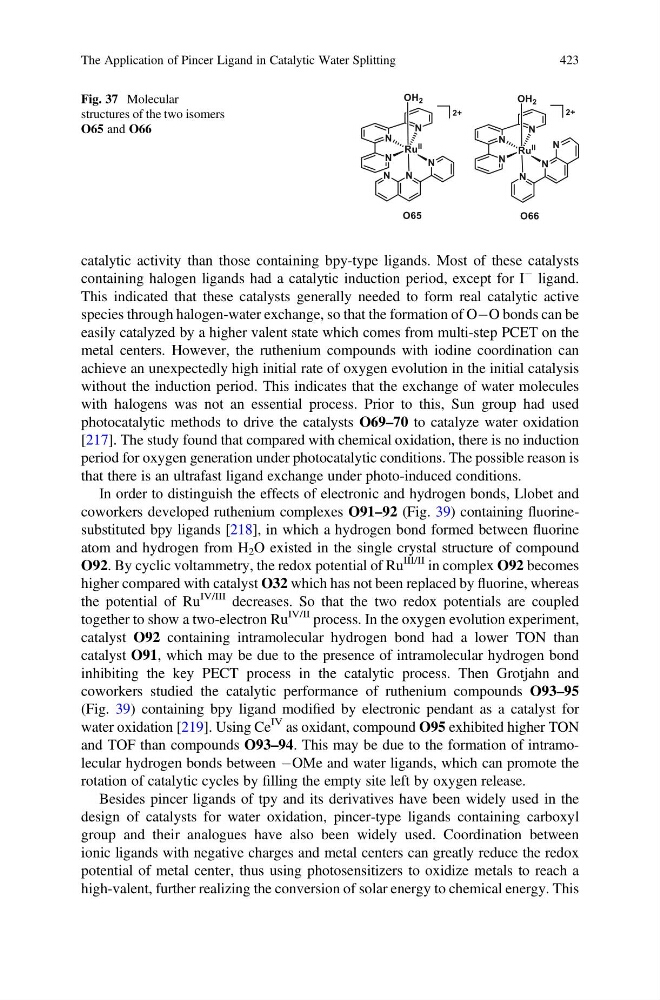
Fig. 37 Molecular
structures of the two isomers
O65 and O66
The Application of Pincer Ligand in Catalytic Water Splitting
423
containing halogen ligands had a catalytic induction period, except for I
À ligand.
This indicated that these catalysts generally needed to form real catalytic active
species through halogen-water exchange, so that the formation of OÀO bonds can be
easily catalyzed by a higher valent state which comes from multi-step PCET on the
metal centers. However, the ruthenium compounds with iodine coordination can
achieve an unexpectedly high initial rate of oxygen evolution in the initial catalysis
without the induction period. This indicates that the exchange of water molecules
with halogens was not an essential process. Prior to this, Sun group had used
photocatalytic methods to drive the catalysts O69–70 to catalyze water oxidation
[217]. The study found that compared with chemical oxidation, there is no induction
period for oxygen generation under photocatalytic conditions. The possible reason is
that there is an ultrafast ligand exchange under photo-induced conditions.
In order to distinguish the effects of electronic and hydrogen bonds, Llobet and
coworkers developed ruthenium complexes O91–92 (Fig. 39) containing fluorinesubstituted bpy ligands [218], in which a hydrogen bond formed between fluorine
atom and hydrogen from H 2 O existed in the single crystal structure of compound
O92. By cyclic voltammetry, the redox potential of Ru
III/II in complex O92 becomes
higher compared with catalyst O32 which has not been replaced by fluorine, whereas
the potential of Ru
IV/III decreases. So that the two redox potentials are coupled
together to show a two-electron Ru
IV/II process. In the oxygen evolution experiment,
catalyst O92 containing intramolecular hydrogen bond had a lower TON than
catalyst O91, which may be due to the presence of intramolecular hydrogen bond
inhibiting the key PECT process in the catalytic process. Then Grotjahn and
coworkers studied the catalytic performance of ruthenium compounds O93–95
(Fig. 39) containing bpy ligand modified by electronic pendant as a catalyst for
water oxidation [219]. Using Ce
IV as oxidant, compound O95 exhibited higher TON
and TOF than compounds O93–94. This may be due to the formation of intramolecular hydrogen bonds between ÀOMe and water ligands, which can promote the
rotation of catalytic cycles by filling the empty site left by oxygen release.
Besides pincer ligands of tpy and its derivatives have been widely used in the
design of catalysts for water oxidation, pincer-type ligands containing carboxyl
group and their analogues have also been widely used. Coordination between
ionic ligands with negative charges and metal centers can greatly reduce the redox
potential of metal center, thus using photosensitizers to oxidize metals to reach a
high-valent, further realizing the conversion of solar energy to chemical energy. This
Fig. 37 Molecular
structures of the two isomers
O65 and O66
The Application of Pincer Ligand in Catalytic Water Splitting
423