

prerequisites of these sacrificial oxidants is that they have higher oxidation potential
than WOC, which makes the oxidation of H 2 O thermodynamically advantageous. At
present, there are three methods to drive catalysts to catalyze water oxidation:
chemical oxidation, photocatalytic oxidation, and electrocatalytic water oxidation.
In chemical oxidation, Ce
IV with 1.74 V vs NHE redox potential is commonly used
as a sacrificial oxidant, but it usually needs acidic conditions [74, 75]. In the lightdriven catalytic process, the corresponding Ru
3+ species produced by commonly [Ru
(bpy) 3 ]
2+ -based photosensitizers excited by photo are employed as oxidants
[76]. The advantages of this system are that this series photosensitizers have orderly
different oxidation potentials. Choosing the right oxidizer as needed can effectively
avoid over-oxidation of catalysts. The method of electrocatalytic water oxidation
provides reliable information support for the study of catalytic kinetics and
mechanism.
For catalytic reaction, the precondition of designing more efficient and perfect
catalysts is the mechanism research. Recognition of every elementary reaction and
key step in catalytic process facilitates the transformation of better catalysts. The
formation of OÀO bond as a key step in catalytic water oxidation needs further
understanding. Although the verification of the mechanism is difficult to fully
discuss with the experimental results, after decades of development, two widely
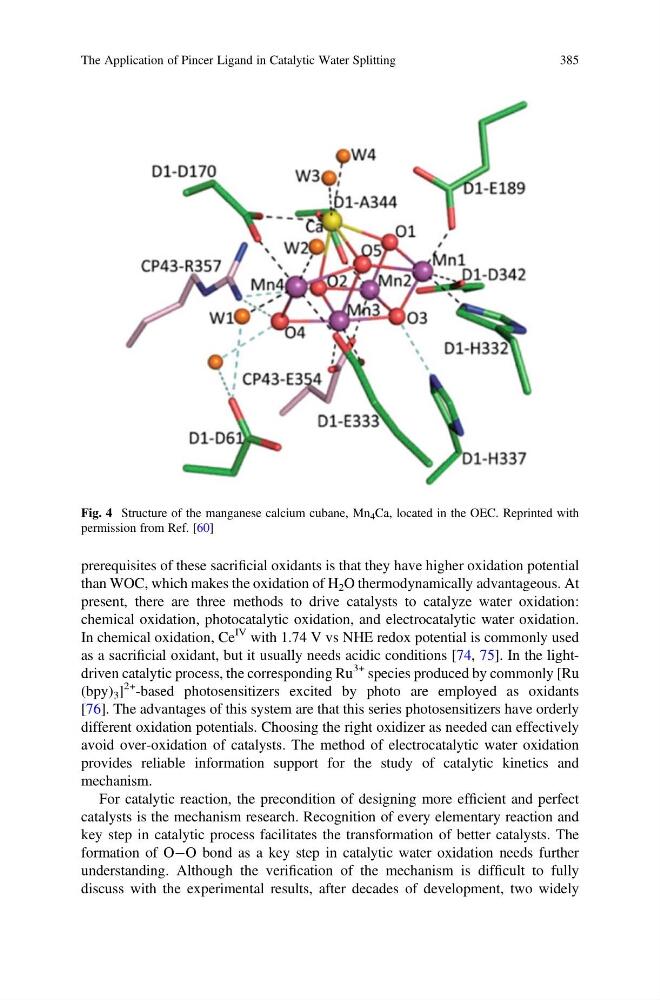
Fig. 4 Structure of the manganese calcium cubane, Mn 4 Ca, located in the OEC. Reprinted with
permission from Ref. [60]
The Application of Pincer Ligand in Catalytic Water Splitting
385
than WOC, which makes the oxidation of H 2 O thermodynamically advantageous. At
present, there are three methods to drive catalysts to catalyze water oxidation:
chemical oxidation, photocatalytic oxidation, and electrocatalytic water oxidation.
In chemical oxidation, Ce
IV with 1.74 V vs NHE redox potential is commonly used
as a sacrificial oxidant, but it usually needs acidic conditions [74, 75]. In the lightdriven catalytic process, the corresponding Ru
3+ species produced by commonly [Ru
(bpy) 3 ]
2+ -based photosensitizers excited by photo are employed as oxidants
[76]. The advantages of this system are that this series photosensitizers have orderly
different oxidation potentials. Choosing the right oxidizer as needed can effectively
avoid over-oxidation of catalysts. The method of electrocatalytic water oxidation
provides reliable information support for the study of catalytic kinetics and
mechanism.
For catalytic reaction, the precondition of designing more efficient and perfect
catalysts is the mechanism research. Recognition of every elementary reaction and
key step in catalytic process facilitates the transformation of better catalysts. The
formation of OÀO bond as a key step in catalytic water oxidation needs further
understanding. Although the verification of the mechanism is difficult to fully
discuss with the experimental results, after decades of development, two widely
Fig. 4 Structure of the manganese calcium cubane, Mn 4 Ca, located in the OEC. Reprinted with
permission from Ref. [60]
The Application of Pincer Ligand in Catalytic Water Splitting
385