

reactivity based on metal-ligand cooperativity (MLC) was reported by de Vries,
Otten and co-workers [87]. Using the dearomatised Ru PNN pincer complex 46,
which was developed by Milstein and co-workers, they examined the oxa-Michael
reaction of α,β-unsaturated nitriles at room temperature in THF. A broad substrate
range was investigated, and the product β-alkoxy-nitriles were obtained in moderate
to excellent yields. Nitriles investigated included acrylonitrile, crotonitrile, 2- and
3-pentenenitrile and the ester containing 10-cyanodec-9-en-1-yl acetate. No
transesterification occurred in the latter substrate. As nucleophiles, primary and
secondary aliphatic alcohols, benzyl alcohols and thiols were used. In a later
publication, the nitrile scope was further extended to more challenging structures
containing β-substituents such as CF 3 , p-CF 3 C 6 H 4 and cyclopentyl. Here the products were obtained in moderate to good yields [88]. Unfortunately, phenols
deactivated the catalyst by strongly binding to the ruthenium. Aza-Michael reactions
were extremely slow and yields below 50% of the products were obtained
(Table 16).
Based on the crystal structure of the dieneamido complex formed from
3-pentenenitrile and 46 (Scheme 46, complex II) as well as on DFT calculations,
they proposed a mechanism (shown here for 2-pentenenitrile) involving (i) the
activation of the C N bond via metal-ligand cooperation resulting in addition of
the nitrile across the ruthenium metal and the carbon atom of the deprotonated side
arm leading to the formation of I in fast equilibrium with II; (b) hydrogen bondassisted 1,4-addition (III ! IV); (c) proton transfer (IV!V); and (d) release of the
product and regeneration of the catalyst (it is the tautomeric form 46-taut that is the
active catalyst).
Milstein and co-workers used manganese PNN pincer complex 47 for the oxaand aza-Michael reaction for which they assumed the same mechanism as proposed
by Otten and de Vries [89]. This catalyst is rather active, which allowed the use of a
low catalyst loading of 0.1 mol% (compared to 0.5 mol% of the ruthenium catalyst
46) to achieve a similar rate in the oxa-Michael reaction. Interestingly, in contrast to
the ruthenium catalyst, the aza-Michael addition also worked very well under the
same conditions, with an even higher rate than the oxa-Michael reaction. Thus, in the
presence of
n BuOH (1 mL) and
n BuNH 2 (1 mL), catalyst 47 selectively promoted the
aza-Michael addition (Scheme 47).
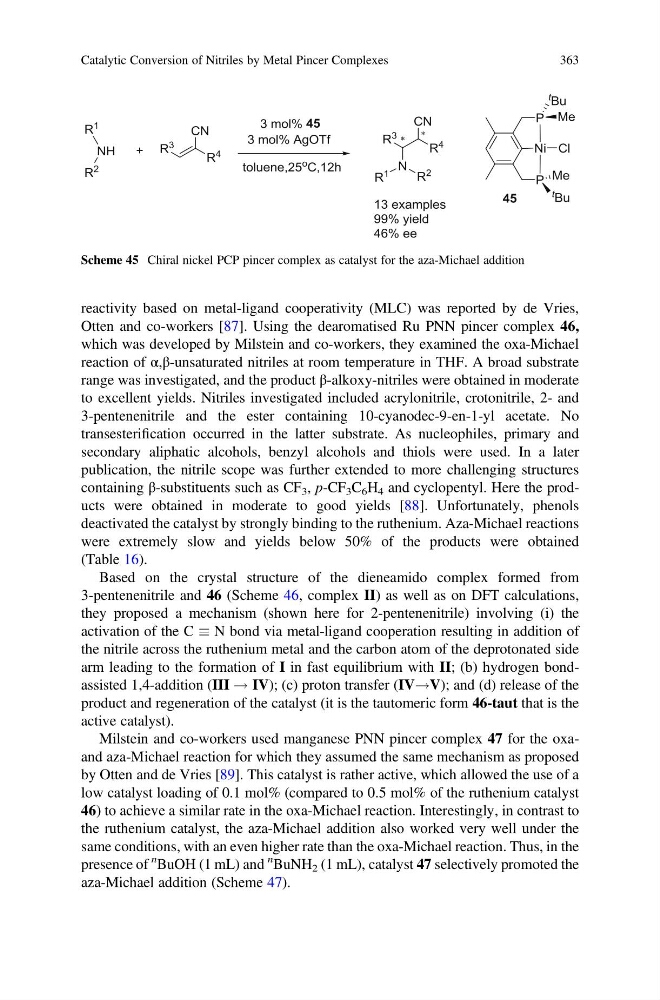
Scheme 45 Chiral nickel PCP pincer complex as catalyst for the aza-Michael addition
Catalytic Conversion of Nitriles by Metal Pincer Complexes
363
Otten and co-workers [87]. Using the dearomatised Ru PNN pincer complex 46,
which was developed by Milstein and co-workers, they examined the oxa-Michael
reaction of α,β-unsaturated nitriles at room temperature in THF. A broad substrate
range was investigated, and the product β-alkoxy-nitriles were obtained in moderate
to excellent yields. Nitriles investigated included acrylonitrile, crotonitrile, 2- and
3-pentenenitrile and the ester containing 10-cyanodec-9-en-1-yl acetate. No
transesterification occurred in the latter substrate. As nucleophiles, primary and
secondary aliphatic alcohols, benzyl alcohols and thiols were used. In a later
publication, the nitrile scope was further extended to more challenging structures
containing β-substituents such as CF 3 , p-CF 3 C 6 H 4 and cyclopentyl. Here the products were obtained in moderate to good yields [88]. Unfortunately, phenols
deactivated the catalyst by strongly binding to the ruthenium. Aza-Michael reactions
were extremely slow and yields below 50% of the products were obtained
(Table 16).
Based on the crystal structure of the dieneamido complex formed from
3-pentenenitrile and 46 (Scheme 46, complex II) as well as on DFT calculations,
they proposed a mechanism (shown here for 2-pentenenitrile) involving (i) the
activation of the C N bond via metal-ligand cooperation resulting in addition of
the nitrile across the ruthenium metal and the carbon atom of the deprotonated side
arm leading to the formation of I in fast equilibrium with II; (b) hydrogen bondassisted 1,4-addition (III ! IV); (c) proton transfer (IV!V); and (d) release of the
product and regeneration of the catalyst (it is the tautomeric form 46-taut that is the
active catalyst).
Milstein and co-workers used manganese PNN pincer complex 47 for the oxaand aza-Michael reaction for which they assumed the same mechanism as proposed
by Otten and de Vries [89]. This catalyst is rather active, which allowed the use of a
low catalyst loading of 0.1 mol% (compared to 0.5 mol% of the ruthenium catalyst
46) to achieve a similar rate in the oxa-Michael reaction. Interestingly, in contrast to
the ruthenium catalyst, the aza-Michael addition also worked very well under the
same conditions, with an even higher rate than the oxa-Michael reaction. Thus, in the
presence of
n BuOH (1 mL) and
n BuNH 2 (1 mL), catalyst 47 selectively promoted the
aza-Michael addition (Scheme 47).
Scheme 45 Chiral nickel PCP pincer complex as catalyst for the aza-Michael addition
Catalytic Conversion of Nitriles by Metal Pincer Complexes
363