

3.8 Alkylation of Nitriles and Sulfonamide
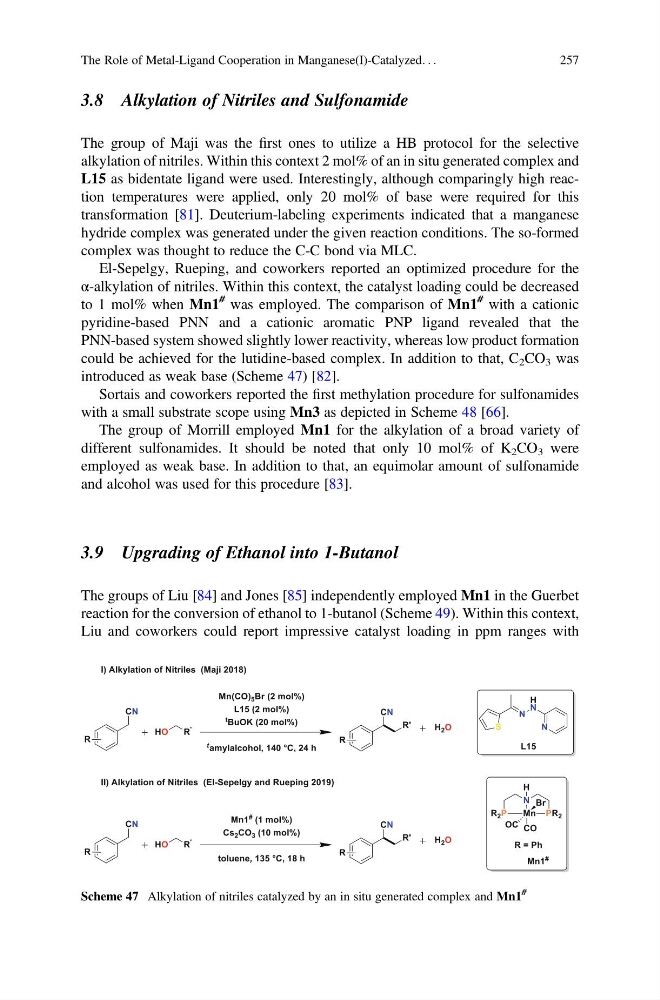
The group of Maji was the first ones to utilize a HB protocol for the selective
alkylation of nitriles. Within this context 2 mol% of an in situ generated complex and
L15 as bidentate ligand were used. Interestingly, although comparingly high reaction temperatures were applied, only 20 mol% of base were required for this
transformation [81]. Deuterium-labeling experiments indicated that a manganese
hydride complex was generated under the given reaction conditions. The so-formed
complex was thought to reduce the C-C bond via MLC.
El-Sepelgy, Rueping, and coworkers reported an optimized procedure for the
α-alkylation of nitriles. Within this context, the catalyst loading could be decreased
to 1 mol% when Mn1
# was employed. The comparison of Mn1
# with a cationic
pyridine-based PNN and a cationic aromatic PNP ligand revealed that the
PNN-based system showed slightly lower reactivity, whereas low product formation
could be achieved for the lutidine-based complex. In addition to that, C 2 CO 3 was
introduced as weak base (Scheme 47) [82].
Sortais and coworkers reported the first methylation procedure for sulfonamides
with a small substrate scope using Mn3 as depicted in Scheme 48 [66].
The group of Morrill employed Mn1 for the alkylation of a broad variety of
different sulfonamides. It should be noted that only 10 mol% of K 2 CO 3 were
employed as weak base. In addition to that, an equimolar amount of sulfonamide
and alcohol was used for this procedure [83].
3.9 Upgrading of Ethanol into 1-Butanol
The groups of Liu [84] and Jones [85] independently employed Mn1 in the Guerbet
reaction for the conversion of ethanol to 1-butanol (Scheme 49). Within this context,
Liu and coworkers could report impressive catalyst loading in ppm ranges with
Scheme 47 Alkylation of nitriles catalyzed by an in situ generated complex and Mn1
#
The Role of Metal-Ligand Cooperation in Manganese(I)-Catalyzed. . .
257
The group of Maji was the first ones to utilize a HB protocol for the selective
alkylation of nitriles. Within this context 2 mol% of an in situ generated complex and
L15 as bidentate ligand were used. Interestingly, although comparingly high reaction temperatures were applied, only 20 mol% of base were required for this
transformation [81]. Deuterium-labeling experiments indicated that a manganese
hydride complex was generated under the given reaction conditions. The so-formed
complex was thought to reduce the C-C bond via MLC.
El-Sepelgy, Rueping, and coworkers reported an optimized procedure for the
α-alkylation of nitriles. Within this context, the catalyst loading could be decreased
to 1 mol% when Mn1
# was employed. The comparison of Mn1
# with a cationic
pyridine-based PNN and a cationic aromatic PNP ligand revealed that the
PNN-based system showed slightly lower reactivity, whereas low product formation
could be achieved for the lutidine-based complex. In addition to that, C 2 CO 3 was
introduced as weak base (Scheme 47) [82].
Sortais and coworkers reported the first methylation procedure for sulfonamides
with a small substrate scope using Mn3 as depicted in Scheme 48 [66].
The group of Morrill employed Mn1 for the alkylation of a broad variety of
different sulfonamides. It should be noted that only 10 mol% of K 2 CO 3 were
employed as weak base. In addition to that, an equimolar amount of sulfonamide
and alcohol was used for this procedure [83].
3.9 Upgrading of Ethanol into 1-Butanol
The groups of Liu [84] and Jones [85] independently employed Mn1 in the Guerbet
reaction for the conversion of ethanol to 1-butanol (Scheme 49). Within this context,
Liu and coworkers could report impressive catalyst loading in ppm ranges with
Scheme 47 Alkylation of nitriles catalyzed by an in situ generated complex and Mn1
#
The Role of Metal-Ligand Cooperation in Manganese(I)-Catalyzed. . .
257