

3.4 Synthesis and Derivatization of Heterocycles
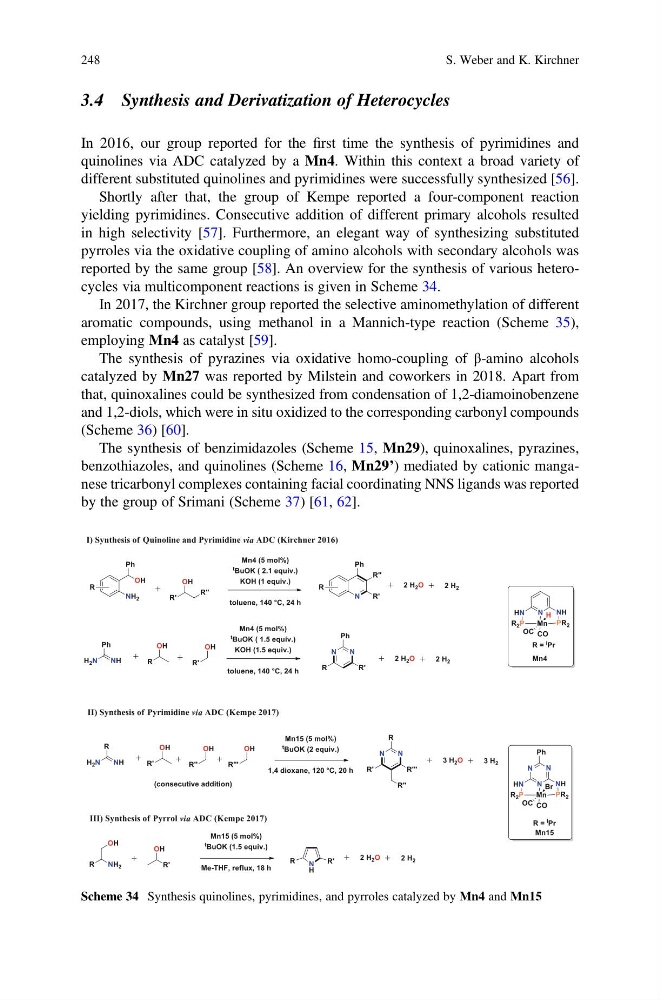
In 2016, our group reported for the first time the synthesis of pyrimidines and
quinolines via ADC catalyzed by a Mn4. Within this context a broad variety of
different substituted quinolines and pyrimidines were successfully synthesized [56].
Shortly after that, the group of Kempe reported a four-component reaction
yielding pyrimidines. Consecutive addition of different primary alcohols resulted
in high selectivity [57]. Furthermore, an elegant way of synthesizing substituted
pyrroles via the oxidative coupling of amino alcohols with secondary alcohols was
reported by the same group [58]. An overview for the synthesis of various heterocycles via multicomponent reactions is given in Scheme 34.
In 2017, the Kirchner group reported the selective aminomethylation of different
aromatic compounds, using methanol in a Mannich-type reaction (Scheme 35),
employing Mn4 as catalyst [59].
The synthesis of pyrazines via oxidative homo-coupling of β-amino alcohols
catalyzed by Mn27 was reported by Milstein and coworkers in 2018. Apart from
that, quinoxalines could be synthesized from condensation of 1,2-diamoinobenzene
and 1,2-diols, which were in situ oxidized to the corresponding carbonyl compounds
(Scheme 36) [60].
The synthesis of benzimidazoles (Scheme 15, Mn29), quinoxalines, pyrazines,
benzothiazoles, and quinolines (Scheme 16, Mn29’) mediated by cationic manganese tricarbonyl complexes containing facial coordinating NNS ligands was reported
by the group of Srimani (Scheme 37) [61, 62].
Scheme 34 Synthesis quinolines, pyrimidines, and pyrroles catalyzed by Mn4 and Mn15
248
S. Weber and K. Kirchner
In 2016, our group reported for the first time the synthesis of pyrimidines and
quinolines via ADC catalyzed by a Mn4. Within this context a broad variety of
different substituted quinolines and pyrimidines were successfully synthesized [56].
Shortly after that, the group of Kempe reported a four-component reaction
yielding pyrimidines. Consecutive addition of different primary alcohols resulted
in high selectivity [57]. Furthermore, an elegant way of synthesizing substituted
pyrroles via the oxidative coupling of amino alcohols with secondary alcohols was
reported by the same group [58]. An overview for the synthesis of various heterocycles via multicomponent reactions is given in Scheme 34.
In 2017, the Kirchner group reported the selective aminomethylation of different
aromatic compounds, using methanol in a Mannich-type reaction (Scheme 35),
employing Mn4 as catalyst [59].
The synthesis of pyrazines via oxidative homo-coupling of β-amino alcohols
catalyzed by Mn27 was reported by Milstein and coworkers in 2018. Apart from
that, quinoxalines could be synthesized from condensation of 1,2-diamoinobenzene
and 1,2-diols, which were in situ oxidized to the corresponding carbonyl compounds
(Scheme 36) [60].
The synthesis of benzimidazoles (Scheme 15, Mn29), quinoxalines, pyrazines,
benzothiazoles, and quinolines (Scheme 16, Mn29’) mediated by cationic manganese tricarbonyl complexes containing facial coordinating NNS ligands was reported
by the group of Srimani (Scheme 37) [61, 62].
Scheme 34 Synthesis quinolines, pyrimidines, and pyrroles catalyzed by Mn4 and Mn15
248
S. Weber and K. Kirchner