

containing a hydride ligand was employed. Mn26 showed interesting behavior upon
heating. In contradiction to many other pincer-based systems, the benzyl carbon was
deprotonated, rather than the NH functionality, forming a tetradentate ligand. Investigation of this species revealed lower catalytic activity in comparison to Mn26
[47]. With the help of DFT calculations, a typical MLC mode via a fivefold
coordinated amido intermediate was suggested for the N-formylation of amines
with methanol. The proposed reaction mechanism included the oxidation of methanol to formaldehyde, formation of a hemiacetal, and finally oxidation to the desired
formamides [48].
In 2019 the group of Milstein reported the synthesis of secondary amides via
ADC of primary alcohols with ammonia employing Mn27. In order to achieve high
selectivity, stoichiometric amounts of KH were used. Interestingly, the use of
catalytic amounts of base mainly resulted in the formation of aldimines [49].
3.3 Synthesis of Esters and Functionalization of Nitriles
and Alkanes
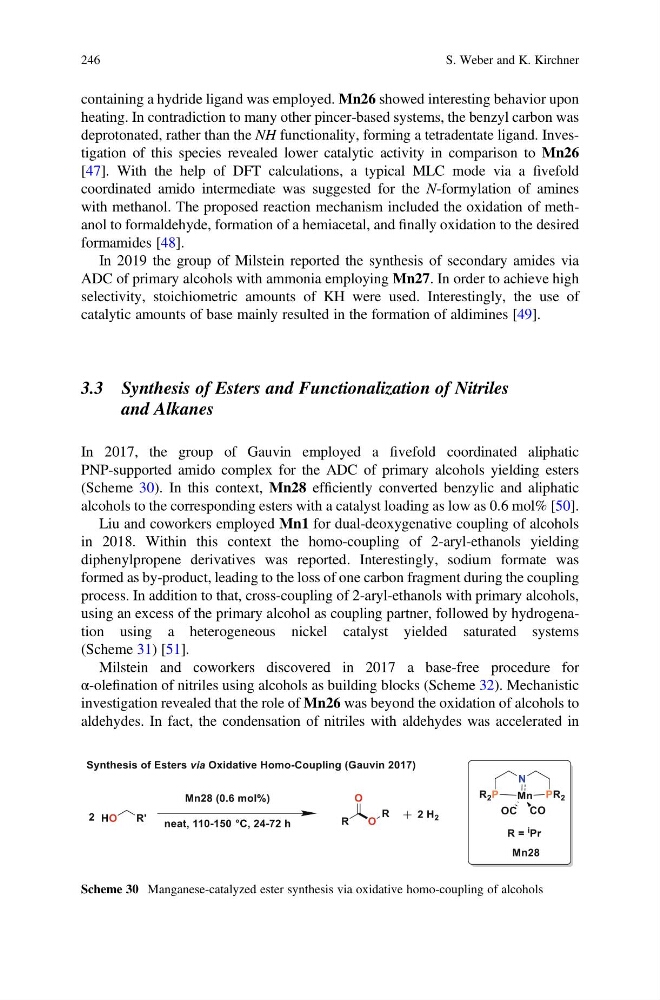
In 2017, the group of Gauvin employed a fivefold coordinated aliphatic
PNP-supported amido complex for the ADC of primary alcohols yielding esters
(Scheme 30). In this context, Mn28 efficiently converted benzylic and aliphatic
alcohols to the corresponding esters with a catalyst loading as low as 0.6 mol% [50].
Liu and coworkers employed Mn1 for dual-deoxygenative coupling of alcohols
in 2018. Within this context the homo-coupling of 2-aryl-ethanols yielding
diphenylpropene derivatives was reported. Interestingly, sodium formate was
formed as by-product, leading to the loss of one carbon fragment during the coupling
process. In addition to that, cross-coupling of 2-aryl-ethanols with primary alcohols,
using an excess of the primary alcohol as coupling partner, followed by hydrogenation using a heterogeneous nickel catalyst yielded saturated systems
(Scheme 31) [51].
Milstein and coworkers discovered in 2017 a base-free procedure for
α-olefination of nitriles using alcohols as building blocks (Scheme 32). Mechanistic
investigation revealed that the role of Mn26 was beyond the oxidation of alcohols to
aldehydes. In fact, the condensation of nitriles with aldehydes was accelerated in
Scheme 30 Manganese-catalyzed ester synthesis via oxidative homo-coupling of alcohols
246
S. Weber and K. Kirchner
heating. In contradiction to many other pincer-based systems, the benzyl carbon was
deprotonated, rather than the NH functionality, forming a tetradentate ligand. Investigation of this species revealed lower catalytic activity in comparison to Mn26
[47]. With the help of DFT calculations, a typical MLC mode via a fivefold
coordinated amido intermediate was suggested for the N-formylation of amines
with methanol. The proposed reaction mechanism included the oxidation of methanol to formaldehyde, formation of a hemiacetal, and finally oxidation to the desired
formamides [48].
In 2019 the group of Milstein reported the synthesis of secondary amides via
ADC of primary alcohols with ammonia employing Mn27. In order to achieve high
selectivity, stoichiometric amounts of KH were used. Interestingly, the use of
catalytic amounts of base mainly resulted in the formation of aldimines [49].
3.3 Synthesis of Esters and Functionalization of Nitriles
and Alkanes
In 2017, the group of Gauvin employed a fivefold coordinated aliphatic
PNP-supported amido complex for the ADC of primary alcohols yielding esters
(Scheme 30). In this context, Mn28 efficiently converted benzylic and aliphatic
alcohols to the corresponding esters with a catalyst loading as low as 0.6 mol% [50].
Liu and coworkers employed Mn1 for dual-deoxygenative coupling of alcohols
in 2018. Within this context the homo-coupling of 2-aryl-ethanols yielding
diphenylpropene derivatives was reported. Interestingly, sodium formate was
formed as by-product, leading to the loss of one carbon fragment during the coupling
process. In addition to that, cross-coupling of 2-aryl-ethanols with primary alcohols,
using an excess of the primary alcohol as coupling partner, followed by hydrogenation using a heterogeneous nickel catalyst yielded saturated systems
(Scheme 31) [51].
Milstein and coworkers discovered in 2017 a base-free procedure for
α-olefination of nitriles using alcohols as building blocks (Scheme 32). Mechanistic
investigation revealed that the role of Mn26 was beyond the oxidation of alcohols to
aldehydes. In fact, the condensation of nitriles with aldehydes was accelerated in
Scheme 30 Manganese-catalyzed ester synthesis via oxidative homo-coupling of alcohols
246
S. Weber and K. Kirchner