

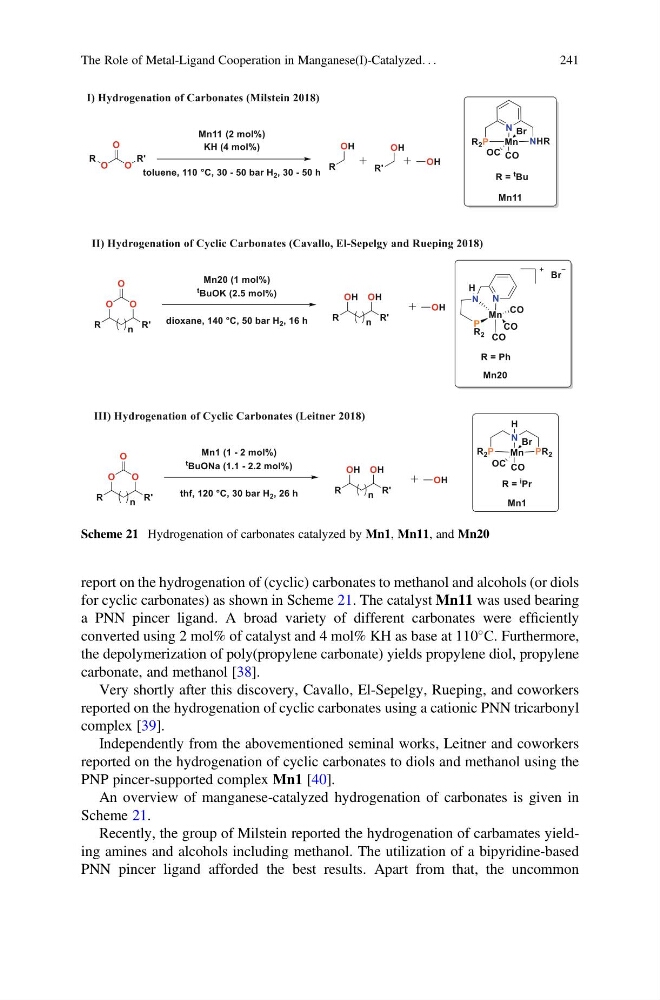
report on the hydrogenation of (cyclic) carbonates to methanol and alcohols (or diols
for cyclic carbonates) as shown in Scheme 21. The catalyst Mn11 was used bearing
a PNN pincer ligand. A broad variety of different carbonates were efficiently
converted using 2 mol% of catalyst and 4 mol% KH as base at 110
C. Furthermore,
the depolymerization of poly(propylene carbonate) yields propylene diol, propylene
carbonate, and methanol [38].
Very shortly after this discovery, Cavallo, El-Sepelgy, Rueping, and coworkers
reported on the hydrogenation of cyclic carbonates using a cationic PNN tricarbonyl
complex [39].
Independently from the abovementioned seminal works, Leitner and coworkers
reported on the hydrogenation of cyclic carbonates to diols and methanol using the
PNP pincer-supported complex Mn1 [40].
An overview of manganese-catalyzed hydrogenation of carbonates is given in
Scheme 21.
Recently, the group of Milstein reported the hydrogenation of carbamates yielding amines and alcohols including methanol. The utilization of a bipyridine-based
PNN pincer ligand afforded the best results. Apart from that, the uncommon
Scheme 21 Hydrogenation of carbonates catalyzed by Mn1, Mn11, and Mn20
The Role of Metal-Ligand Cooperation in Manganese(I)-Catalyzed. . .
241
for cyclic carbonates) as shown in Scheme 21. The catalyst Mn11 was used bearing
a PNN pincer ligand. A broad variety of different carbonates were efficiently
converted using 2 mol% of catalyst and 4 mol% KH as base at 110
C. Furthermore,
the depolymerization of poly(propylene carbonate) yields propylene diol, propylene
carbonate, and methanol [38].
Very shortly after this discovery, Cavallo, El-Sepelgy, Rueping, and coworkers
reported on the hydrogenation of cyclic carbonates using a cationic PNN tricarbonyl
complex [39].
Independently from the abovementioned seminal works, Leitner and coworkers
reported on the hydrogenation of cyclic carbonates to diols and methanol using the
PNP pincer-supported complex Mn1 [40].
An overview of manganese-catalyzed hydrogenation of carbonates is given in
Scheme 21.
Recently, the group of Milstein reported the hydrogenation of carbamates yielding amines and alcohols including methanol. The utilization of a bipyridine-based
PNN pincer ligand afforded the best results. Apart from that, the uncommon
Scheme 21 Hydrogenation of carbonates catalyzed by Mn1, Mn11, and Mn20
The Role of Metal-Ligand Cooperation in Manganese(I)-Catalyzed. . .
241