

4 m-Benziporphyrins and Aza-m-Benziporphyrins:
Coordination Chemistry
4.1 Coordination Motifs
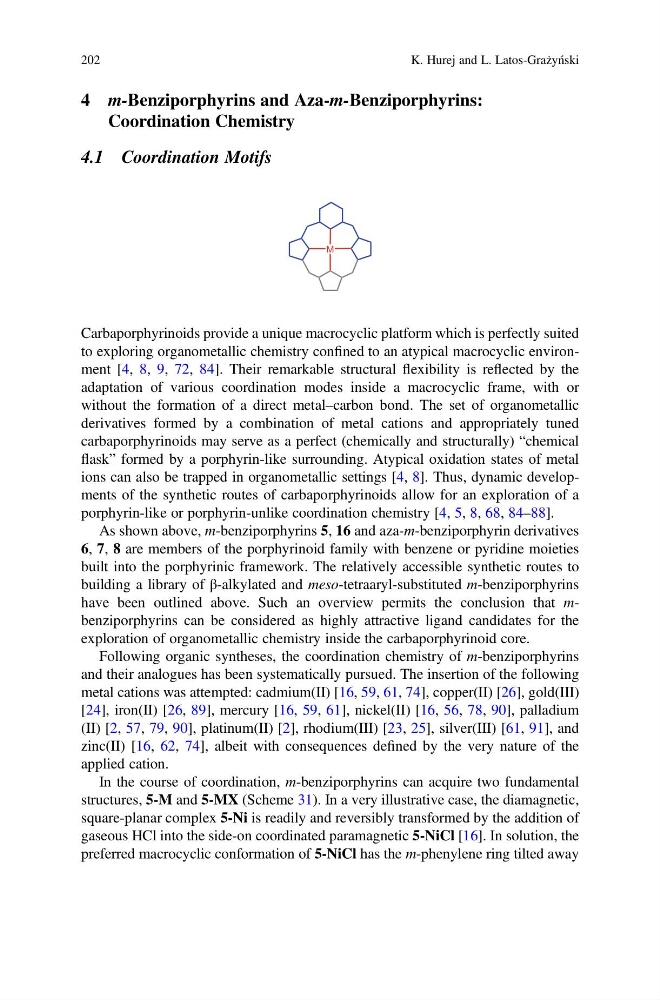
M
Carbaporphyrinoids provide a unique macrocyclic platform which is perfectly suited
to exploring organometallic chemistry confined to an atypical macrocyclic environment [4, 8, 9, 72, 84]. Their remarkable structural flexibility is reflected by the
adaptation of various coordination modes inside a macrocyclic frame, with or
without the formation of a direct metal–carbon bond. The set of organometallic
derivatives formed by a combination of metal cations and appropriately tuned
carbaporphyrinoids may serve as a perfect (chemically and structurally) “chemical
flask” formed by a porphyrin-like surrounding. Atypical oxidation states of metal
ions can also be trapped in organometallic settings [4, 8]. Thus, dynamic developments of the synthetic routes of carbaporphyrinoids allow for an exploration of a
porphyrin-like or porphyrin-unlike coordination chemistry [4, 5, 8, 68, 84–88].
As shown above, m-benziporphyrins 5, 16 and aza-m-benziporphyrin derivatives
6, 7, 8 are members of the porphyrinoid family with benzene or pyridine moieties
built into the porphyrinic framework. The relatively accessible synthetic routes to
building a library of β-alkylated and meso-tetraaryl-substituted m-benziporphyrins
have been outlined above. Such an overview permits the conclusion that mbenziporphyrins can be considered as highly attractive ligand candidates for the
exploration of organometallic chemistry inside the carbaporphyrinoid core.
Following organic syntheses, the coordination chemistry of m-benziporphyrins
and their analogues has been systematically pursued. The insertion of the following
metal cations was attempted: cadmium(II) [16, 59, 61, 74], copper(II) [26], gold(III)
[24], iron(II) [26, 89], mercury [16, 59, 61], nickel(II) [16, 56, 78, 90], palladium
(II) [2, 57, 79, 90], platinum(II) [2], rhodium(III) [23, 25], silver(III) [61, 91], and
zinc(II) [16, 62, 74], albeit with consequences defined by the very nature of the
applied cation.
In the course of coordination, m-benziporphyrins can acquire two fundamental
structures, 5-M and 5-MX (Scheme 31). In a very illustrative case, the diamagnetic,
square-planar complex 5-Ni is readily and reversibly transformed by the addition of
gaseous HCl into the side-on coordinated paramagnetic 5-NiCl [16]. In solution, the
preferred macrocyclic conformation of 5-NiCl has the m-phenylene ring tilted away
202
K. Hurej and L. Latos-Grażyński
Coordination Chemistry
4.1 Coordination Motifs
M
Carbaporphyrinoids provide a unique macrocyclic platform which is perfectly suited
to exploring organometallic chemistry confined to an atypical macrocyclic environment [4, 8, 9, 72, 84]. Their remarkable structural flexibility is reflected by the
adaptation of various coordination modes inside a macrocyclic frame, with or
without the formation of a direct metal–carbon bond. The set of organometallic
derivatives formed by a combination of metal cations and appropriately tuned
carbaporphyrinoids may serve as a perfect (chemically and structurally) “chemical
flask” formed by a porphyrin-like surrounding. Atypical oxidation states of metal
ions can also be trapped in organometallic settings [4, 8]. Thus, dynamic developments of the synthetic routes of carbaporphyrinoids allow for an exploration of a
porphyrin-like or porphyrin-unlike coordination chemistry [4, 5, 8, 68, 84–88].
As shown above, m-benziporphyrins 5, 16 and aza-m-benziporphyrin derivatives
6, 7, 8 are members of the porphyrinoid family with benzene or pyridine moieties
built into the porphyrinic framework. The relatively accessible synthetic routes to
building a library of β-alkylated and meso-tetraaryl-substituted m-benziporphyrins
have been outlined above. Such an overview permits the conclusion that mbenziporphyrins can be considered as highly attractive ligand candidates for the
exploration of organometallic chemistry inside the carbaporphyrinoid core.
Following organic syntheses, the coordination chemistry of m-benziporphyrins
and their analogues has been systematically pursued. The insertion of the following
metal cations was attempted: cadmium(II) [16, 59, 61, 74], copper(II) [26], gold(III)
[24], iron(II) [26, 89], mercury [16, 59, 61], nickel(II) [16, 56, 78, 90], palladium
(II) [2, 57, 79, 90], platinum(II) [2], rhodium(III) [23, 25], silver(III) [61, 91], and
zinc(II) [16, 62, 74], albeit with consequences defined by the very nature of the
applied cation.
In the course of coordination, m-benziporphyrins can acquire two fundamental
structures, 5-M and 5-MX (Scheme 31). In a very illustrative case, the diamagnetic,
square-planar complex 5-Ni is readily and reversibly transformed by the addition of
gaseous HCl into the side-on coordinated paramagnetic 5-NiCl [16]. In solution, the
preferred macrocyclic conformation of 5-NiCl has the m-phenylene ring tilted away
202
K. Hurej and L. Latos-Grażyński