

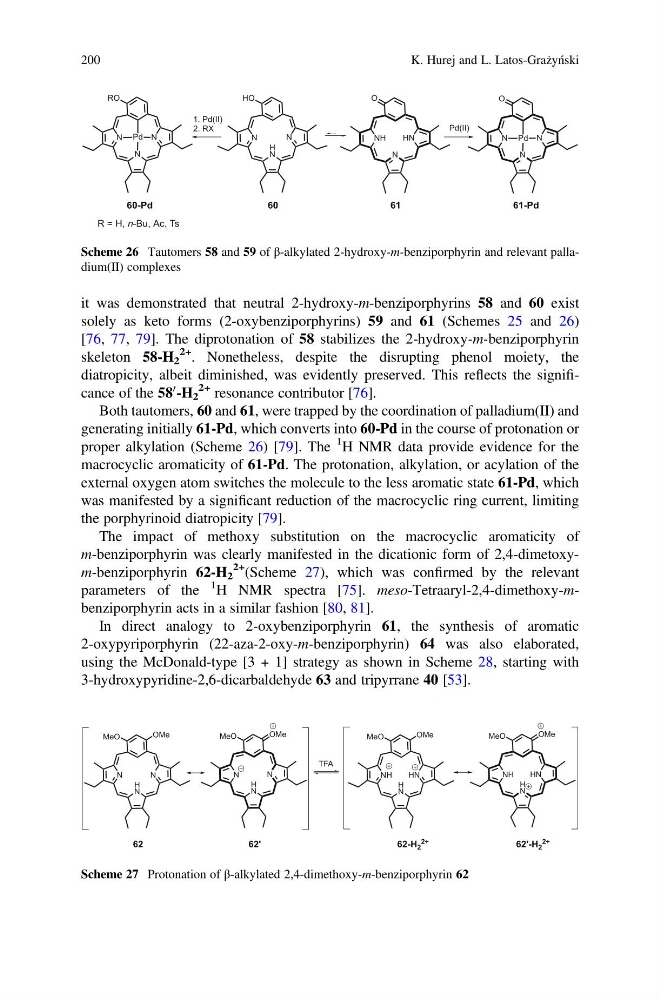
it was demonstrated that neutral 2-hydroxy-m-benziporphyrins 58 and 60 exist
solely as keto forms (2-oxybenziporphyrins) 59 and 61 (Schemes 25 and 26)
[76, 77, 79]. The diprotonation of 58 stabilizes the 2-hydroxy-m-benziporphyrin
skeleton 58-H 2
2+ . Nonetheless, despite the disrupting phenol moiety, the
diatropicity, albeit diminished, was evidently preserved. This reflects the significance of the 58
0 -H 2
2+ resonance contributor [76].
Both tautomers, 60 and 61, were trapped by the coordination of palladium(II) and
generating initially 61-Pd, which converts into 60-Pd in the course of protonation or
proper alkylation (Scheme 26) [79]. The
1 H NMR data provide evidence for the
macrocyclic aromaticity of 61-Pd. The protonation, alkylation, or acylation of the
external oxygen atom switches the molecule to the less aromatic state 61-Pd, which
was manifested by a significant reduction of the macrocyclic ring current, limiting
the porphyrinoid diatropicity [79].
The impact of methoxy substitution on the macrocyclic aromaticity of
m-benziporphyrin was clearly manifested in the dicationic form of 2,4-dimetoxym-benziporphyrin 62-H 2
2+ (Scheme 27), which was confirmed by the relevant
parameters of the
1 H NMR spectra [75]. meso-Tetraaryl-2,4-dimethoxy-mbenziporphyrin acts in a similar fashion [80, 81].
In direct analogy to 2-oxybenziporphyrin 61, the synthesis of aromatic
2-oxypyriporphyrin (22-aza-2-oxy-m-benziporphyrin) 64 was also elaborated,
using the McDonald-type [3 + 1] strategy as shown in Scheme 28, starting with
3-hydroxypyridine-2,6-dicarbaldehyde 63 and tripyrrane 40 [53].
H
N
N
N
N
NH
HN
60-Pd
60
61
61-Pd
HO
O
N
N
N
RO
N
N
N
Pd
Pd
1. Pd(II)
2. RX
R = H, n-Bu, Ac, Ts
Pd(II)
O
Scheme 26 Tautomers 58 and 59 of β-alkylated 2-hydroxy-m-benziporphyrin and relevant palladium(II) complexes
H
N
N
N
TFA
H
N
NH
HN
MeO
OMe
MeO
OMe
H
N
N
N
MeO
OMe
H
N
NH
HN
MeO
OMe
62
62'
62-H 2
2+
62'-H 2
2+
Scheme 27 Protonation of β-alkylated 2,4-dimethoxy-m-benziporphyrin 62
200
K. Hurej and L. Latos-Grażyński
solely as keto forms (2-oxybenziporphyrins) 59 and 61 (Schemes 25 and 26)
[76, 77, 79]. The diprotonation of 58 stabilizes the 2-hydroxy-m-benziporphyrin
skeleton 58-H 2
2+ . Nonetheless, despite the disrupting phenol moiety, the
diatropicity, albeit diminished, was evidently preserved. This reflects the significance of the 58
0 -H 2
2+ resonance contributor [76].
Both tautomers, 60 and 61, were trapped by the coordination of palladium(II) and
generating initially 61-Pd, which converts into 60-Pd in the course of protonation or
proper alkylation (Scheme 26) [79]. The
1 H NMR data provide evidence for the
macrocyclic aromaticity of 61-Pd. The protonation, alkylation, or acylation of the
external oxygen atom switches the molecule to the less aromatic state 61-Pd, which
was manifested by a significant reduction of the macrocyclic ring current, limiting
the porphyrinoid diatropicity [79].
The impact of methoxy substitution on the macrocyclic aromaticity of
m-benziporphyrin was clearly manifested in the dicationic form of 2,4-dimetoxym-benziporphyrin 62-H 2
2+ (Scheme 27), which was confirmed by the relevant
parameters of the
1 H NMR spectra [75]. meso-Tetraaryl-2,4-dimethoxy-mbenziporphyrin acts in a similar fashion [80, 81].
In direct analogy to 2-oxybenziporphyrin 61, the synthesis of aromatic
2-oxypyriporphyrin (22-aza-2-oxy-m-benziporphyrin) 64 was also elaborated,
using the McDonald-type [3 + 1] strategy as shown in Scheme 28, starting with
3-hydroxypyridine-2,6-dicarbaldehyde 63 and tripyrrane 40 [53].
H
N
N
N
N
NH
HN
60-Pd
60
61
61-Pd
HO
O
N
N
N
RO
N
N
N
Pd
Pd
1. Pd(II)
2. RX
R = H, n-Bu, Ac, Ts
Pd(II)
O
Scheme 26 Tautomers 58 and 59 of β-alkylated 2-hydroxy-m-benziporphyrin and relevant palladium(II) complexes
H
N
N
N
TFA
H
N
NH
HN
MeO
OMe
MeO
OMe
H
N
N
N
MeO
OMe
H
N
NH
HN
MeO
OMe
62
62'
62-H 2
2+
62'-H 2
2+
Scheme 27 Protonation of β-alkylated 2,4-dimethoxy-m-benziporphyrin 62
200
K. Hurej and L. Latos-Grażyński