

2.5.2 2-Aza-m-Benziporphyrins
N
R
R
R 1
R 2
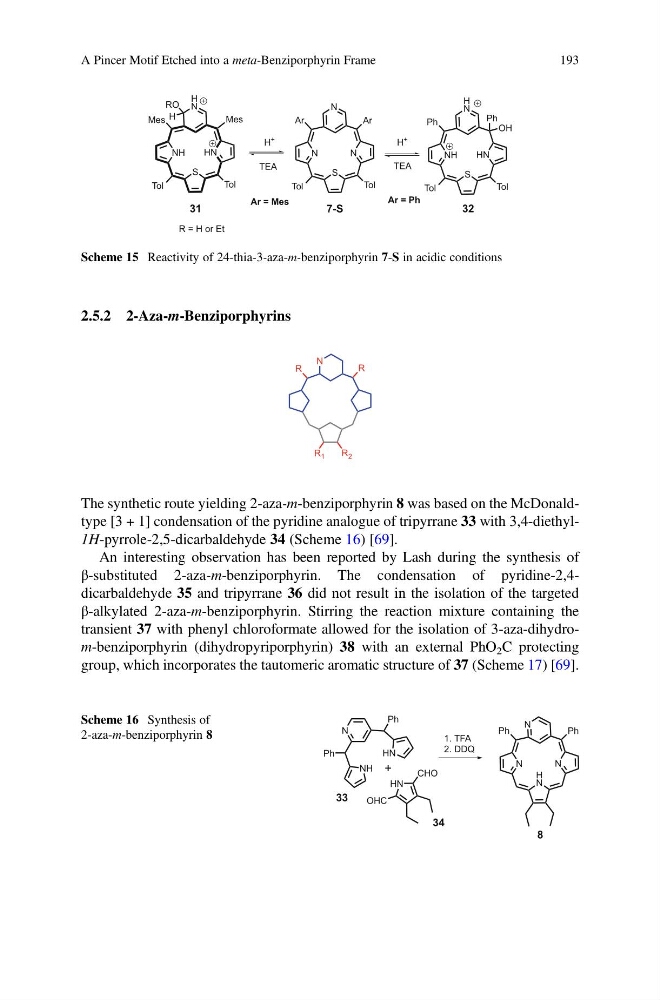
The synthetic route yielding 2-aza-m-benziporphyrin 8 was based on the McDonaldtype [3 + 1] condensation of the pyridine analogue of tripyrrane 33 with 3,4-diethyl1H-pyrrole-2,5-dicarbaldehyde 34 (Scheme 16) [69].
An interesting observation has been reported by Lash during the synthesis of
β-substituted 2-aza-m-benziporphyrin. The condensation of pyridine-2,4dicarbaldehyde 35 and tripyrrane 36 did not result in the isolation of the targeted
β-alkylated 2-aza-m-benziporphyrin. Stirring the reaction mixture containing the
transient 37 with phenyl chloroformate allowed for the isolation of 3-aza-dihydrom-benziporphyrin (dihydropyriporphyrin) 38 with an external PhO 2 C protecting
group, which incorporates the tautomeric aromatic structure of 37 (Scheme 17) [69].
HN
N
NH
1. TFA
2. DDQ
H
N
N
N
N
Ph
Ph
HN
OHC
CHO
+
Ph
Ph
33
8
34
Scheme 16 Synthesis of
2-aza-m-benziporphyrin 8
S
N
N
N
Ar
Ar
Tol
Tol
S
NH
HN
H
N
Ph
OH
Tol
Tol
H
+
Ph
S
NH
HN
H
N
Mes
Mes
Tol
Tol
RO
H
H
+
R = H or Et
Ar = Mes
Ar = Ph
TEA
TEA
31
7-S
32
Scheme 15 Reactivity of 24-thia-3-aza-m-benziporphyrin 7-S in acidic conditions
A Pincer Motif Etched into a meta-Benziporphyrin Frame
193
N
R
R
R 1
R 2
The synthetic route yielding 2-aza-m-benziporphyrin 8 was based on the McDonaldtype [3 + 1] condensation of the pyridine analogue of tripyrrane 33 with 3,4-diethyl1H-pyrrole-2,5-dicarbaldehyde 34 (Scheme 16) [69].
An interesting observation has been reported by Lash during the synthesis of
β-substituted 2-aza-m-benziporphyrin. The condensation of pyridine-2,4dicarbaldehyde 35 and tripyrrane 36 did not result in the isolation of the targeted
β-alkylated 2-aza-m-benziporphyrin. Stirring the reaction mixture containing the
transient 37 with phenyl chloroformate allowed for the isolation of 3-aza-dihydrom-benziporphyrin (dihydropyriporphyrin) 38 with an external PhO 2 C protecting
group, which incorporates the tautomeric aromatic structure of 37 (Scheme 17) [69].
HN
N
NH
1. TFA
2. DDQ
H
N
N
N
N
Ph
Ph
HN
OHC
CHO
+
Ph
Ph
33
8
34
Scheme 16 Synthesis of
2-aza-m-benziporphyrin 8
S
N
N
N
Ar
Ar
Tol
Tol
S
NH
HN
H
N
Ph
OH
Tol
Tol
H
+
Ph
S
NH
HN
H
N
Mes
Mes
Tol
Tol
RO
H
H
+
R = H or Et
Ar = Mes
Ar = Ph
TEA
TEA
31
7-S
32
Scheme 15 Reactivity of 24-thia-3-aza-m-benziporphyrin 7-S in acidic conditions
A Pincer Motif Etched into a meta-Benziporphyrin Frame
193