

2.4 22-Alkyl-m-Benziporphyrins
R 1
R 1
R 3
R 3
R
5,20-Diphenyl-10,15-ditolyl-22-methyl-m-benziporphyrin 29-Me was formed in a
several-step process starting from 2,6-dicyanotoluene 26-Me [24]. The first step
involved the reduction of two nitriles to imines and hydrolysis to form 27-Me
(Scheme 12). The subsequent reaction with phenylmagnesium bromide afforded
the crucial diol 28-Me. The precursor 28-Me was used in the typical stochastic
condensation with pyrrole and p-tolylaldehyde, giving 29-Me with a 22% yield. The
conditions of the last two steps were analogous to the synthetic method applied for
m-benziporphyrin [2]. The higher yield for 29-Me as compared to 5 can be due to the
lack of phlorin formation during this condensation.
In the synthesis of 22-ethyl-m-benziporphyrin 29-Et, 2-ethylisophthalonitrile
26-Et was used instead of 2-methylisophthalonitrile 26-Me [25]. Initially,
isophthalonitrile 26-H reacted with ethyl iodide yielding 26-Et almost quantitatively. The further procedure followed the analogous path already elaborated for
22-methyl-m-benziporphyrin 29-Me (Scheme 12).
HN
NH
H
N
N
N
Ar
Ar
23
EtO 2 C
EtO 2 C
EtO 2 C
CO 2 Et
EtO 2 C
EtO 2 C
CO 2 Et
CO 2 Et
1. pyrrole, ArCHO,
TFA
2. DDQ
22
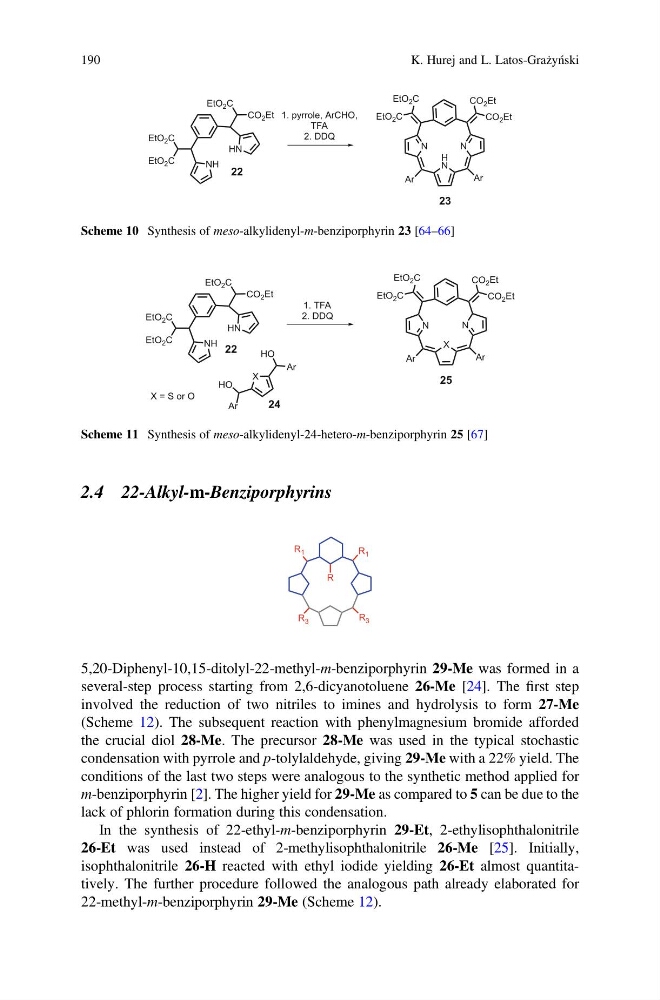
Scheme 10 Synthesis of meso-alkylidenyl-m-benziporphyrin 23 [64–66]
HN
NH
X
N
N
Ar
Ar
25
EtO 2 C
EtO 2 C
EtO 2 C
CO 2 Et
EtO 2 C
EtO 2 C
CO 2 Et
CO 2 Et
1. TFA
2. DDQ
22
X
HO
HO
Ar
Ar
24
X = S or O
Scheme 11 Synthesis of meso-alkylidenyl-24-hetero-m-benziporphyrin 25 [67]
190
K. Hurej and L. Latos-Grażyński
R 1
R 1
R 3
R 3
R
5,20-Diphenyl-10,15-ditolyl-22-methyl-m-benziporphyrin 29-Me was formed in a
several-step process starting from 2,6-dicyanotoluene 26-Me [24]. The first step
involved the reduction of two nitriles to imines and hydrolysis to form 27-Me
(Scheme 12). The subsequent reaction with phenylmagnesium bromide afforded
the crucial diol 28-Me. The precursor 28-Me was used in the typical stochastic
condensation with pyrrole and p-tolylaldehyde, giving 29-Me with a 22% yield. The
conditions of the last two steps were analogous to the synthetic method applied for
m-benziporphyrin [2]. The higher yield for 29-Me as compared to 5 can be due to the
lack of phlorin formation during this condensation.
In the synthesis of 22-ethyl-m-benziporphyrin 29-Et, 2-ethylisophthalonitrile
26-Et was used instead of 2-methylisophthalonitrile 26-Me [25]. Initially,
isophthalonitrile 26-H reacted with ethyl iodide yielding 26-Et almost quantitatively. The further procedure followed the analogous path already elaborated for
22-methyl-m-benziporphyrin 29-Me (Scheme 12).
HN
NH
H
N
N
N
Ar
Ar
23
EtO 2 C
EtO 2 C
EtO 2 C
CO 2 Et
EtO 2 C
EtO 2 C
CO 2 Et
CO 2 Et
1. pyrrole, ArCHO,
TFA
2. DDQ
22
Scheme 10 Synthesis of meso-alkylidenyl-m-benziporphyrin 23 [64–66]
HN
NH
X
N
N
Ar
Ar
25
EtO 2 C
EtO 2 C
EtO 2 C
CO 2 Et
EtO 2 C
EtO 2 C
CO 2 Et
CO 2 Et
1. TFA
2. DDQ
22
X
HO
HO
Ar
Ar
24
X = S or O
Scheme 11 Synthesis of meso-alkylidenyl-24-hetero-m-benziporphyrin 25 [67]
190
K. Hurej and L. Latos-Grażyński