

64
4 Responses of Plasma-Facing Surface to Power Load Given by Radiation …
4.6.1 Reemission of Hydrogen (Fuel)
In the case of fuel (referred to as hydrogen hereafter), some of implanted hydrogen
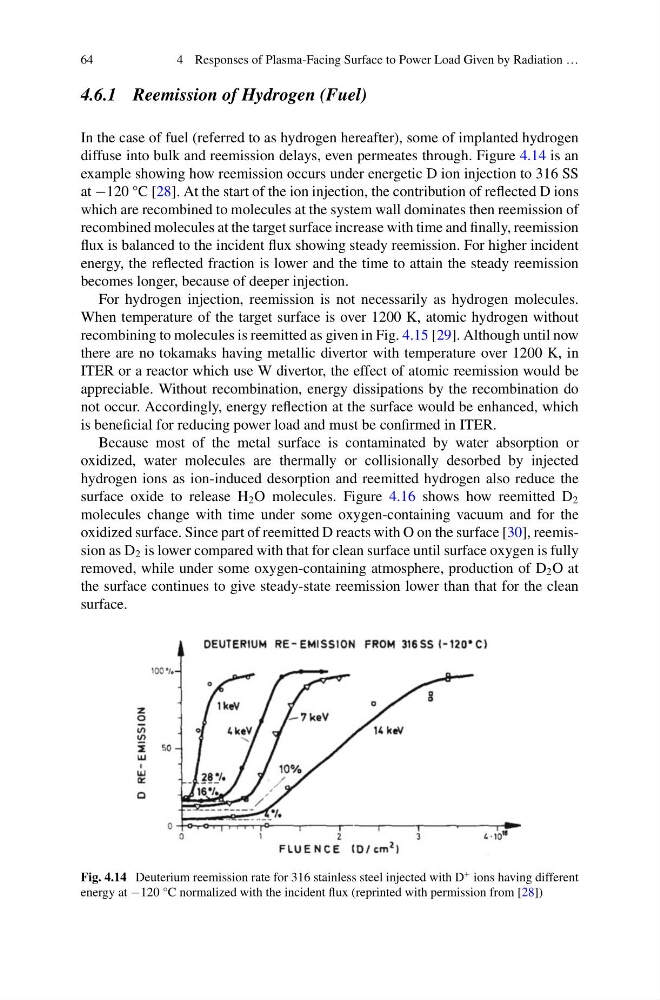
diffuse into bulk and reemission delays, even permeates through. Figure 4.14 is an
example showing how reemission occurs under energetic D ion injection to 316 SS
at −120 °C [28]. At the start of the ion injection, the contribution of reflected D ions
which are recombined to molecules at the system wall dominates then reemission of
recombined molecules at the target surface increase with time and finally, reemission
flux is balanced to the incident flux showing steady reemission. For higher incident
energy, the reflected fraction is lower and the time to attain the steady reemission
becomes longer, because of deeper injection.
For hydrogen injection, reemission is not necessarily as hydrogen molecules.
When temperature of the target surface is over 1200 K, atomic hydrogen without
recombining to molecules is reemitted as given in Fig. 4.15 [29]. Although until now
there are no tokamaks having metallic divertor with temperature over 1200 K, in
ITER or a reactor which use W divertor, the effect of atomic reemission would be
appreciable. Without recombination, energy dissipations by the recombination do
not occur. Accordingly, energy reflection at the surface would be enhanced, which
is beneficial for reducing power load and must be confirmed in ITER.
Because most of the metal surface is contaminated by water absorption or
oxidized, water molecules are thermally or collisionally desorbed by injected
hydrogen ions as ion-induced desorption and reemitted hydrogen also reduce the
surface oxide to release H 2 O molecules. Figure 4.16 shows how reemitted D 2
molecules change with time under some oxygen-containing vacuum and for the
oxidized surface. Since part of reemitted D reacts with O on the surface [30], reemission as D 2 is lower compared with that for clean surface until surface oxygen is fully
removed, while under some oxygen-containing atmosphere, production of D 2 O at
the surface continues to give steady-state reemission lower than that for the clean
surface.
Fig. 4.14 Deuterium reemission rate for 316 stainless steel injected with D + ions having different
energy at −120 °C normalized with the incident flux (reprinted with permission from [28])
4 Responses of Plasma-Facing Surface to Power Load Given by Radiation …
4.6.1 Reemission of Hydrogen (Fuel)
In the case of fuel (referred to as hydrogen hereafter), some of implanted hydrogen
diffuse into bulk and reemission delays, even permeates through. Figure 4.14 is an
example showing how reemission occurs under energetic D ion injection to 316 SS
at −120 °C [28]. At the start of the ion injection, the contribution of reflected D ions
which are recombined to molecules at the system wall dominates then reemission of
recombined molecules at the target surface increase with time and finally, reemission
flux is balanced to the incident flux showing steady reemission. For higher incident
energy, the reflected fraction is lower and the time to attain the steady reemission
becomes longer, because of deeper injection.
For hydrogen injection, reemission is not necessarily as hydrogen molecules.
When temperature of the target surface is over 1200 K, atomic hydrogen without
recombining to molecules is reemitted as given in Fig. 4.15 [29]. Although until now
there are no tokamaks having metallic divertor with temperature over 1200 K, in
ITER or a reactor which use W divertor, the effect of atomic reemission would be
appreciable. Without recombination, energy dissipations by the recombination do
not occur. Accordingly, energy reflection at the surface would be enhanced, which
is beneficial for reducing power load and must be confirmed in ITER.
Because most of the metal surface is contaminated by water absorption or
oxidized, water molecules are thermally or collisionally desorbed by injected
hydrogen ions as ion-induced desorption and reemitted hydrogen also reduce the
surface oxide to release H 2 O molecules. Figure 4.16 shows how reemitted D 2
molecules change with time under some oxygen-containing vacuum and for the
oxidized surface. Since part of reemitted D reacts with O on the surface [30], reemission as D 2 is lower compared with that for clean surface until surface oxygen is fully
removed, while under some oxygen-containing atmosphere, production of D 2 O at
the surface continues to give steady-state reemission lower than that for the clean
surface.
Fig. 4.14 Deuterium reemission rate for 316 stainless steel injected with D + ions having different
energy at −120 °C normalized with the incident flux (reprinted with permission from [28])