

60
4 Responses of Plasma-Facing Surface to Power Load Given by Radiation …
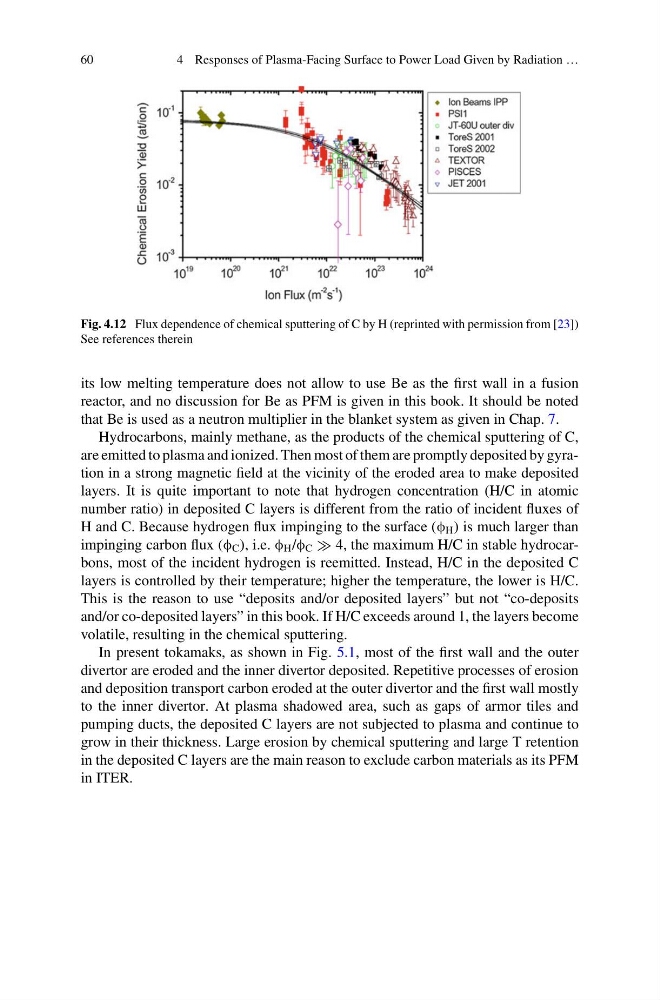
Fig. 4.12 Flux dependence of chemical sputtering of C by H (reprinted with permission from [23])
See references therein
its low melting temperature does not allow to use Be as the first wall in a fusion
reactor, and no discussion for Be as PFM is given in this book. It should be noted
that Be is used as a neutron multiplier in the blanket system as given in Chap. 7.
Hydrocarbons, mainly methane, as the products of the chemical sputtering of C,
are emitted to plasma and ionized. Then most of them are promptly deposited by gyration in a strong magnetic field at the vicinity of the eroded area to make deposited
layers. It is quite important to note that hydrogen concentration (H/C in atomic
number ratio) in deposited C layers is different from the ratio of incident fluxes of
H and C. Because hydrogen flux impinging to the surface (φ H ) is much larger than
impinging carbon flux (φ C ), i.e. φ H /φ C 4, the maximum H/C in stable hydrocarbons, most of the incident hydrogen is reemitted. Instead, H/C in the deposited C
layers is controlled by their temperature; higher the temperature, the lower is H/C.
This is the reason to use “deposits and/or deposited layers” but not “co-deposits
and/or co-deposited layers” in this book. If H/C exceeds around 1, the layers become
volatile, resulting in the chemical sputtering.
In present tokamaks, as shown in Fig. 5.1, most of the first wall and the outer
divertor are eroded and the inner divertor deposited. Repetitive processes of erosion
and deposition transport carbon eroded at the outer divertor and the first wall mostly
to the inner divertor. At plasma shadowed area, such as gaps of armor tiles and
pumping ducts, the deposited C layers are not subjected to plasma and continue to
grow in their thickness. Large erosion by chemical sputtering and large T retention
in the deposited C layers are the main reason to exclude carbon materials as its PFM
in ITER.
4 Responses of Plasma-Facing Surface to Power Load Given by Radiation …
Fig. 4.12 Flux dependence of chemical sputtering of C by H (reprinted with permission from [23])
See references therein
its low melting temperature does not allow to use Be as the first wall in a fusion
reactor, and no discussion for Be as PFM is given in this book. It should be noted
that Be is used as a neutron multiplier in the blanket system as given in Chap. 7.
Hydrocarbons, mainly methane, as the products of the chemical sputtering of C,
are emitted to plasma and ionized. Then most of them are promptly deposited by gyration in a strong magnetic field at the vicinity of the eroded area to make deposited
layers. It is quite important to note that hydrogen concentration (H/C in atomic
number ratio) in deposited C layers is different from the ratio of incident fluxes of
H and C. Because hydrogen flux impinging to the surface (φ H ) is much larger than
impinging carbon flux (φ C ), i.e. φ H /φ C 4, the maximum H/C in stable hydrocarbons, most of the incident hydrogen is reemitted. Instead, H/C in the deposited C
layers is controlled by their temperature; higher the temperature, the lower is H/C.
This is the reason to use “deposits and/or deposited layers” but not “co-deposits
and/or co-deposited layers” in this book. If H/C exceeds around 1, the layers become
volatile, resulting in the chemical sputtering.
In present tokamaks, as shown in Fig. 5.1, most of the first wall and the outer
divertor are eroded and the inner divertor deposited. Repetitive processes of erosion
and deposition transport carbon eroded at the outer divertor and the first wall mostly
to the inner divertor. At plasma shadowed area, such as gaps of armor tiles and
pumping ducts, the deposited C layers are not subjected to plasma and continue to
grow in their thickness. Large erosion by chemical sputtering and large T retention
in the deposited C layers are the main reason to exclude carbon materials as its PFM
in ITER.