

58
4 Responses of Plasma-Facing Surface to Power Load Given by Radiation …
long-range transport of eroded materials. Those deposited at plasma shadowed areas,
like gaps of plasma-facing tiles and vacuum ducts, are simply piled-up without
re-sputtering.
In the deposited layers, fuel particles are easily incorporated, often referred to as
co-deposition. Therefore, the incorporation of the fuel in the deposited materials at
the plasma shadowed area becomes the dominant cause of T retention in the reactor
vessel (in-vessel T inventory).
4.3.3 Chemical Sputtering
When plasma-facing wall is made of materials reactive to hydrogen, like C and Beryllium (Be), the material surface can be eroded by chemical reaction with hydrogenproducing volatile products, like CH 4 and BeH 2 (chemical sputtering) additionally
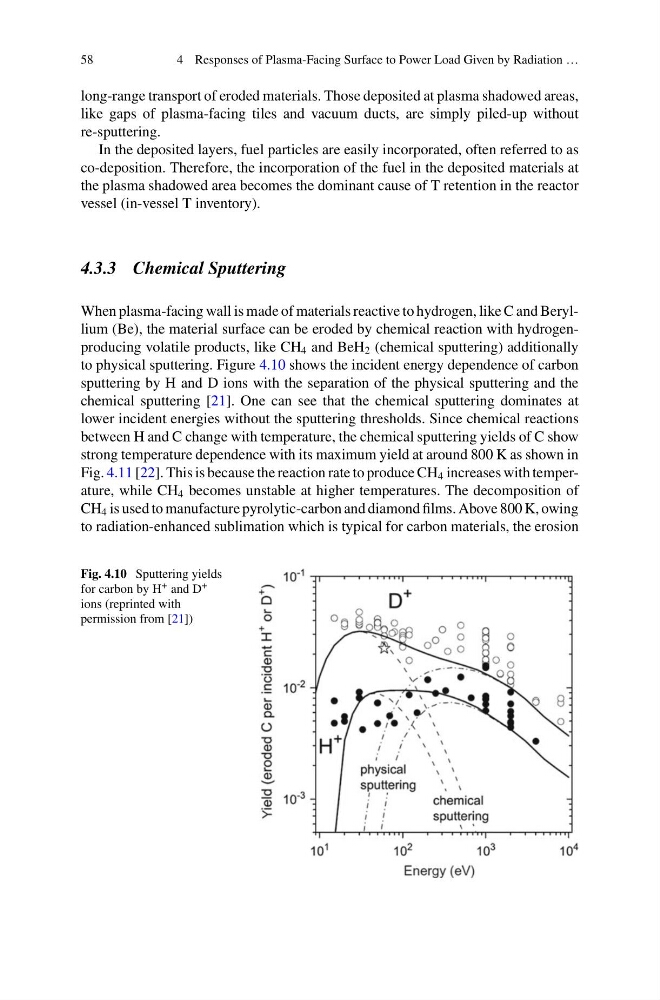
to physical sputtering. Figure 4.10 shows the incident energy dependence of carbon
sputtering by H and D ions with the separation of the physical sputtering and the
chemical sputtering [21]. One can see that the chemical sputtering dominates at
lower incident energies without the sputtering thresholds. Since chemical reactions
between H and C change with temperature, the chemical sputtering yields of C show
strong temperature dependence with its maximum yield at around 800 K as shown in
Fig. 4.11 [22]. This is because the reaction rate to produce CH 4 increases with temperature, while CH 4 becomes unstable at higher temperatures. The decomposition of
CH 4 is used to manufacture pyrolytic-carbon and diamond films. Above 800 K, owing
to radiation-enhanced sublimation which is typical for carbon materials, the erosion
Fig. 4.10 Sputtering yields
for carbon by H + and D +
ions (reprinted with
permission from [21])
4 Responses of Plasma-Facing Surface to Power Load Given by Radiation …
long-range transport of eroded materials. Those deposited at plasma shadowed areas,
like gaps of plasma-facing tiles and vacuum ducts, are simply piled-up without
re-sputtering.
In the deposited layers, fuel particles are easily incorporated, often referred to as
co-deposition. Therefore, the incorporation of the fuel in the deposited materials at
the plasma shadowed area becomes the dominant cause of T retention in the reactor
vessel (in-vessel T inventory).
4.3.3 Chemical Sputtering
When plasma-facing wall is made of materials reactive to hydrogen, like C and Beryllium (Be), the material surface can be eroded by chemical reaction with hydrogenproducing volatile products, like CH 4 and BeH 2 (chemical sputtering) additionally
to physical sputtering. Figure 4.10 shows the incident energy dependence of carbon
sputtering by H and D ions with the separation of the physical sputtering and the
chemical sputtering [21]. One can see that the chemical sputtering dominates at
lower incident energies without the sputtering thresholds. Since chemical reactions
between H and C change with temperature, the chemical sputtering yields of C show
strong temperature dependence with its maximum yield at around 800 K as shown in
Fig. 4.11 [22]. This is because the reaction rate to produce CH 4 increases with temperature, while CH 4 becomes unstable at higher temperatures. The decomposition of
CH 4 is used to manufacture pyrolytic-carbon and diamond films. Above 800 K, owing
to radiation-enhanced sublimation which is typical for carbon materials, the erosion
Fig. 4.10 Sputtering yields
for carbon by H + and D +
ions (reprinted with
permission from [21])