

3.4 Transient Power Load
43
The sudden collapse of plasma confinement results in a disruption in which most of
the stored energy in plasma is loaded to a localized area of PFS in a very short time,
hence, resulting in extremely high-power load. The disruption often accompanies
the emission of runaway electron beams with an energy of MeV range within a very
short time and could destroy plasma-facing components and reactor vessel. If the
energy of 100 MW is given to the area of 1 m
2 within 1 ms, its loaded power to the
area becomes 100 GJ m
−2 , which exceeds the melting threshold of any materials.
Mitigation of disruption is one of the most important tasks to establish a fusion
reactor as an energy source [8, 9]. Another concern is ELM which seems necessary
to keep plasma confinement resulting in pulsed power load to the localized area of
PFS. Sometimes the power load by ELM exceeds 1 MJ m
−2 as observed in giant
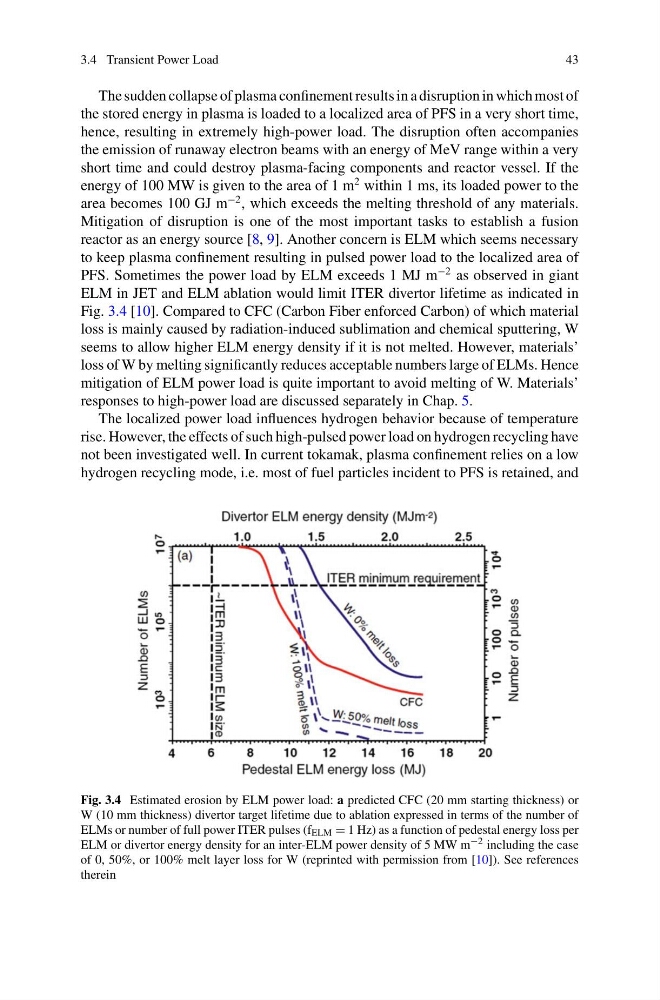
ELM in JET and ELM ablation would limit ITER divertor lifetime as indicated in
Fig. 3.4 [10]. Compared to CFC (Carbon Fiber enforced Carbon) of which material
loss is mainly caused by radiation-induced sublimation and chemical sputtering, W
seems to allow higher ELM energy density if it is not melted. However, materials’
loss of W by melting significantly reduces acceptable numbers large of ELMs. Hence
mitigation of ELM power load is quite important to avoid melting of W. Materials’
responses to high-power load are discussed separately in Chap. 5.
The localized power load influences hydrogen behavior because of temperature
rise. However, the effects of such high-pulsed power load on hydrogen recycling have
not been investigated well. In current tokamak, plasma confinement relies on a low
hydrogen recycling mode, i.e. most of fuel particles incident to PFS is retained, and
Fig. 3.4 Estimated erosion by ELM power load: a predicted CFC (20 mm starting thickness) or
W (10 mm thickness) divertor target lifetime due to ablation expressed in terms of the number of
ELMs or number of full power ITER pulses (f ELM = 1 Hz) as a function of pedestal energy loss per
ELM or divertor energy density for an inter-ELM power density of 5 MW m −2 including the case
of 0, 50%, or 100% melt layer loss for W (reprinted with permission from [10]). See references
therein
43
The sudden collapse of plasma confinement results in a disruption in which most of
the stored energy in plasma is loaded to a localized area of PFS in a very short time,
hence, resulting in extremely high-power load. The disruption often accompanies
the emission of runaway electron beams with an energy of MeV range within a very
short time and could destroy plasma-facing components and reactor vessel. If the
energy of 100 MW is given to the area of 1 m
2 within 1 ms, its loaded power to the
area becomes 100 GJ m
−2 , which exceeds the melting threshold of any materials.
Mitigation of disruption is one of the most important tasks to establish a fusion
reactor as an energy source [8, 9]. Another concern is ELM which seems necessary
to keep plasma confinement resulting in pulsed power load to the localized area of
PFS. Sometimes the power load by ELM exceeds 1 MJ m
−2 as observed in giant
ELM in JET and ELM ablation would limit ITER divertor lifetime as indicated in
Fig. 3.4 [10]. Compared to CFC (Carbon Fiber enforced Carbon) of which material
loss is mainly caused by radiation-induced sublimation and chemical sputtering, W
seems to allow higher ELM energy density if it is not melted. However, materials’
loss of W by melting significantly reduces acceptable numbers large of ELMs. Hence
mitigation of ELM power load is quite important to avoid melting of W. Materials’
responses to high-power load are discussed separately in Chap. 5.
The localized power load influences hydrogen behavior because of temperature
rise. However, the effects of such high-pulsed power load on hydrogen recycling have
not been investigated well. In current tokamak, plasma confinement relies on a low
hydrogen recycling mode, i.e. most of fuel particles incident to PFS is retained, and
Fig. 3.4 Estimated erosion by ELM power load: a predicted CFC (20 mm starting thickness) or
W (10 mm thickness) divertor target lifetime due to ablation expressed in terms of the number of
ELMs or number of full power ITER pulses (f ELM = 1 Hz) as a function of pedestal energy loss per
ELM or divertor energy density for an inter-ELM power density of 5 MW m −2 including the case
of 0, 50%, or 100% melt layer loss for W (reprinted with permission from [10]). See references
therein