

1.4 Brief History of the Development of Plasma-Facing Materials
11
of vacuum and the control of impurities in plasma. In the early stage of plasma
researches, glass was used as a vacuum vessel because of its small desorption of
impurities, in particular, water. With the improvement of vacuum pumps, metals
have replaced the glass. Improvement of plasma confinement has proceeded with
the development of vacuum technology. Nevertheless, radiation from impurities in
plasma, mostly carbon and oxygen originated from residual gas in a vacuum, prohibited raising plasma temperature. In some sense, an increase in plasma temperature
or improvement of plasma confinement is fighting with radiation loss caused by
impurities. From the beginning, plasma researchers were targeting to develop fusion
reactors as an energy source. Hence, high melting temperature materials and/or materials admitting cooling came in sight as PFM. Various materials were tested, starting
from the glass, stainless steel, Cu for easy cooling, carbon with no melting, and
high melting temperature metals like Mo and W. Even liquid Li has been used. For
any materials used as a vacuum wall, radiation or power load induces desorption
of water and hydrocarbons adsorbed on the wall to retard making a good vacuum.
Hence removing water and hydrocarbons was the key to improve the vacuum and
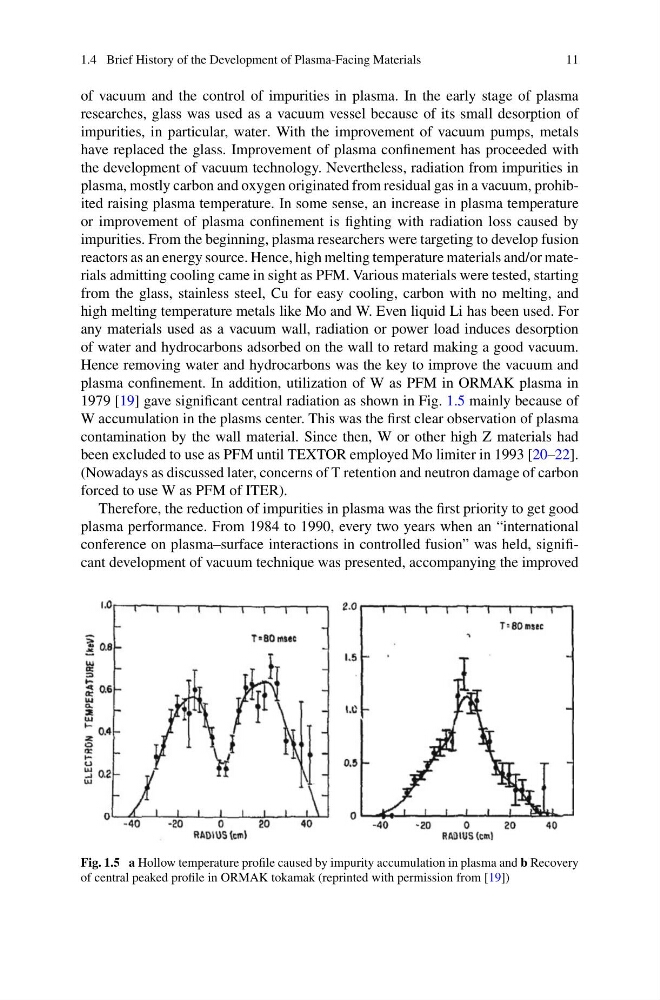
plasma confinement. In addition, utilization of W as PFM in ORMAK plasma in
1979 [19] gave significant central radiation as shown in Fig. 1.5 mainly because of
W accumulation in the plasms center. This was the first clear observation of plasma
contamination by the wall material. Since then, W or other high Z materials had
been excluded to use as PFM until TEXTOR employed Mo limiter in 1993 [20–22].
(Nowadays as discussed later, concerns of T retention and neutron damage of carbon
forced to use W as PFM of ITER).
Therefore, the reduction of impurities in plasma was the first priority to get good
plasma performance. From 1984 to 1990, every two years when an “international
conference on plasma–surface interactions in controlled fusion” was held, significant development of vacuum technique was presented, accompanying the improved
Fig. 1.5 a Hollow temperature profile caused by impurity accumulation in plasma and b Recovery
of central peaked profile in ORMAK tokamak (reprinted with permission from [19])
11
of vacuum and the control of impurities in plasma. In the early stage of plasma
researches, glass was used as a vacuum vessel because of its small desorption of
impurities, in particular, water. With the improvement of vacuum pumps, metals
have replaced the glass. Improvement of plasma confinement has proceeded with
the development of vacuum technology. Nevertheless, radiation from impurities in
plasma, mostly carbon and oxygen originated from residual gas in a vacuum, prohibited raising plasma temperature. In some sense, an increase in plasma temperature
or improvement of plasma confinement is fighting with radiation loss caused by
impurities. From the beginning, plasma researchers were targeting to develop fusion
reactors as an energy source. Hence, high melting temperature materials and/or materials admitting cooling came in sight as PFM. Various materials were tested, starting
from the glass, stainless steel, Cu for easy cooling, carbon with no melting, and
high melting temperature metals like Mo and W. Even liquid Li has been used. For
any materials used as a vacuum wall, radiation or power load induces desorption
of water and hydrocarbons adsorbed on the wall to retard making a good vacuum.
Hence removing water and hydrocarbons was the key to improve the vacuum and
plasma confinement. In addition, utilization of W as PFM in ORMAK plasma in
1979 [19] gave significant central radiation as shown in Fig. 1.5 mainly because of
W accumulation in the plasms center. This was the first clear observation of plasma
contamination by the wall material. Since then, W or other high Z materials had
been excluded to use as PFM until TEXTOR employed Mo limiter in 1993 [20–22].
(Nowadays as discussed later, concerns of T retention and neutron damage of carbon
forced to use W as PFM of ITER).
Therefore, the reduction of impurities in plasma was the first priority to get good
plasma performance. From 1984 to 1990, every two years when an “international
conference on plasma–surface interactions in controlled fusion” was held, significant development of vacuum technique was presented, accompanying the improved
Fig. 1.5 a Hollow temperature profile caused by impurity accumulation in plasma and b Recovery
of central peaked profile in ORMAK tokamak (reprinted with permission from [19])