

1.2 Plasma–Material Interactions Caused by Power Load …
5
1.2 Plasma–Material Interactions Caused by Power Load
of Radiation and Energetic Particles
Nearly 90 years have passed after finding that nuclear reactions give energy. Now
fission reactors are well established as energy sources, while a fusion reactor seems
to need still a few decades to be realized. Why so much longer time has been required
to establish a fusion reactor as an energy source compared to fission reactors?
There have been various difficulties in the research and development of a fusion
reactor as an energy source. Although confinement of burning plasma has been the
largest hurdle, it could be overcome in ITER. In engineering aspects, several problems
are coming up, such as extremely high-power load to plasma-facing materials (PFM),
conversion of neutron energy to heat, and management of radioactive T fuel to keep
safety and fuel self-sufficiency. For consideration of the power load and energy
conversion, principles of energy conversion in a fusion reactor system and a fission
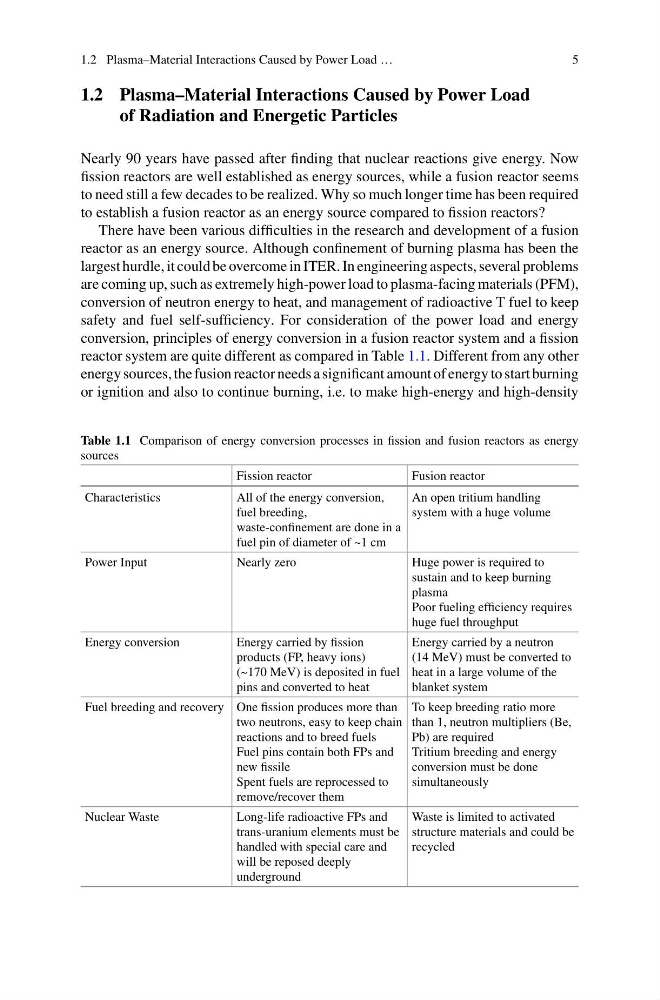
reactor system are quite different as compared in Table 1.1. Different from any other
energy sources, the fusion reactor needs a significant amount of energy to start burning
or ignition and also to continue burning, i.e. to make high-energy and high-density
Table 1.1 Comparison of energy conversion processes in fission and fusion reactors as energy
sources
Fission reactor
Fusion reactor
Characteristics
All of the energy conversion,
fuel breeding,
waste-confinement are done in a
fuel pin of diameter of ~1 cm
An open tritium handling
system with a huge volume
Power Input
Nearly zero
Huge power is required to
sustain and to keep burning
plasma
Poor fueling efficiency requires
huge fuel throughput
Energy conversion
Energy carried by fission
products (FP, heavy ions)
(~170 MeV) is deposited in fuel
pins and converted to heat
Energy carried by a neutron
(14 MeV) must be converted to
heat in a large volume of the
blanket system
Fuel breeding and recovery One fission produces more than
two neutrons, easy to keep chain
reactions and to breed fuels
Fuel pins contain both FPs and
new fissile
Spent fuels are reprocessed to
remove/recover them
To keep breeding ratio more
than 1, neutron multipliers (Be,
Pb) are required
Tritium breeding and energy
conversion must be done
simultaneously
Nuclear Waste
Long-life radioactive FPs and
trans-uranium elements must be
handled with special care and
will be reposed deeply
underground
Waste is limited to activated
structure materials and could be
recycled
5
1.2 Plasma–Material Interactions Caused by Power Load
of Radiation and Energetic Particles
Nearly 90 years have passed after finding that nuclear reactions give energy. Now
fission reactors are well established as energy sources, while a fusion reactor seems
to need still a few decades to be realized. Why so much longer time has been required
to establish a fusion reactor as an energy source compared to fission reactors?
There have been various difficulties in the research and development of a fusion
reactor as an energy source. Although confinement of burning plasma has been the
largest hurdle, it could be overcome in ITER. In engineering aspects, several problems
are coming up, such as extremely high-power load to plasma-facing materials (PFM),
conversion of neutron energy to heat, and management of radioactive T fuel to keep
safety and fuel self-sufficiency. For consideration of the power load and energy
conversion, principles of energy conversion in a fusion reactor system and a fission
reactor system are quite different as compared in Table 1.1. Different from any other
energy sources, the fusion reactor needs a significant amount of energy to start burning
or ignition and also to continue burning, i.e. to make high-energy and high-density
Table 1.1 Comparison of energy conversion processes in fission and fusion reactors as energy
sources
Fission reactor
Fusion reactor
Characteristics
All of the energy conversion,
fuel breeding,
waste-confinement are done in a
fuel pin of diameter of ~1 cm
An open tritium handling
system with a huge volume
Power Input
Nearly zero
Huge power is required to
sustain and to keep burning
plasma
Poor fueling efficiency requires
huge fuel throughput
Energy conversion
Energy carried by fission
products (FP, heavy ions)
(~170 MeV) is deposited in fuel
pins and converted to heat
Energy carried by a neutron
(14 MeV) must be converted to
heat in a large volume of the
blanket system
Fuel breeding and recovery One fission produces more than
two neutrons, easy to keep chain
reactions and to breed fuels
Fuel pins contain both FPs and
new fissile
Spent fuels are reprocessed to
remove/recover them
To keep breeding ratio more
than 1, neutron multipliers (Be,
Pb) are required
Tritium breeding and energy
conversion must be done
simultaneously
Nuclear Waste
Long-life radioactive FPs and
trans-uranium elements must be
handled with special care and
will be reposed deeply
underground
Waste is limited to activated
structure materials and could be
recycled