

118
7 Fundamentals of Hydrogen Recycling
into be dissolved or trapped and some permeate to the back surface to be released
as molecules of T 2 , DT, D 2 , HT, and DT. In the following sections, injection of
energetic hydrogen, reflection and remission, permeation and hydrogen retention
(fuel inventory) are separately introduced.
7.3 Injection of Energetic Hydrogen
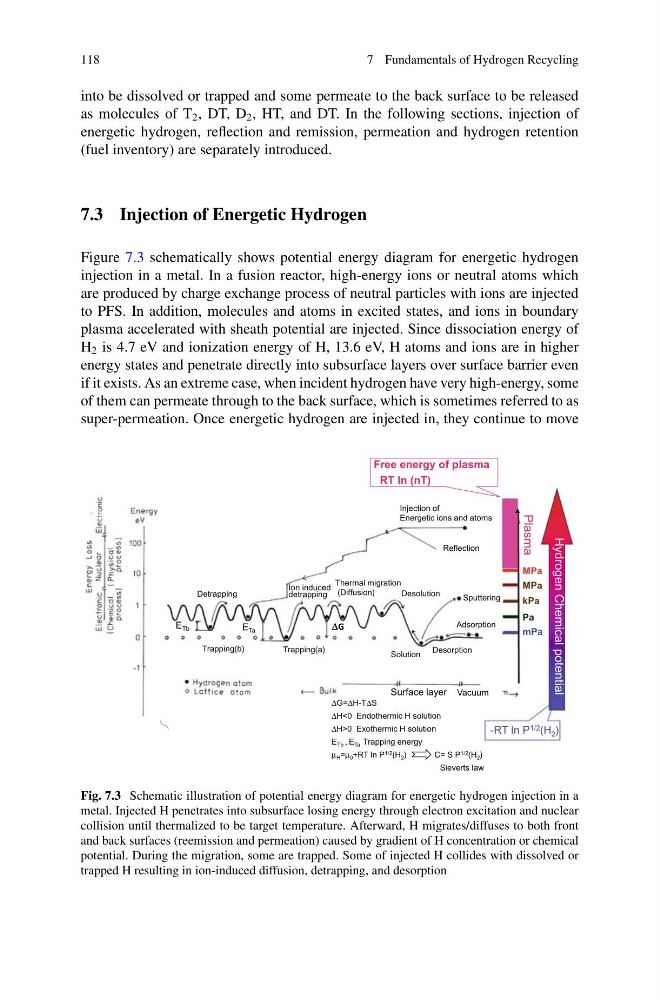
Figure 7.3 schematically shows potential energy diagram for energetic hydrogen
injection in a metal. In a fusion reactor, high-energy ions or neutral atoms which
are produced by charge exchange process of neutral particles with ions are injected
to PFS. In addition, molecules and atoms in excited states, and ions in boundary
plasma accelerated with sheath potential are injected. Since dissociation energy of
H 2 is 4.7 eV and ionization energy of H, 13.6 eV, H atoms and ions are in higher
energy states and penetrate directly into subsurface layers over surface barrier even
if it exists. As an extreme case, when incident hydrogen have very high-energy, some
of them can permeate through to the back surface, which is sometimes referred to as
super-permeation. Once energetic hydrogen are injected in, they continue to move
Hydrogen Chemical potential
mPa
Pa
kPa
MPa
MPa
Plasma
Free energy of plasma
RT ln (nT)
E Ta
E Tb
Detrapping
Ion induced
detrapping
Thermal migration
(Diffusion)
Desolution
Solution
Adsorption
Desorption
Trapping(a)
Trapping(b)
ΔG=ΔH-TΔS
ΔH<0 Endothermic H solution
ΔH>0 Exothermic H solution
E Tb , E Ta Trapping energy
μ H =μ 0 +RT ln P 1/2 (H 2 )
C= S P 1/2 (H 2 )
Sieverts law
Sputtering
ΔG
Surface layer Vacuum
-RT ln P 1/2 (H 2 )
Reflection
Injection of
Energetic ions and atoms
Fig. 7.3 Schematic illustration of potential energy diagram for energetic hydrogen injection in a
metal. Injected H penetrates into subsurface losing energy through electron excitation and nuclear
collision until thermalized to be target temperature. Afterward, H migrates/diffuses to both front
and back surfaces (reemission and permeation) caused by gradient of H concentration or chemical
potential. During the migration, some are trapped. Some of injected H collides with dissolved or
trapped H resulting in ion-induced diffusion, detrapping, and desorption
7 Fundamentals of Hydrogen Recycling
into be dissolved or trapped and some permeate to the back surface to be released
as molecules of T 2 , DT, D 2 , HT, and DT. In the following sections, injection of
energetic hydrogen, reflection and remission, permeation and hydrogen retention
(fuel inventory) are separately introduced.
7.3 Injection of Energetic Hydrogen
Figure 7.3 schematically shows potential energy diagram for energetic hydrogen
injection in a metal. In a fusion reactor, high-energy ions or neutral atoms which
are produced by charge exchange process of neutral particles with ions are injected
to PFS. In addition, molecules and atoms in excited states, and ions in boundary
plasma accelerated with sheath potential are injected. Since dissociation energy of
H 2 is 4.7 eV and ionization energy of H, 13.6 eV, H atoms and ions are in higher
energy states and penetrate directly into subsurface layers over surface barrier even
if it exists. As an extreme case, when incident hydrogen have very high-energy, some
of them can permeate through to the back surface, which is sometimes referred to as
super-permeation. Once energetic hydrogen are injected in, they continue to move
Hydrogen Chemical potential
mPa
Pa
kPa
MPa
MPa
Plasma
Free energy of plasma
RT ln (nT)
E Ta
E Tb
Detrapping
Ion induced
detrapping
Thermal migration
(Diffusion)
Desolution
Solution
Adsorption
Desorption
Trapping(a)
Trapping(b)
ΔG=ΔH-TΔS
ΔH<0 Endothermic H solution
ΔH>0 Exothermic H solution
E Tb , E Ta Trapping energy
μ H =μ 0 +RT ln P 1/2 (H 2 )
C= S P 1/2 (H 2 )
Sieverts law
Sputtering
ΔG
Surface layer Vacuum
-RT ln P 1/2 (H 2 )
Reflection
Injection of
Energetic ions and atoms
Fig. 7.3 Schematic illustration of potential energy diagram for energetic hydrogen injection in a
metal. Injected H penetrates into subsurface losing energy through electron excitation and nuclear
collision until thermalized to be target temperature. Afterward, H migrates/diffuses to both front
and back surfaces (reemission and permeation) caused by gradient of H concentration or chemical
potential. During the migration, some are trapped. Some of injected H collides with dissolved or
trapped H resulting in ion-induced diffusion, detrapping, and desorption