

96
6 Material Modification by High-Power Load …
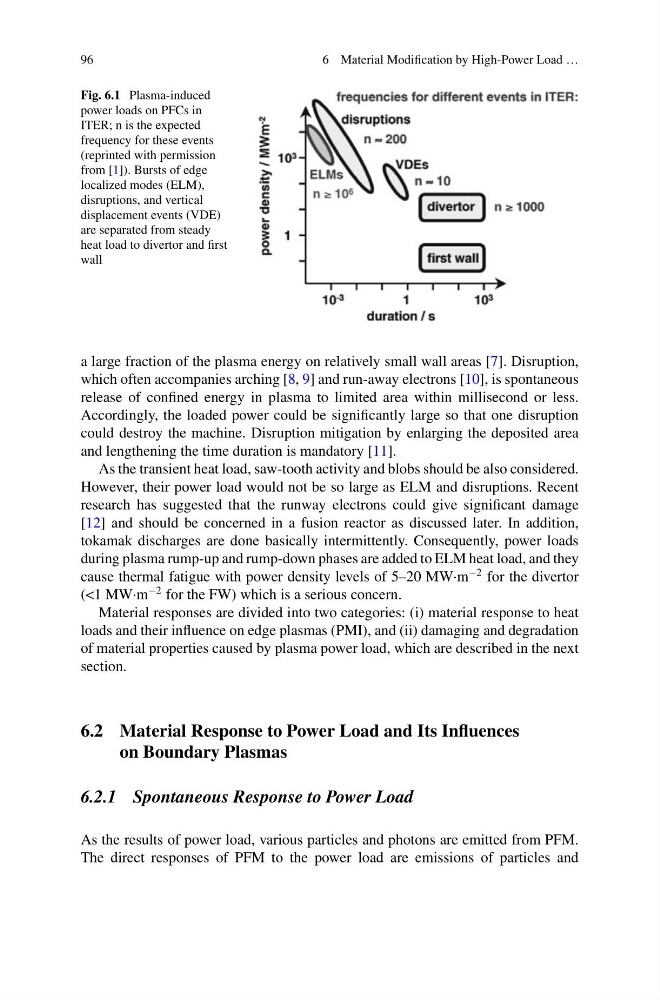
Fig. 6.1 Plasma-induced
power loads on PFCs in
ITER; n is the expected
frequency for these events
(reprinted with permission
from [1]). Bursts of edge
localized modes (ELM),
disruptions, and vertical
displacement events (VDE)
are separated from steady
heat load to divertor and first
wall
a large fraction of the plasma energy on relatively small wall areas [7]. Disruption,
which often accompanies arching [8, 9] and run-away electrons [10], is spontaneous
release of confined energy in plasma to limited area within millisecond or less.
Accordingly, the loaded power could be significantly large so that one disruption
could destroy the machine. Disruption mitigation by enlarging the deposited area
and lengthening the time duration is mandatory [11].
As the transient heat load, saw-tooth activity and blobs should be also considered.
However, their power load would not be so large as ELM and disruptions. Recent
research has suggested that the runway electrons could give significant damage
[12] and should be concerned in a fusion reactor as discussed later. In addition,
tokamak discharges are done basically intermittently. Consequently, power loads
during plasma rump-up and rump-down phases are added to ELM heat load, and they
cause thermal fatigue with power density levels of 5–20 MW·m
−2 for the divertor
(<1 MW·m
−2 for the FW) which is a serious concern.
Material responses are divided into two categories: (i) material response to heat
loads and their influence on edge plasmas (PMI), and (ii) damaging and degradation
of material properties caused by plasma power load, which are described in the next
section.
6.2 Material Response to Power Load and Its Influences
on Boundary Plasmas
6.2.1 Spontaneous Response to Power Load
As the results of power load, various particles and photons are emitted from PFM.
The direct responses of PFM to the power load are emissions of particles and
6 Material Modification by High-Power Load …
Fig. 6.1 Plasma-induced
power loads on PFCs in
ITER; n is the expected
frequency for these events
(reprinted with permission
from [1]). Bursts of edge
localized modes (ELM),
disruptions, and vertical
displacement events (VDE)
are separated from steady
heat load to divertor and first
wall
a large fraction of the plasma energy on relatively small wall areas [7]. Disruption,
which often accompanies arching [8, 9] and run-away electrons [10], is spontaneous
release of confined energy in plasma to limited area within millisecond or less.
Accordingly, the loaded power could be significantly large so that one disruption
could destroy the machine. Disruption mitigation by enlarging the deposited area
and lengthening the time duration is mandatory [11].
As the transient heat load, saw-tooth activity and blobs should be also considered.
However, their power load would not be so large as ELM and disruptions. Recent
research has suggested that the runway electrons could give significant damage
[12] and should be concerned in a fusion reactor as discussed later. In addition,
tokamak discharges are done basically intermittently. Consequently, power loads
during plasma rump-up and rump-down phases are added to ELM heat load, and they
cause thermal fatigue with power density levels of 5–20 MW·m
−2 for the divertor
(<1 MW·m
−2 for the FW) which is a serious concern.
Material responses are divided into two categories: (i) material response to heat
loads and their influence on edge plasmas (PMI), and (ii) damaging and degradation
of material properties caused by plasma power load, which are described in the next
section.
6.2 Material Response to Power Load and Its Influences
on Boundary Plasmas
6.2.1 Spontaneous Response to Power Load
As the results of power load, various particles and photons are emitted from PFM.
The direct responses of PFM to the power load are emissions of particles and