

DI6.1: Capture of CO 2 from the Atmosphere or Direct Air Capture (DAC)
Revitalization of the atmosphere with capture of CO 2 is a key problem on board
submarines and shuttles. Because of the low concentration of CO 2 , absorbers which
can tightly bind it, by forming strong chemical bonds, are necessary. Traditionally,
lime (that combines NaOH and Ca(OH) 2 ) is used for CO 2 capture. The process,
originally developed for the paper industry by Kraft (1884) for the extraction of
cellulose, has been adapted to capture CO 2 . It is based on a set of four reactions
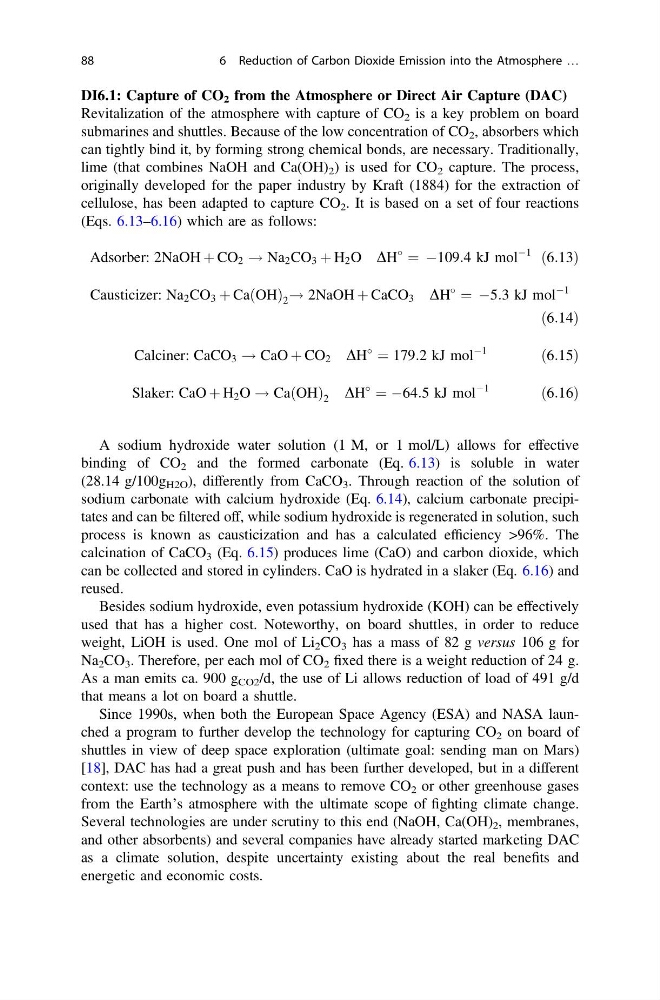
(Eqs. 6.13–6.16) which are as follows:
Adsorber: 2NaOH þ CO 2 ! Na 2 CO 3 þ H 2 O DH
¼ À109:4 kJ mol
À1
ð6:13Þ
Causticizer: Na 2 CO 3 þ Ca OH
ð Þ 2 ! 2NaOH þ CaCO 3 DH
¼ À5:3 kJ mol
À1
ð6:14Þ
Calciner: CaCO 3 ! CaO þ CO 2 DH
¼ 179:2 kJ mol
À1
ð6:15Þ
Slaker: CaO þ H 2 O ! Ca OH
ð Þ 2 DH
¼ À64:5 kJ mol
À1
ð6:16Þ
A sodium hydroxide water solution (1 M, or 1 mol/L) allows for effective
binding of CO 2 and the formed carbonate (Eq. 6.13) is soluble in water
(28.14 g/100g H2O ), differently from CaCO 3 . Through reaction of the solution of
sodium carbonate with calcium hydroxide (Eq. 6.14), calcium carbonate precipitates and can be filtered off, while sodium hydroxide is regenerated in solution, such
process is known as causticization and has a calculated efficiency >96%. The
calcination of CaCO 3 (Eq. 6.15) produces lime (CaO) and carbon dioxide, which
can be collected and stored in cylinders. CaO is hydrated in a slaker (Eq. 6.16) and
reused.
Besides sodium hydroxide, even potassium hydroxide (KOH) can be effectively
used that has a higher cost. Noteworthy, on board shuttles, in order to reduce
weight, LiOH is used. One mol of Li 2 CO 3 has a mass of 82 g versus 106 g for
Na 2 CO 3 . Therefore, per each mol of CO 2 fixed there is a weight reduction of 24 g.
As a man emits ca. 900 g CO2 /d, the use of Li allows reduction of load of 491 g/d
that means a lot on board a shuttle.
Since 1990s, when both the European Space Agency (ESA) and NASA launched a program to further develop the technology for capturing CO 2 on board of
shuttles in view of deep space exploration (ultimate goal: sending man on Mars)
[18], DAC has had a great push and has been further developed, but in a different
context: use the technology as a means to remove CO 2 or other greenhouse gases
from the Earth’s atmosphere with the ultimate scope of fighting climate change.
Several technologies are under scrutiny to this end (NaOH, Ca(OH) 2 , membranes,
and other absorbents) and several companies have already started marketing DAC
as a climate solution, despite uncertainty existing about the real benefits and
energetic and economic costs.
88
6 Reduction of Carbon Dioxide Emission into the Atmosphere …
Revitalization of the atmosphere with capture of CO 2 is a key problem on board
submarines and shuttles. Because of the low concentration of CO 2 , absorbers which
can tightly bind it, by forming strong chemical bonds, are necessary. Traditionally,
lime (that combines NaOH and Ca(OH) 2 ) is used for CO 2 capture. The process,
originally developed for the paper industry by Kraft (1884) for the extraction of
cellulose, has been adapted to capture CO 2 . It is based on a set of four reactions
(Eqs. 6.13–6.16) which are as follows:
Adsorber: 2NaOH þ CO 2 ! Na 2 CO 3 þ H 2 O DH
¼ À109:4 kJ mol
À1
ð6:13Þ
Causticizer: Na 2 CO 3 þ Ca OH
ð Þ 2 ! 2NaOH þ CaCO 3 DH
¼ À5:3 kJ mol
À1
ð6:14Þ
Calciner: CaCO 3 ! CaO þ CO 2 DH
¼ 179:2 kJ mol
À1
ð6:15Þ
Slaker: CaO þ H 2 O ! Ca OH
ð Þ 2 DH
¼ À64:5 kJ mol
À1
ð6:16Þ
A sodium hydroxide water solution (1 M, or 1 mol/L) allows for effective
binding of CO 2 and the formed carbonate (Eq. 6.13) is soluble in water
(28.14 g/100g H2O ), differently from CaCO 3 . Through reaction of the solution of
sodium carbonate with calcium hydroxide (Eq. 6.14), calcium carbonate precipitates and can be filtered off, while sodium hydroxide is regenerated in solution, such
process is known as causticization and has a calculated efficiency >96%. The
calcination of CaCO 3 (Eq. 6.15) produces lime (CaO) and carbon dioxide, which
can be collected and stored in cylinders. CaO is hydrated in a slaker (Eq. 6.16) and
reused.
Besides sodium hydroxide, even potassium hydroxide (KOH) can be effectively
used that has a higher cost. Noteworthy, on board shuttles, in order to reduce
weight, LiOH is used. One mol of Li 2 CO 3 has a mass of 82 g versus 106 g for
Na 2 CO 3 . Therefore, per each mol of CO 2 fixed there is a weight reduction of 24 g.
As a man emits ca. 900 g CO2 /d, the use of Li allows reduction of load of 491 g/d
that means a lot on board a shuttle.
Since 1990s, when both the European Space Agency (ESA) and NASA launched a program to further develop the technology for capturing CO 2 on board of
shuttles in view of deep space exploration (ultimate goal: sending man on Mars)
[18], DAC has had a great push and has been further developed, but in a different
context: use the technology as a means to remove CO 2 or other greenhouse gases
from the Earth’s atmosphere with the ultimate scope of fighting climate change.
Several technologies are under scrutiny to this end (NaOH, Ca(OH) 2 , membranes,
and other absorbents) and several companies have already started marketing DAC
as a climate solution, despite uncertainty existing about the real benefits and
energetic and economic costs.
88
6 Reduction of Carbon Dioxide Emission into the Atmosphere …