

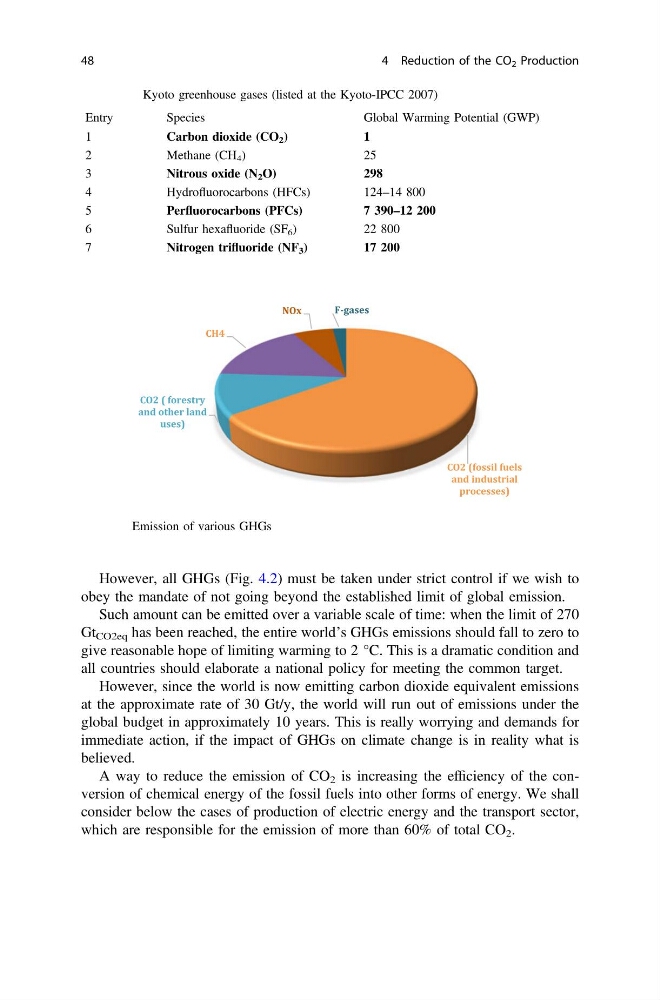
However, all GHGs (Fig. 4.2) must be taken under strict control if we wish to
obey the mandate of not going beyond the established limit of global emission.
Such amount can be emitted over a variable scale of time: when the limit of 270
Gt CO2eq has been reached, the entire world’s GHGs emissions should fall to zero to
give reasonable hope of limiting warming to 2 °C. This is a dramatic condition and
all countries should elaborate a national policy for meeting the common target.
However, since the world is now emitting carbon dioxide equivalent emissions
at the approximate rate of 30 Gt/y, the world will run out of emissions under the
global budget in approximately 10 years. This is really worrying and demands for
immediate action, if the impact of GHGs on climate change is in reality what is
believed.
A way to reduce the emission of CO 2 is increasing the efficiency of the conversion of chemical energy of the fossil fuels into other forms of energy. We shall
consider below the cases of production of electric energy and the transport sector,
which are responsible for the emission of more than 60% of total CO 2 .
Table 4.1 Kyoto greenhouse gases (listed at the Kyoto-IPCC 2007)
Entry
Species
Global Warming Potential (GWP)
1
Carbon dioxide (CO 2 )
1
2
Methane (CH 4 )
2 5
3
Nitrous oxide (N 2 O)
298
4
Hydrofluorocarbons (HFCs)
124–14 800
5
Perfluorocarbons (PFCs)
7 390–12 200
6
Sulfur hexafluoride (SF 6 )
22 800
7
Nitrogen trifluoride (NF 3 )
17 200
Fig. 4.2 Emission of various GHGs
48
4 Reduction of the CO 2 Production
obey the mandate of not going beyond the established limit of global emission.
Such amount can be emitted over a variable scale of time: when the limit of 270
Gt CO2eq has been reached, the entire world’s GHGs emissions should fall to zero to
give reasonable hope of limiting warming to 2 °C. This is a dramatic condition and
all countries should elaborate a national policy for meeting the common target.
However, since the world is now emitting carbon dioxide equivalent emissions
at the approximate rate of 30 Gt/y, the world will run out of emissions under the
global budget in approximately 10 years. This is really worrying and demands for
immediate action, if the impact of GHGs on climate change is in reality what is
believed.
A way to reduce the emission of CO 2 is increasing the efficiency of the conversion of chemical energy of the fossil fuels into other forms of energy. We shall
consider below the cases of production of electric energy and the transport sector,
which are responsible for the emission of more than 60% of total CO 2 .
Table 4.1 Kyoto greenhouse gases (listed at the Kyoto-IPCC 2007)
Entry
Species
Global Warming Potential (GWP)
1
Carbon dioxide (CO 2 )
1
2
Methane (CH 4 )
2 5
3
Nitrous oxide (N 2 O)
298
4
Hydrofluorocarbons (HFCs)
124–14 800
5
Perfluorocarbons (PFCs)
7 390–12 200
6
Sulfur hexafluoride (SF 6 )
22 800
7
Nitrogen trifluoride (NF 3 )
17 200
Fig. 4.2 Emission of various GHGs
48
4 Reduction of the CO 2 Production