

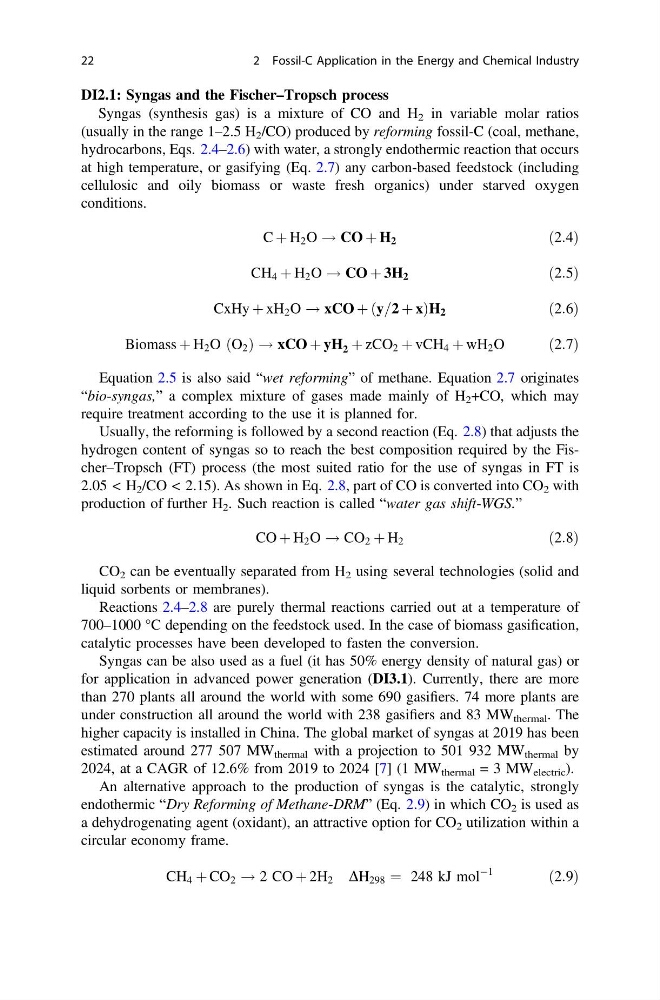
DI2.1: Syngas and the Fischer–Tropsch process
Syngas (synthesis gas) is a mixture of CO and H 2 in variable molar ratios
(usually in the range 1–2.5 H 2 /CO) produced by reforming fossil-C (coal, methane,
hydrocarbons, Eqs. 2.4–2.6) with water, a strongly endothermic reaction that occurs
at high temperature, or gasifying (Eq. 2.7) any carbon-based feedstock (including
cellulosic and oily biomass or waste fresh organics) under starved oxygen
conditions.
C þ H 2 O ! CO þ H 2
ð2:4Þ
CH 4 þ H 2 O ! CO þ 3H 2
ð2:5Þ
CxHy þ xH 2 O ! xCO þ y=2 þ x
ð
Þ H 2
ð2:6Þ
Biomass þ H 2 O O 2
ð Þ ! xCO þ yH 2 þ zCO 2 þ vCH 4 þ wH 2 O
ð2:7Þ
Equation 2.5 is also said “wet reforming” of methane. Equation 2.7 originates
“bio-syngas,” a complex mixture of gases made mainly of H 2 +CO, which may
require treatment according to the use it is planned for.
Usually, the reforming is followed by a second reaction (Eq. 2.8) that adjusts the
hydrogen content of syngas so to reach the best composition required by the Fischer–Tropsch (FT) process (the most suited ratio for the use of syngas in FT is
2.05 < H 2 /CO < 2.15). As shown in Eq. 2.8, part of CO is converted into CO 2 with
production of further H 2 . Such reaction is called “water gas shift-WGS.”
CO þ H 2 O ! CO 2 þ H 2
ð2:8Þ
CO 2 can be eventually separated from H 2 using several technologies (solid and
liquid sorbents or membranes).
Reactions 2.4–2.8 are purely thermal reactions carried out at a temperature of
700–1000 °C depending on the feedstock used. In the case of biomass gasification,
catalytic processes have been developed to fasten the conversion.
Syngas can be also used as a fuel (it has 50% energy density of natural gas) or
for application in advanced power generation (DI3.1). Currently, there are more
than 270 plants all around the world with some 690 gasifiers. 74 more plants are
under construction all around the world with 238 gasifiers and 83 MW thermal . The
higher capacity is installed in China. The global market of syngas at 2019 has been
estimated around 277 507 MW thermal with a projection to 501 932 MW thermal by
2024, at a CAGR of 12.6% from 2019 to 2024 [7] (1 MW thermal = 3 MW electric ).
An alternative approach to the production of syngas is the catalytic, strongly
endothermic “Dry Reforming of Methane-DRM” (Eq. 2.9) in which CO 2 is used as
a dehydrogenating agent (oxidant), an attractive option for CO 2 utilization within a
circular economy frame.
CH 4 þ CO 2 ! 2 CO þ 2H 2 DH 298 ¼ 248 kJ mol
À1
ð2:9Þ
22
2 Fossil-C Application in the Energy and Chemical Industry
Syngas (synthesis gas) is a mixture of CO and H 2 in variable molar ratios
(usually in the range 1–2.5 H 2 /CO) produced by reforming fossil-C (coal, methane,
hydrocarbons, Eqs. 2.4–2.6) with water, a strongly endothermic reaction that occurs
at high temperature, or gasifying (Eq. 2.7) any carbon-based feedstock (including
cellulosic and oily biomass or waste fresh organics) under starved oxygen
conditions.
C þ H 2 O ! CO þ H 2
ð2:4Þ
CH 4 þ H 2 O ! CO þ 3H 2
ð2:5Þ
CxHy þ xH 2 O ! xCO þ y=2 þ x
ð
Þ H 2
ð2:6Þ
Biomass þ H 2 O O 2
ð Þ ! xCO þ yH 2 þ zCO 2 þ vCH 4 þ wH 2 O
ð2:7Þ
Equation 2.5 is also said “wet reforming” of methane. Equation 2.7 originates
“bio-syngas,” a complex mixture of gases made mainly of H 2 +CO, which may
require treatment according to the use it is planned for.
Usually, the reforming is followed by a second reaction (Eq. 2.8) that adjusts the
hydrogen content of syngas so to reach the best composition required by the Fischer–Tropsch (FT) process (the most suited ratio for the use of syngas in FT is
2.05 < H 2 /CO < 2.15). As shown in Eq. 2.8, part of CO is converted into CO 2 with
production of further H 2 . Such reaction is called “water gas shift-WGS.”
CO þ H 2 O ! CO 2 þ H 2
ð2:8Þ
CO 2 can be eventually separated from H 2 using several technologies (solid and
liquid sorbents or membranes).
Reactions 2.4–2.8 are purely thermal reactions carried out at a temperature of
700–1000 °C depending on the feedstock used. In the case of biomass gasification,
catalytic processes have been developed to fasten the conversion.
Syngas can be also used as a fuel (it has 50% energy density of natural gas) or
for application in advanced power generation (DI3.1). Currently, there are more
than 270 plants all around the world with some 690 gasifiers. 74 more plants are
under construction all around the world with 238 gasifiers and 83 MW thermal . The
higher capacity is installed in China. The global market of syngas at 2019 has been
estimated around 277 507 MW thermal with a projection to 501 932 MW thermal by
2024, at a CAGR of 12.6% from 2019 to 2024 [7] (1 MW thermal = 3 MW electric ).
An alternative approach to the production of syngas is the catalytic, strongly
endothermic “Dry Reforming of Methane-DRM” (Eq. 2.9) in which CO 2 is used as
a dehydrogenating agent (oxidant), an attractive option for CO 2 utilization within a
circular economy frame.
CH 4 þ CO 2 ! 2 CO þ 2H 2 DH 298 ¼ 248 kJ mol
À1
ð2:9Þ
22
2 Fossil-C Application in the Energy and Chemical Industry