

biomass growth rate is much lower (from 1 000 to 10 000 times [2]) than its
combustion. Nuclear will not expand its potential until safety issues will not find a
solution that may assure people against radiation damage in case of accident.
However, a limited number of options are available to supplant fossil-C as primary
source of energy and not all of them are suited for large-scale exploitation at high
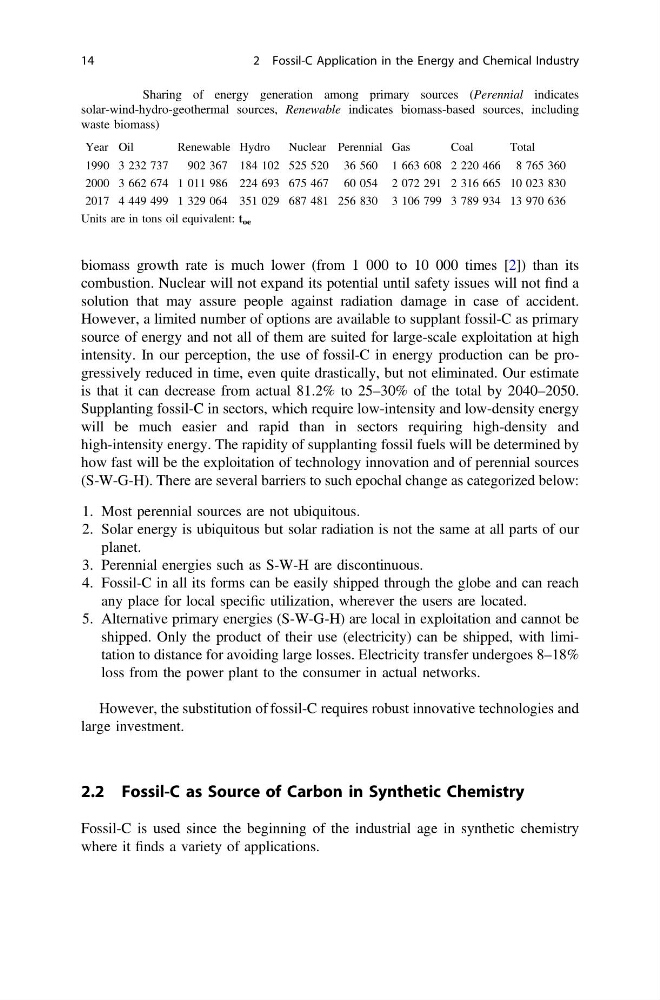
intensity. In our perception, the use of fossil-C in energy production can be progressively reduced in time, even quite drastically, but not eliminated. Our estimate
is that it can decrease from actual 81.2% to 25–30% of the total by 2040–2050.
Supplanting fossil-C in sectors, which require low-intensity and low-density energy
will be much easier and rapid than in sectors requiring high-density and
high-intensity energy. The rapidity of supplanting fossil fuels will be determined by
how fast will be the exploitation of technology innovation and of perennial sources
(S-W-G-H). There are several barriers to such epochal change as categorized below:
1. Most perennial sources are not ubiquitous.
2. Solar energy is ubiquitous but solar radiation is not the same at all parts of our
planet.
3. Perennial energies such as S-W-H are discontinuous.
4. Fossil-C in all its forms can be easily shipped through the globe and can reach
any place for local specific utilization, wherever the users are located.
5. Alternative primary energies (S-W-G-H) are local in exploitation and cannot be
shipped. Only the product of their use (electricity) can be shipped, with limitation to distance for avoiding large losses. Electricity transfer undergoes 8–18%
loss from the power plant to the consumer in actual networks.
However, the substitution of fossil-C requires robust innovative technologies and
large investment.
2.2 Fossil-C as Source of Carbon in Synthetic Chemistry
Fossil-C is used since the beginning of the industrial age in synthetic chemistry
where it finds a variety of applications.
Table 2.1 Sharing of energy generation among primary sources (Perennial indicates
solar-wind-hydro-geothermal sources, Renewable indicates biomass-based sources, including
waste biomass)
Year Oil
Renewable Hydro
Nuclear Perennial Gas
Coal
Total
1990 3 232 737
902 367 184 102 525 520 36 560 1 663 608 2 220 466 8 765 360
2000 3 662 674 1 011 986 224 693 675 467 60 054 2 072 291 2 316 665 10 023 830
2017 4 449 499 1 329 064 351 029 687 481 256 830 3 106 799 3 789 934 13 970 636
Units are in tons oil equivalent: t oe
14
2 Fossil-C Application in the Energy and Chemical Industry
combustion. Nuclear will not expand its potential until safety issues will not find a
solution that may assure people against radiation damage in case of accident.
However, a limited number of options are available to supplant fossil-C as primary
source of energy and not all of them are suited for large-scale exploitation at high
intensity. In our perception, the use of fossil-C in energy production can be progressively reduced in time, even quite drastically, but not eliminated. Our estimate
is that it can decrease from actual 81.2% to 25–30% of the total by 2040–2050.
Supplanting fossil-C in sectors, which require low-intensity and low-density energy
will be much easier and rapid than in sectors requiring high-density and
high-intensity energy. The rapidity of supplanting fossil fuels will be determined by
how fast will be the exploitation of technology innovation and of perennial sources
(S-W-G-H). There are several barriers to such epochal change as categorized below:
1. Most perennial sources are not ubiquitous.
2. Solar energy is ubiquitous but solar radiation is not the same at all parts of our
planet.
3. Perennial energies such as S-W-H are discontinuous.
4. Fossil-C in all its forms can be easily shipped through the globe and can reach
any place for local specific utilization, wherever the users are located.
5. Alternative primary energies (S-W-G-H) are local in exploitation and cannot be
shipped. Only the product of their use (electricity) can be shipped, with limitation to distance for avoiding large losses. Electricity transfer undergoes 8–18%
loss from the power plant to the consumer in actual networks.
However, the substitution of fossil-C requires robust innovative technologies and
large investment.
2.2 Fossil-C as Source of Carbon in Synthetic Chemistry
Fossil-C is used since the beginning of the industrial age in synthetic chemistry
where it finds a variety of applications.
Table 2.1 Sharing of energy generation among primary sources (Perennial indicates
solar-wind-hydro-geothermal sources, Renewable indicates biomass-based sources, including
waste biomass)
Year Oil
Renewable Hydro
Nuclear Perennial Gas
Coal
Total
1990 3 232 737
902 367 184 102 525 520 36 560 1 663 608 2 220 466 8 765 360
2000 3 662 674 1 011 986 224 693 675 467 60 054 2 072 291 2 316 665 10 023 830
2017 4 449 499 1 329 064 351 029 687 481 256 830 3 106 799 3 789 934 13 970 636
Units are in tons oil equivalent: t oe
14
2 Fossil-C Application in the Energy and Chemical Industry